
Welcome to the unit on Highway and Tunnel Riding Strategies! This lesson focuses specifically on Dutch motorway law (snelwegwet) and the critical rules of lane discipline for Category A motorcycle riders. Understanding these regulations is vital for ensuring your safety and compliance on the high-speed roads of the Netherlands.
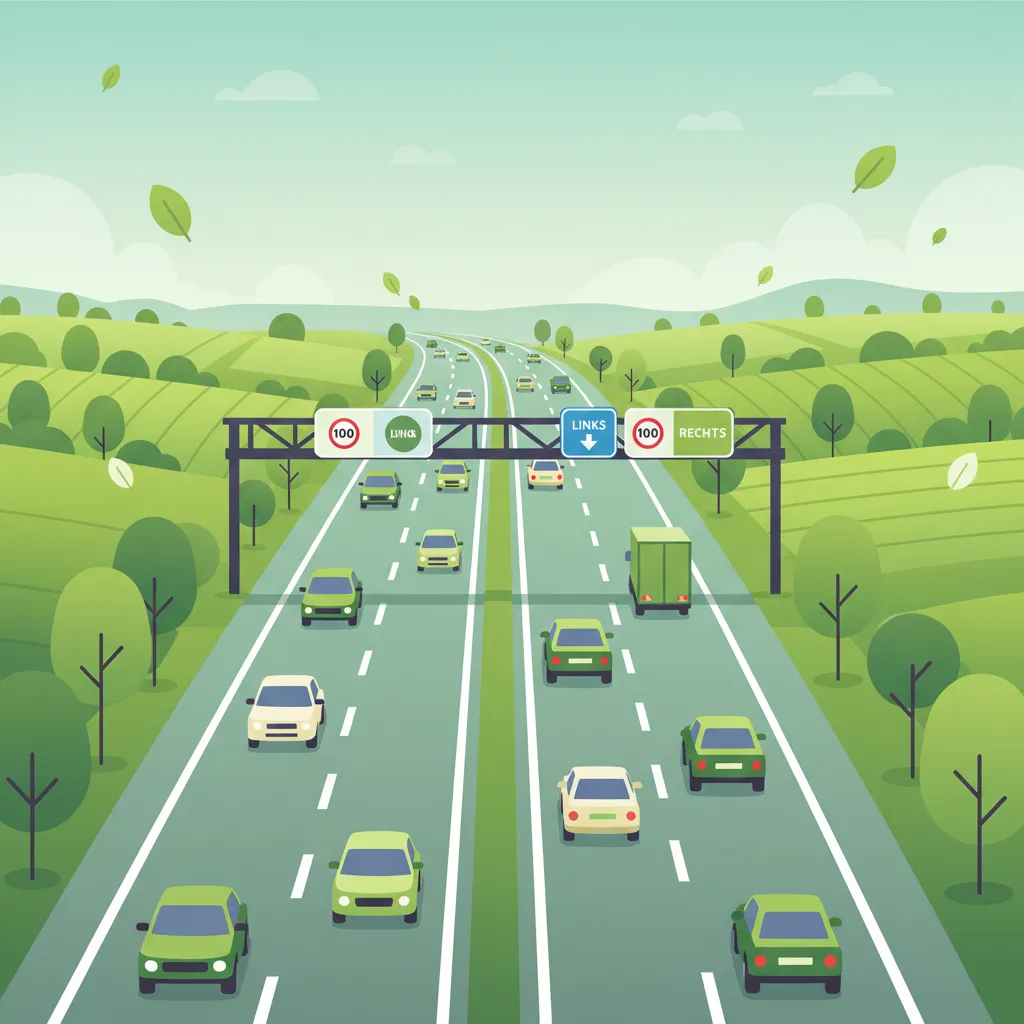
Navigating the Dutch motorways, known as snelwegen, requires a thorough understanding of specific traffic regulations and an unwavering commitment to lane discipline. These rules, primarily governed by the Wegenverkeerswet 1990 (Road Traffic Act 1990) and the Reglement Verkeersregels en Verkeerstekens 1990 (RVV 1990 – Traffic Rules and Traffic Signs Regulations 1990), are crucial for ensuring smooth traffic flow, minimizing collision risks, and maintaining safety for all road users, especially motorcyclists. Mastery of the snelwegwet and its application is vital not only for passing your Dutch Category A motorcycle theory exam but also for safe and legal riding in the Netherlands.
The snelwegwet establishes a structured system for lane usage on Dutch motorways, designed to optimize capacity, reduce traffic turbulence, and significantly lower the risk of accidents. This system is founded on principles of safety, traffic physics, and clear legal intent.
At its heart, the Dutch motorway system mandates a hierarchical approach to lane usage:
Understanding these principles enhances your ability to predict other drivers' actions and react appropriately, making you a safer and more confident rider.
The cornerstone of Dutch motorway discipline is the Right-Most Free Lane Rule. This is a fundamental legal obligation for all drivers, including motorcyclists.
A legal requirement on Dutch motorways to drive in the rightmost lane that is not obstructed by slower traffic, roadworks, or specific lane restrictions, unless you are actively overtaking.
According to Article 41(2) of the Wegenverkeerswet (Dutch Road Traffic Act), drivers must travel in the rightmost available lane. This means that if the right lane is clear and you are not in the process of overtaking another vehicle, you are legally obliged to move into it. The purpose is to keep the left lanes free for overtaking traffic, thereby maintaining optimal traffic flow and preventing unnecessary congestion.
For motorcyclists, this rule means:
Constantly scan your mirrors and assess traffic conditions to identify when the rightmost lane becomes free. Anticipate your return to the right lane as soon as it's safe and practical.
A common misconception is believing that this rule only applies to heavy vehicles, or that it's acceptable to stay in a left lane simply because it's free. The rule applies to all vehicles capable of using the motorway, and neglecting the need to move right when a lane is free is a violation.
Another critical aspect of Dutch motorway law is the strict requirement to overtake only on the left side of the vehicle you are passing.
A legal requirement stating that all overtaking maneuvers (passing another vehicle) on Dutch roads, especially motorways, must be performed on the left side of the vehicle being overtaken. Overtaking from the right is strictly prohibited.
Article 3-21(b) of the RVV 1990 explicitly states: "Inhalen is altijd uitsluitend aan de linkerkant" (Overtaking is always exclusively on the left side). This rule ensures a consistent and predictable overtaking direction, which significantly reduces the risk of collisions. If drivers can overtake on either side, it creates uncertainty and increases the likelihood of a vehicle unexpectedly moving into another's path.
A correct and safe overtaking procedure on a motorway involves several steps:
Attempting to overtake on the right is illegal and extremely dangerous. It creates an immediate hazard because the driver you are passing will not anticipate you coming from that side. This is often met with severe penalties.
While the right-most free lane rule is paramount, Dutch law allows for temporary deviations during heavy traffic or congestion (file).
During periods of heavy traffic or a traffic jam on a motorway, temporary deviation from the right-most lane rule is permitted if the right lane is fully occupied or moving significantly slower than the left lane(s).
According to Article 3-8(c) of the RVV 1990, if traffic is moving slowly (typically below 40 km/h) or is at a standstill in the right lane, you are allowed to remain in the left lane. This flexibility is essential to prevent gridlock and allow traffic to keep moving where possible. However, this is not a permanent exemption.
The key is "temporary deviation". You are not permitted to "hop" between lanes to gain an advantage in congestion, which is known as "filter riding" and is generally not allowed on motorways unless traffic is completely stationary and other conditions are met (this is a separate, complex topic).
Do not assume that once a traffic jam starts, you can stay in any lane indefinitely. The obligation to move right reappears as soon as the congestion eases and the right lane becomes a viable option for your speed. Staying in a left lane unnecessarily once traffic flow recovers can be considered "lane hogging" and lead to penalties.
While not explicitly defined by a single RVV article, proper in-lane positioning for motorcyclists is an essential safety practice enforced by the general duty to drive safely (Article 3-27 RVV 1990) and promoted by the CBR's motorcycle safety guidelines.
The longitudinal and lateral placement of a vehicle within its designated lane. For motorcyclists, this typically means riding centrally to maximize visibility and stability.
Motorcyclists should generally ride in the center of their chosen lane. This means maintaining a safe lateral distance, roughly 0.5 to 1 meter (depending on lane width), from both the left and right lane markings.
Adjust your position only when preparing to change lanes (move slightly towards the direction of your intended lane change), or if a specific hazard (e.g., a large pothole, spillage) requires temporary evasion.
The hard shoulder, or vluchtstrook, is a dedicated emergency lane on Dutch motorways and has very specific usage rules.
The emergency lane located adjacent to the outermost (rightmost) lane of a motorway, exclusively intended for breakdowns, emergency stops, and use by rescue and police vehicles.
Article 22-1 of the RVV 1990 clearly states that the hard shoulder is for emergency situations (noodsituaties). This means:
If your motorcycle experiences a mechanical failure or you face an immediate emergency:
Using the hard shoulder to avoid traffic is a serious violation and can result in significant fines and penalty points, not to mention creating a dangerous situation for yourself and emergency responders.
Beyond lane discipline, several other rules are critical for safe and legal riding on Dutch motorways.
| Rule Statement | Applicability | Legal Status | Rationale | Correct Application Example | Incorrect Application Example |
|---|---|---|---|---|---|
| Right-most lane must be used unless overtaking (Art. 41(2) Wegenverkeerswet) | All motorways, at any speed | Mandatory | Ensures traffic flow efficiency, reduces lane changes, improves safety | Rider travels in the right lane at 120 km/h, overtakes a slower vehicle by moving left, then returns right when clear. | Rider stays in the middle lane while the right lane is free and moving at the same speed. |
| Overtaking only on the left (Art. 3-21(b) RVV 1990) | Any road where overtaking is permitted | Mandatory | Provides predictable overtaking direction, reduces conflict | Rider signals, checks mirrors, moves to the left lane, passes a vehicle, then returns to the right lane after a safe distance. | Rider attempts to overtake a car from the right side on a motorway. |
| Lane use in congestion (Art. 3-8(c) RVV 1990) | Motorways when traffic speed < 40 km/h in any lane | Conditional | Allows traffic to maintain momentum, prevents deadlock | Rider stays in the left lane while both lanes move at 20 km/h, then moves right when the right lane clears to 70 km/h. | Rider remains in the left lane after the right lane resumes normal speed, blocking faster traffic. |
| Proper in-lane positioning (Art. 3-27 RVV 1990 – general duty of care) | All road users, particularly motorcyclists | Mandatory | Improves visibility, reduces risk of side-impact and "dooring" | Rider rides centrally, maintaining ~0.5 m from each marking, adjusts only for lane changes or hazards. | Rider rides on the far right edge hugging the line, reducing their visibility to other drivers. |
| Hard shoulder (emergency lane) usage prohibited (Art. 22-1 RVV 1990) | All motorways, at all times | Mandatory | Keeps emergency lane free for breakdowns, rescue, and police. | Rider’s motorcycle suffers a mechanical failure, pulls onto the hard shoulder, activates hazard lights, and calls assistance. | Rider uses the hard shoulder to overtake a slow truck during a traffic jam. |
| Mandatory signalling before lane change (Art. 3-25(a) RVV 1990) | All lane changes on motorways | Mandatory | Provides advance warning to other road users, reduces collision risk | Rider signals left for at least 3 seconds before moving into the left lane for overtaking. | Rider changes lane without signalling, causing a following vehicle to brake suddenly. |
| Minimum following distance (Art. 3-30(b) RVV 1990 – safety distance) | Applicable when traveling at any speed | Mandatory | Allows sufficient reaction time to avoid rear-end collisions | Rider maintains a 2-second gap behind the vehicle ahead at 100 km/h, increasing to 3-second in rain. | Rider follows a truck at a 0.5-second distance, leading to a rear-end crash when the truck brakes unexpectedly. |
| Speed limits on motorways (Art. 5-46(a) Wegenverkeerswet) | Max 130 km/h (variable via signs) for cars; 120 km/h for motorcycles in most cases | Mandatory | Aligns with road design, safety, and emissions standards. | Rider respects the posted 130 km/h limit, reducing speed in adverse weather or at specific times of day where lower limits apply. | Rider exceeds the speed limit, causing higher stopping distances and increasing the risk of fines and accidents. |
Understanding common violations helps in proactively avoiding them. Motorway infringements in the Netherlands often carry substantial fines and can result in penalty points on your driving record.
| Violation | Why it’s Wrong | Correct Behaviour | Typical Consequence |
|---|---|---|---|
| Staying in the left lane while the right lane is free | Violates the right-most lane rule; creates unnecessary bottleneck. | Move to the right lane as soon as it’s free and traveling at a comparable speed. | Fine (€150 approx.) + 2 points; increased collision risk due to unpredictable behavior. |
| Overtaking on the right | Illegal overtaking direction; reduces reaction time for the overtaken driver. | Overtake only from the left, signalling clearly and ensuring safe clearance. | Fine (€250 approx.) + 2 points; immediate danger of collision. |
| Riding on the hard shoulder to avoid traffic | Hard shoulder reserved for emergencies; obstructs emergency services. | Remain in the carriageway lanes; only use the hard shoulder in genuine breakdown or medical emergencies. | Significant fine (€380 approx.); possible license suspension if repeated; immediate danger to emergency personnel. |
| Late lane change without signalling | No warning to following traffic; high rear-end collision risk. | Signal at least 3 seconds before a lane change, check mirrors, and ensure a safe gap. | Fine (€100 approx.) + 1 point; high potential for rear-end collision. |
| Insufficient following distance | Shorter reaction time, higher rear-end crash probability. | Maintain at least a 2-second gap (3-4 seconds in adverse conditions) behind the vehicle ahead. | Fine (€280 approx.); high probability of rear-end crash with potential for severe injuries. |
Motorway rules, while strict, must be applied with flexibility and caution based on prevailing conditions.
Lesson 8.4 – Tunnel Safety Rules, remember that within tunnels, additional specific speed limits may apply, and maintaining strict lane discipline is crucial due to the confined space and often reduced escape routes. Avoid lane changes unless absolutely necessary.The emphasis on strict lane discipline on Dutch motorways is not arbitrary; it is rooted in sound safety principles, traffic flow dynamics, and human psychology.
Understanding the rules theoretically is one thing; applying them correctly in real-world scenarios is another. Here are a few examples:
vluchtstrook, ensuring your motorcycle is well away from the live lanes. You then switch off your engine and move behind any safety barrier while calling for roadside assistance.Mastering Dutch motorway law and lane discipline is essential for your safety and for passing the Dutch Category A motorcycle theory exam. The rules are designed to create a predictable and efficient traffic environment. Always remember the right-most free lane rule, overtake strictly on the left, use the hard shoulder only for genuine emergencies, and adjust your riding to prevailing conditions. Consistent adherence to these principles ensures you contribute to safer roads and protect yourself and others.
This lesson forms a vital part of your Dutch Motorcycle Theory – Category A Comprehensive Preparation. It builds upon foundational knowledge and sets the stage for more advanced topics.
Lesson content overview
Explore all units and lessons included in this driving theory course.
Explore search topics learners often look for when studying Dutch Motorway Law (snelwegwet) and Lane Discipline. These topics reflect common questions about road rules, driving situations, safety guidance, and lesson level theory preparation for learners in the Netherlands.
Browse additional driving theory lessons that cover connected traffic rules, road signs, and common driving situations related to this topic. Improve your understanding of how different rules interact across everyday traffic scenarios.
Explore advanced applications of Dutch motorway law and lane discipline. Understand complex scenarios, special conditions, and edge cases for motorcycles on Dutch snelwegen, focusing on advanced theory and safe decision-making.

This lesson reinforces the fundamental rule of Dutch highway driving: use the rightmost lane available and use the lanes to the left only for overtaking. You will learn the complete, safe overtaking procedure: check mirrors, signal, perform a shoulder check for the blind spot, smoothly move over, accelerate past the vehicle, and then return to the right lane when safe.
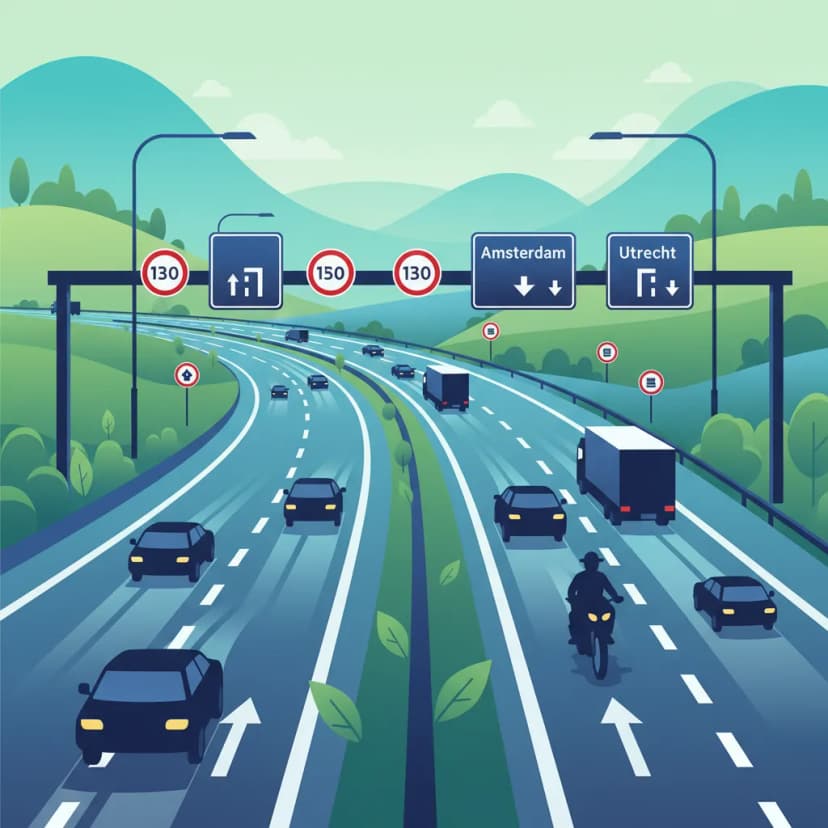
This lesson details the specific regulations for driving on Dutch motorways, identifiable by the G1 sign. You will learn the correct procedure for joining the flow of traffic using the acceleration lane and for leaving via the deceleration lane. The curriculum reinforces the 'keep right unless overtaking' rule for lane discipline. It also explains that stopping is strictly forbidden, and the hard shoulder (vluchtstrook) may only be used for genuine emergencies.

This lesson focuses on the unique demands of riding at sustained high speeds on motorways ('snelwegen'). It covers essential topics such as strict lane discipline, safe overtaking procedures, and maintaining a greater following distance to compensate for higher reaction and braking times. The content also addresses the physical and mental challenges, including managing wind blast, increased noise levels, and maintaining heightened situational awareness over long distances to combat fatigue.
This lesson focuses on the meaning of different road markings and their implications for motorcycle lane discipline. You will learn the legal distinction between solid and broken lines regarding overtaking, how to interpret directional arrows for lane choice, and the rules for using special lanes. The content emphasizes maintaining a safe and strategic position within the lane to maximize visibility and create a safety buffer from other vehicles.

This lesson covers the universal Dutch road rules with a specific focus on their application to light motorcycles. It details the various speed limits for different road types, from urban areas to motorways, and explains the correct procedures for overtaking and lane positioning. The legal aspects of lane filtering in congestion are also examined, alongside mandatory equipment use like daytime running lights, to ensure riders can integrate safely and legally into traffic flow.
This lesson prepares you for the unique dangers of high-speed highway riding. You will learn to scan for and navigate road hazards like debris, potholes, and slippery steel expansion joints on bridges. The content also addresses the powerful air turbulence created by large trucks that can upset a motorcycle's stability and the mental challenge of maintaining focus on long, monotonous stretches of road.

This lesson details the systematic process for safely overtaking on a multi-lane motorway, leveraging the acceleration capabilities of a Category A motorcycle. It covers the 'mirror, signal, maneuver' sequence, with a strong emphasis on the critical shoulder check to clear the blind spot before moving out. The content also discusses how to judge closing speeds, ensure adequate space before returning to the lane, and how to handle situations involving multiple lanes and slower-moving heavy vehicles.

This lesson provides a detailed explanation of the various markings painted on the road surface, which are as legally binding as physical signs. It clarifies the rules associated with solid and broken white lines, including restrictions on crossing them, and the function of arrows, chevrons, and text painted in lanes. A thorough understanding of these markings is fundamental for correct lane discipline, positioning, and safe maneuvering on a motorcycle.

Understand the meaning of various road markings and how they dictate your position on the road. This lesson covers the rules associated with solid and broken white lines, bicycle lane symbols, suggestion strips, and arrows painted on the road surface. Proper lane discipline, including when overtaking is permitted and how to position yourself correctly within a lane or on a cycle path, is a fundamental skill for safe and predictable riding that is tested by the CBR.
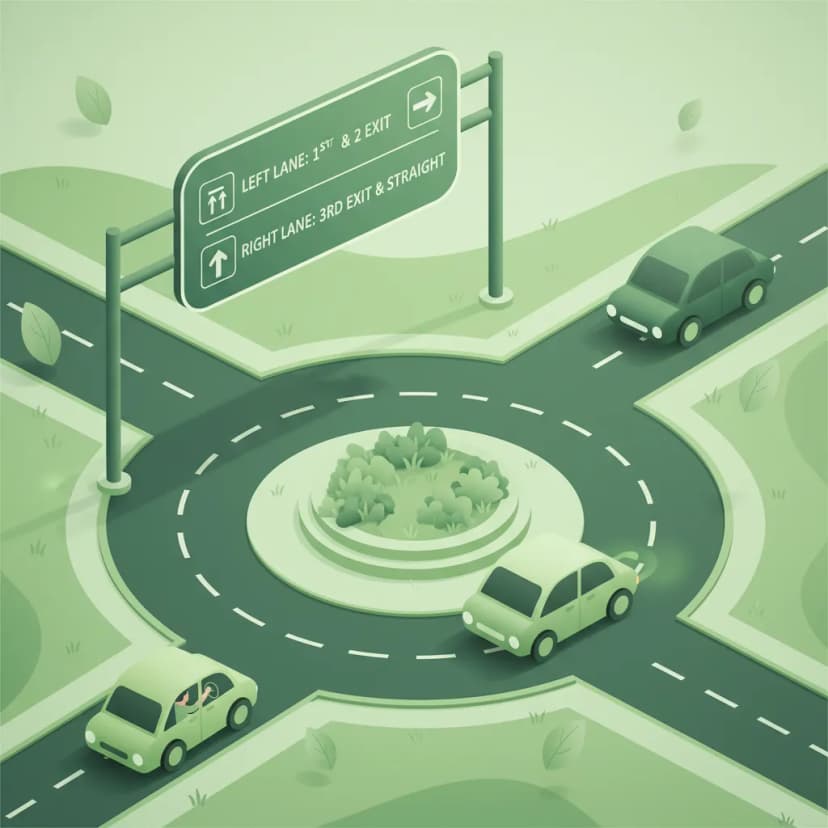
This lesson provides a detailed guide to navigating Dutch roundabouts ('rotondes'), including single-lane, multi-lane, and 'turbo' designs. It clarifies the specific priority rules that apply when entering the roundabout and the critical importance of correct signaling when changing lanes or exiting. Special attention is given to the vulnerable position of motorcyclists and the need to be aware of other vehicles' blind spots and the priority rules concerning cyclists on or near the roundabout.
Learn about typical mistakes motorcyclists make regarding Dutch motorway law and lane discipline. This lesson clarifies common violations, their consequences, and emphasizes correct, safe behaviour on Dutch snelwegen based on theory.
This lesson reinforces the fundamental rule of Dutch highway driving: use the rightmost lane available and use the lanes to the left only for overtaking. You will learn the complete, safe overtaking procedure: check mirrors, signal, perform a shoulder check for the blind spot, smoothly move over, accelerate past the vehicle, and then return to the right lane when safe.
This lesson focuses on the meaning of different road markings and their implications for motorcycle lane discipline. You will learn the legal distinction between solid and broken lines regarding overtaking, how to interpret directional arrows for lane choice, and the rules for using special lanes. The content emphasizes maintaining a safe and strategic position within the lane to maximize visibility and create a safety buffer from other vehicles.

This lesson provides a detailed overview of the structure of Dutch traffic legislation, focusing on the Road Traffic Act (Wegenverkeerswet 1994) and its relationship with CBR regulations. It explains the hierarchy from national statutes to local ordinances and how these rules govern rider behavior in various traffic situations. Furthermore, the lesson clarifies the mechanisms for enforcement, the types of sanctions for non-compliance, and the legislative goal of ensuring road safety for all participants.

This lesson focuses on the legal requirements and safe practices for riding near pedestrian crossings ('zebrapaden') and designated school zones. It details the absolute obligation to yield to pedestrians on or about to use a crossing and the need for significantly reduced speeds and heightened vigilance in areas with children. The content underscores the importance of anticipation and being prepared for unpredictable movements from vulnerable road users to prevent serious incidents.
This lesson focuses on the unique demands of riding at sustained high speeds on motorways ('snelwegen'). It covers essential topics such as strict lane discipline, safe overtaking procedures, and maintaining a greater following distance to compensate for higher reaction and braking times. The content also addresses the physical and mental challenges, including managing wind blast, increased noise levels, and maintaining heightened situational awareness over long distances to combat fatigue.
This lesson prepares you for the unique dangers of high-speed highway riding. You will learn to scan for and navigate road hazards like debris, potholes, and slippery steel expansion joints on bridges. The content also addresses the powerful air turbulence created by large trucks that can upset a motorcycle's stability and the mental challenge of maintaining focus on long, monotonous stretches of road.

This lesson examines the statutory duties imposed on motorcyclists, with a strong emphasis on the 'duty of care' (zorgplicht) and the conditions under which legal liability arises after a traffic incident. It clarifies the relationship between personal responsibility, mandatory insurance coverage, and the legal expectation for proactive risk mitigation to prevent accidents. The content also analyzes scenarios to illustrate how liability is typically determined within Dutch traffic jurisprudence, preparing riders for their legal responsibilities.

This lesson provides a detailed framework for how motorcyclists must safely and legally interact with diverse road users, including cars, trucks, cyclists, and pedestrians. It covers the required communication signals, anticipatory behaviors, and specific positioning techniques necessary to coexist in complex traffic environments like urban centers and shared spaces. Emphasis is placed on legal expectations and practical methods that actively reduce collision risk and promote smooth traffic flow.

This lesson explores the legal meaning of various road surface markings, including solid and broken lane delimiters, directional arrows, and special-purpose lane indicators. It describes how markings dictate permitted maneuvers, such as overtaking and lane changes, and alert riders to upcoming hazards or changes in road layout. The content also examines the relationship between markings and road design in the Netherlands, emphasizing how a motorcyclist must interpret these visual cues for safe positioning.
This lesson covers the universal Dutch road rules with a specific focus on their application to light motorcycles. It details the various speed limits for different road types, from urban areas to motorways, and explains the correct procedures for overtaking and lane positioning. The legal aspects of lane filtering in congestion are also examined, alongside mandatory equipment use like daytime running lights, to ensure riders can integrate safely and legally into traffic flow.
Find clear answers to common questions learners have about Dutch Motorway Law (snelwegwet) and Lane Discipline. Learn how the lesson is structured, which driving theory objectives it supports, and how it fits into the overall learning path of units and curriculum progression in the Netherlands. These explanations help you understand key concepts, lesson flow, and exam focused study goals.
The primary rule is to keep to the rightmost available lane at all times, unless you are overtaking another vehicle. Passing is legally permitted only on the left side.
The snelwegwet dictates that lane changes must be done safely and efficiently. You should only change lanes to overtake, and you must always pass on the left. You should also indicate your intention to change lanes and ensure there is sufficient space.
Even in heavy congestion, the principle of keeping right generally applies. While you might be moving slowly, you should still occupy the rightmost lane unless actively overtaking. Avoid unnecessary lane changes and maintain a safe distance from the vehicle in front.
Staying right ensures that faster traffic can pass unimpeded on the left, which improves overall traffic flow and safety. It also makes you more visible to other vehicles and reduces the chances of them misjudging your position or speed.
Yes, the rules of the Dutch Motorway Act (snelwegwet) and associated lane discipline apply to all Category A motorcycles and their riders, regardless of engine size or specific type, when riding on a designated motorway (snelweg).