
Navigating Dutch intersections, junctions, and roundabouts requires a solid understanding of priority rules ('voorrangsregels'). This unit breaks down the general rule of yielding to the right and all its exceptions, ensuring you can confidently make safe priority decisions on the road. Master these essential concepts for both your Category A CBR theory exam and everyday riding.
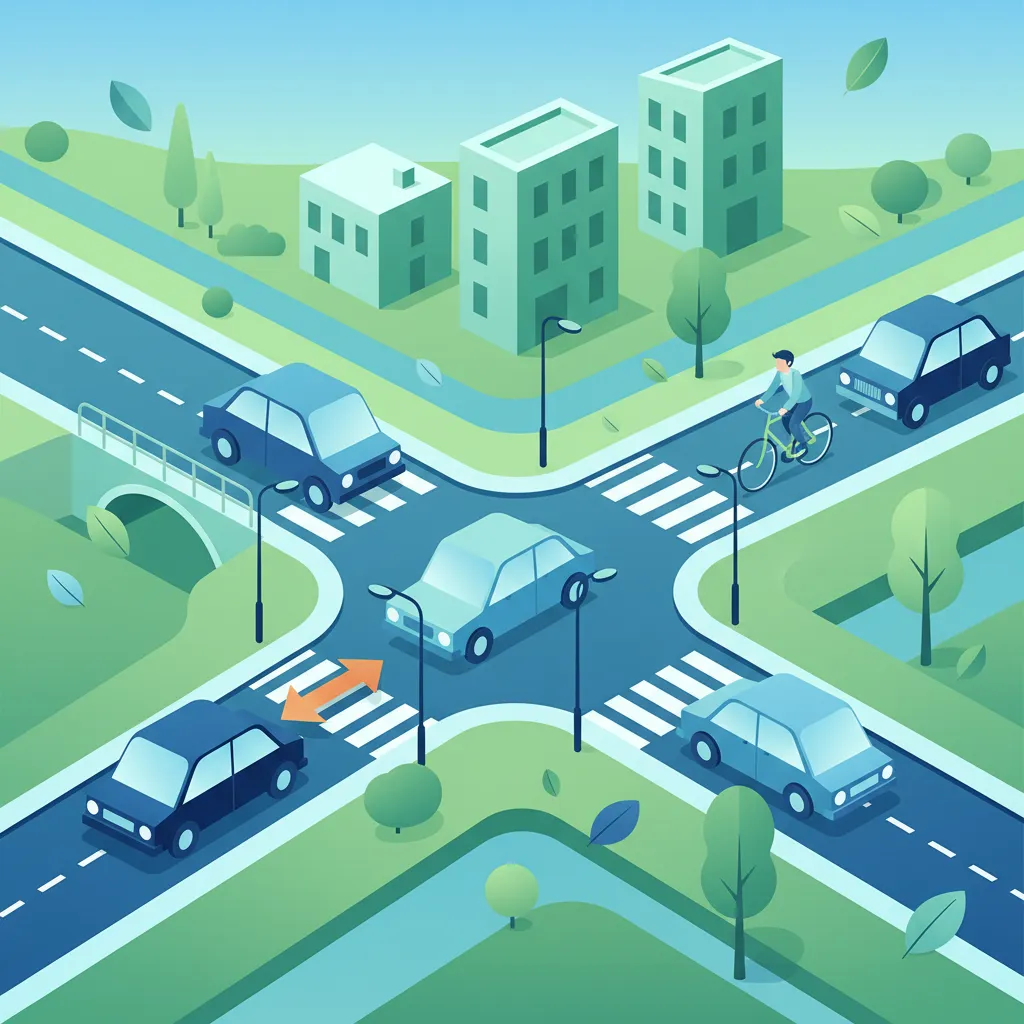
Browse all lessons that make up Priority Rules and Intersection Navigation. Each lesson focuses on specific topics, learning objectives, and core concepts, helping you build essential knowledge and follow a clear, structured progression toward your study goals in the Netherlands.
This lesson establishes the foundational rule of priority in Dutch traffic law: yielding to traffic from the right at intersections of equal roads unless otherwise indicated. It explains how to identify an unmarked or 'equal' junction and the correct procedure for approaching, assessing, and proceeding safely. The content also introduces the primary signs and markings, such as 'shark's teeth,' that override this default rule, forming the basis for all other priority scenarios.
This lesson provides a detailed guide to navigating Dutch roundabouts ('rotondes'), including single-lane, multi-lane, and 'turbo' designs. It clarifies the specific priority rules that apply when entering the roundabout and the critical importance of correct signaling when changing lanes or exiting. Special attention is given to the vulnerable position of motorcyclists and the need to be aware of other vehicles' blind spots and the priority rules concerning cyclists on or near the roundabout.
This lesson focuses on the legal requirements and safe practices for riding near pedestrian crossings ('zebrapaden') and designated school zones. It details the absolute obligation to yield to pedestrians on or about to use a crossing and the need for significantly reduced speeds and heightened vigilance in areas with children. The content underscores the importance of anticipation and being prepared for unpredictable movements from vulnerable road users to prevent serious incidents.
This lesson analyzes the specific challenges and priority rules associated with various common junction layouts, including T-junctions, Y-junctions, and standard crossroads. It explains how the geometry of each type of intersection influences sightlines, vehicle positioning, and the application of right-of-way rules. Riders will learn systematic approaches for assessing these junctions, positioning their motorcycle correctly for the intended maneuver, and executing turns safely and efficiently.
This lesson details the legal obligation and safe procedures for yielding to emergency vehicles ('noodvoertuigen' or 'voorrangsvoertuigen') that are using audible and visual warnings. It provides clear guidance on how to safely create space, whether by pulling over, adjusting speed, or clearing an intersection, without causing a secondary hazard. The content emphasizes maintaining composure and making predictable maneuvers to allow emergency services to pass quickly and safely.
This lesson addresses the unique priority rules concerning trams in urban environments, clarifying that trams generally have priority unless signs or signals indicate otherwise. It explains the specific hazards motorcyclists face, such as slippery tracks (especially in wet conditions) and the long stopping distance of trams. Riders will learn how to safely cross tram lines, navigate shared lanes, and correctly interpret tram-specific traffic signals to avoid dangerous conflicts.
This lesson equips riders with cognitive strategies for managing ambiguous or conflicting traffic situations where priority rules may be misinterpreted by other road users. It focuses on the principles of defensive riding, such as making eye contact, using clear signals, and being prepared to yield the right-of-way to avoid a collision. The content teaches how to resolve uncertainty safely by prioritizing hazard avoidance over asserting one's legal right-of-way, a critical skill for motorcyclist survival.
Explore high-intent keywords and long-tail search topics learners use when researching Priority Rules and Intersection Navigation. These terms reflect how people search for reliable study materials, structured explanations, and unit-level theory preparation support in the Netherlands.
Find clear answers to the most common questions learners ask about Priority Rules and Intersection Navigation. Understand how the unit is organized, what learning goals it supports, and how it contributes to your study progression with structured explanations and practical guidance tailored for learners in the Netherlands.
The general rule in the Netherlands is that you must yield to traffic coming from your right ('verkeer van rechts voorrang'). This applies at uncontrolled intersections and junctions where no specific signs or road markings indicate otherwise. Always be aware of the traffic to your right unless a sign or signal dictates a different priority.
In the Netherlands, most roundabouts are marked with a 'yield to the right' sign (a triangular sign with a blue circle) or a 'priority to traffic on the roundabout' sign (a blue circle with a red border and a white arrow). Generally, traffic already on the roundabout has priority, and you must yield to them before entering. Always look for specific signs or road markings.
Yes, you generally must yield to trams ('trams') in the Netherlands, especially when they are on a tram crossing or when they indicate they are entering or leaving a stop. Trams often have priority due to their fixed track. Always be observant of tram tracks and approaching trams.
When you see or hear an emergency vehicle ('noodvoertuig') with flashing lights and sirens, you must give way immediately. Pull over to the side of the road safely and stop to let it pass. Do not try to follow the emergency vehicle. This rule is critical for public safety and a common exam topic.
Absolutely. The 'yield to the right' rule is often overridden by traffic signs (like 'priority road' signs, 'stop' signs, or 'give way' signs), road markings (like yellow lines or arrows), and specific situations such as roundabouts or police directing traffic. This unit covers all these exceptions in detail.
The CBR theory exam frequently includes questions about priority rules, often presented as challenging scenarios with multiple vehicles at intersections or junctions. You'll need to identify who has priority based on signs, road markings, and the general rules to select the correct action. Understanding these situations is vital for a passing score.
All included lessons
Lessons in Priority Rules and Intersection Navigation
See who benefits most from studying Priority Rules and Intersection Navigation. This overview explains how the unit supports different learning needs, what level of knowledge is helpful before starting, and how it fits into the overall study path in the Netherlands.
This unit is crucial for all aspiring Category A motorcycle riders preparing for the Dutch CBR theory exam. It is particularly beneficial for learners who find priority situations confusing or struggle with interpreting complex junction layouts. If you want to build confidence in navigating Dutch traffic, this unit is for you.

See how Dutch Motorcycle Theory A is structured, with key topics, learning objectives, and a step-by-step path for theory preparation in the Netherlands.
Explore all units and lessons included in this driving theory course.