
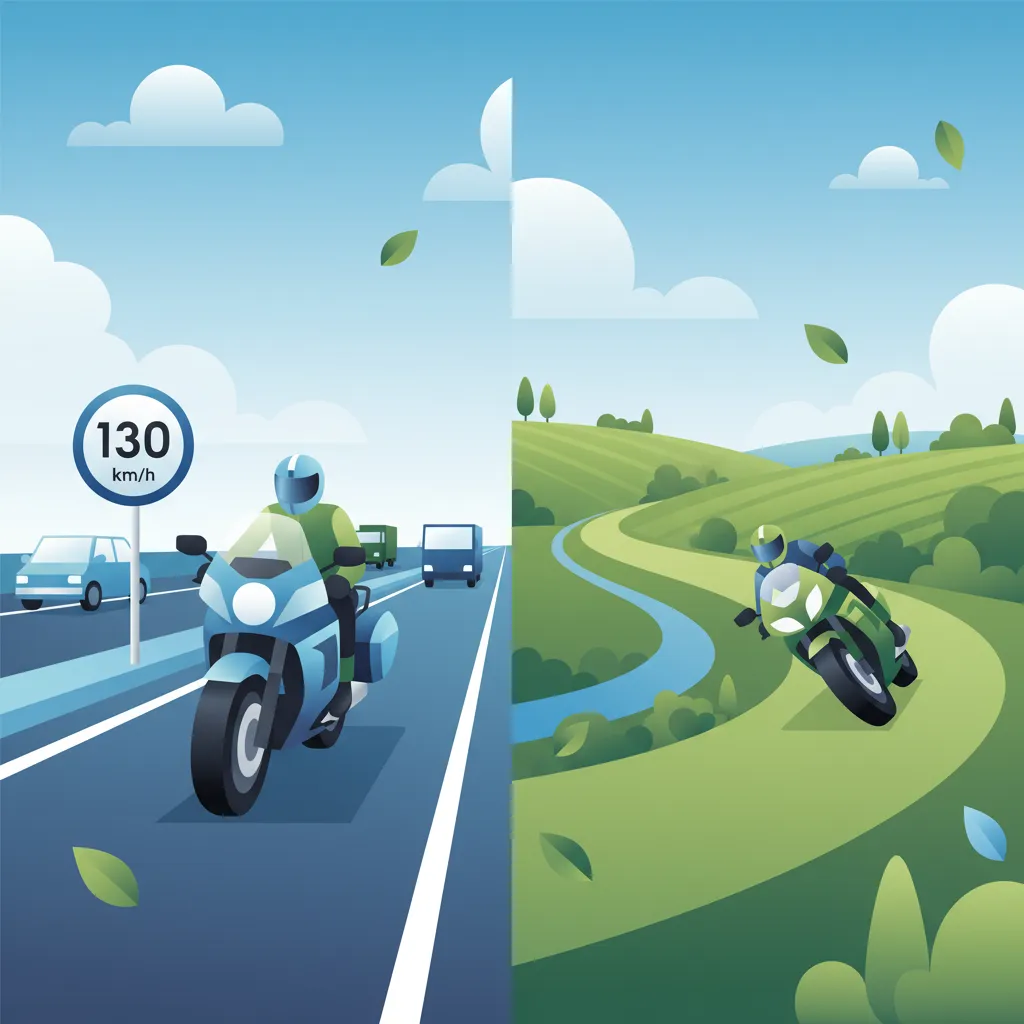
Mastering speed is crucial for motorcycle safety and legal compliance in the Netherlands. This unit delves into the national speed limits for Category A motorcycles, covering both built-up and open road restrictions. You'll also learn to select appropriate speeds for varying conditions, understand speed enforcement, and grasp the physics behind safe cornering.
Browse all lessons that make up Speed Management and Legal Limits. Each lesson focuses on specific topics, learning objectives, and core concepts, helping you build essential knowledge and follow a clear, structured progression toward your study goals in the Netherlands.
This lesson outlines the statutory national speed limits applicable to motorcycles in the Netherlands. It clearly defines the maximum permitted speeds on motorways ('snelwegen'), non-motorway rural roads ('buiten de bebouwde kom'), and within built-up areas ('binnen de bebouwde kom'). The content also addresses variations, such as time-dependent speed limits on certain motorways, ensuring riders have a complete and accurate understanding of the legal requirements for speed.
This lesson focuses on identifying different types of speed zones and understanding the rationale behind their limits. It explains how to recognize the start and end of a 'built-up area' ('binnen de bebouwde kom') via place-name signs and discusses special zones like 30 km/h zones and 'woonerven' (residential yards). The curriculum emphasizes adapting riding style to the specific hazards present in each type of zone, from high pedestrian activity in urban areas to unexpected curves on rural roads.
This lesson provides an overview of the various speed enforcement technologies and strategies used in the Netherlands. It explains the operation of fixed speed cameras ('flitspalen'), average speed check systems ('trajectcontrole'), and mobile enforcement units used by the police. Understanding these methods helps riders appreciate the high likelihood of being caught for speeding, reinforcing the importance of consistent compliance with all posted speed limits to avoid fines and other penalties.
This lesson delves into the critical skill of determining a safe and appropriate speed for navigating curves and bends. It explains the physical principles involved, including the relationship between speed, lean angle, and available traction, and teaches riders how to assess a corner's radius and camber visually. Techniques such as using the 'vanishing point' to judge a curve's tightness are covered, enabling riders to select a safe entry speed and maintain control throughout the turn.
This lesson examines how adding weight, such as a pillion passenger or luggage, and changes in aerodynamics affect a motorcycle's performance and stability at speed. It explains the impact on acceleration, braking distances, and cornering ability due to a higher center of gravity and increased mass. Riders will learn how to adjust their speed and control inputs to safely manage the altered handling characteristics, especially when riding in windy conditions or at high motorway speeds.
This lesson teaches the crucial skill of assessing road surfaces and adjusting speed accordingly to maintain maximum traction. It covers a variety of hazardous conditions, including wet asphalt, loose gravel, oil patches, metal manhole covers, and painted road markings, all of which can significantly reduce grip. Riders will learn to constantly scan the road ahead, identify potential traction-reducing surfaces, and proactively manage their speed to prevent slides and loss of control.
This lesson focuses on the unique demands of riding at sustained high speeds on motorways ('snelwegen'). It covers essential topics such as strict lane discipline, safe overtaking procedures, and maintaining a greater following distance to compensate for higher reaction and braking times. The content also addresses the physical and mental challenges, including managing wind blast, increased noise levels, and maintaining heightened situational awareness over long distances to combat fatigue.
Explore high-intent keywords and long-tail search topics learners use when researching Speed Management and Legal Limits. These terms reflect how people search for reliable study materials, structured explanations, and unit-level theory preparation support in the Netherlands.
Find clear answers to the most common questions learners ask about Speed Management and Legal Limits. Understand how the unit is organized, what learning goals it supports, and how it contributes to your study progression with structured explanations and practical guidance tailored for learners in the Netherlands.
In the Netherlands, the general speed limits for motorcycles depend on the road type. Typically, it's 50 km/h within built-up areas ('binnen de bebouwde kom'), 100 km/h outside built-up areas ('buiten de bebouwde kom'), and 130 km/h on motorways ('snelweg'), though this can be reduced to 100 or 120 km/h on certain sections. Always pay close attention to posted signs as these limits can vary.
Carrying a passenger or luggage increases the weight of the motorcycle. This affects its acceleration, braking distances, and handling, especially in corners. You'll need to reduce your speed to compensate for the altered dynamics and ensure you can still control the bike safely.
'Bochtsnelheid' translates to cornering speed. It's crucial because riding too fast into a corner is a common cause of motorcycle accidents. Understanding how factors like lean angle, road surface grip, and tire condition influence your safe cornering speed is essential for preventing loss of control.
Trajectcontrole (average speed check) measures your average speed over a set distance. Flitspalen (speed cameras) measure instantaneous speed. Both systems are used on motorcycles just as they are on cars. It’s important to be aware of these systems and always adhere to the legal limits to avoid fines and penalty points.
No, the legal speed limit is the maximum permitted speed under ideal conditions. You must always adjust your speed to suit the actual traffic and road conditions. This includes factors like weather, visibility, road surface quality, traffic density, and your own riding ability. Riding at a safe, appropriate speed is always the priority, even if it’s below the posted limit.
Different road surfaces offer varying levels of grip. Wet roads, gravel, or icy patches significantly reduce traction, meaning you must reduce your speed considerably to maintain control. This unit will teach you how to assess these conditions and adjust your speed accordingly to prevent skidding or loss of traction.
All included lessons
Lessons in Speed Management and Legal Limits
See who benefits most from studying Speed Management and Legal Limits. This overview explains how the unit supports different learning needs, what level of knowledge is helpful before starting, and how it fits into the overall study path in the Netherlands.
This unit is designed for all aspiring Category A motorcycle riders in the Netherlands preparing for their CBR theory exam. It is particularly beneficial for those who want to thoroughly understand the nuances of speed regulations and the physics of safe riding beyond just memorizing limits.

See how Dutch Motorcycle Theory A is structured, with key topics, learning objectives, and a step-by-step path for theory preparation in the Netherlands.
Explore all units and lessons included in this driving theory course.