
This lesson delves into the critical concept of 'zorgplicht' (duty of care) as defined by Article 5 of the Dutch Road Traffic Act. As a Category A motorcyclist, understanding this legal principle is crucial for navigating your responsibilities and potential liability in traffic incidents. It builds on your foundational knowledge of traffic law and prepares you for real-world scenarios and specific CBR exam questions on rider accountability.

Navigating the roads of the Netherlands as a motorcyclist (Category A) requires more than just mastering riding techniques; it demands a deep understanding of your legal responsibilities. At the heart of Dutch traffic law lies a fundamental principle: the duty of care or zorgplicht. This concept dictates that every road user must act in a way that avoids causing danger or hindrance to others.
This lesson delves into Article 5 of the Dutch Road Traffic Act (Wegenverkeerswet 1990) and related provisions, exploring how this general obligation applies specifically to motorcyclists. We will examine how your actions are assessed after an accident, how legal liability is determined, and the enhanced protections afforded to vulnerable road users. A thorough grasp of the zorgplicht is crucial for both passing your CBR Category A theory exam and ensuring safe, legally compliant riding.
The bedrock of responsible road use in the Netherlands is the general duty of care, or zorgplicht, enshrined in Article 5 of the Wegenverkeerswet 1990 (WVW). This statutory obligation mandates that every participant in traffic, including every motorcyclist, must conduct themselves in a manner that does not create danger or unnecessary hindrance for other road users. It is a broad principle designed to guarantee a baseline of safety for everyone sharing the road.
This duty isn't just about avoiding collisions; it extends to preventing any situation that could reasonably lead to danger or inconvenience. This includes both active care, such as signalling intentions or adjusting speed, and passive care, which involves refraining from dangerous omissions like not blocking a lane. Motorcyclists, due to their vehicle's speed and agility, must continuously assess their surroundings and adapt their speed, position, and manoeuvres to uphold this duty. Failing to do so can lead to significant civil liability and administrative sanctions.
While the general duty of care sets the fundamental expectation, the specific standard of care (norm van redelijke zorg) required from a motorcyclist is not absolute. It is a dynamic concept, adjusting to the specific circumstances of the moment. This means the level of conduct expected from a reasonably prudent rider will vary depending on factors like traffic density, weather conditions, road type, and even the state of the motorcycle itself.
For instance, riding at the legal speed limit might be acceptable on a dry, clear day with light traffic. However, in heavy rain, fog, or on an icy road, a responsible motorcyclist would reduce their speed significantly below the limit and increase their following distance. This adaptation demonstrates adherence to the standard of care. Ignoring the impact of adverse conditions and riding as if they do not exist constitutes a breach of this standard, potentially leading to negligence. The Reglement Verkeersregels en Verkeerstekens (RVV 1990) provides more detailed rules (e.g., regarding overtaking or lane usage) that help define this standard in various situations.
When an accident occurs, a series of legal principles come into play to determine who is responsible and to what extent. Understanding these concepts is vital for any motorcyclist in the Netherlands, as they form the backbone of liability judgments.
For a motorcyclist to be held legally liable for an accident, two primary elements must be established: culpa (fault) and a causal link (causaal verband) between that fault and the resulting damage.
Culpa implies that the motorcyclist's actions or inactions breached their duty of care in a blameworthy manner. This means they did something a reasonably careful rider would not have done, or failed to do something they should have done. Merely being involved in an accident does not automatically mean there is culpa.
The causal link is a two-part test:
For example, if a motorcyclist fails to signal a lane change, causing a car in the target lane to swerve and hit a cyclist, the motorcyclist's omission is causally linked to the cyclist's injury. Without both culpa and a clear causal link, liability may be difficult to establish, even if a duty was technically breached. These principles are primarily governed by civil liability provisions in the Dutch Civil Code (Burgerlijk Wetboek 6, Articles 162-170).
Traffic accidents are rarely black and white. In many cases, the injured party may also have contributed to the incident through their own failure to observe their duty of care. This is known as contributory negligence (gedeelde aansprakelijkheid). When contributory negligence is established, the motorcyclist's liability for damages may be reduced proportionally.
For instance, if a motorcyclist brakes too late but a pedestrian also stepped onto the road without looking, liability for any resulting injury might be split, perhaps 50/50, between the two parties. This principle ensures that the financial burden of an accident is shared when both parties' actions contributed to the danger. It's important to remember that contributory negligence does not completely absolve the motorcyclist; it merely reduces the extent of their liability.
In specific, common traffic scenarios, Dutch law establishes a presumption of negligence (aannemingsnorm). This means that in certain types of accidents, the law presumes one party is at fault unless they can prove otherwise. This significantly shifts the burden of proof.
The most well-known example for motorcyclists is the rear-end collision, as per RVV 1990 Article 26. If you collide with the rear of another vehicle, you are generally presumed to be at fault. The rationale is that a following driver is expected to maintain sufficient distance and control to stop safely, even if the vehicle in front brakes suddenly. To overcome this presumption, the motorcyclist must present compelling evidence that the collision was not their fault—for example, by proving that the lead vehicle stopped exceptionally abruptly and without warning, or that the road conditions were extraordinarily hazardous and unforeseen.
Other presumptions can also apply, such as the presumption of negligence for a driver failing to yield when entering a main road from a side road. These presumptions encourage higher vigilance and streamline the process of liability determination in straightforward cases.
Dutch traffic law places a special emphasis on safeguarding vulnerable road users (VRUs). This category primarily includes pedestrians, cyclists, and individuals with reduced mobility. Crucially, motorcyclists are themselves considered VRUs when interacting with larger vehicles, but they bear a heightened duty of care when interacting with even more vulnerable participants like pedestrians and cyclists.
The rationale behind VRU protection is their higher risk of severe injury in a collision compared to occupants of cars or trucks. Consequently, a motorcyclist's duty of care may be judged more strictly when a VRU is present. This means you must:
Treating motorcyclists the same as car drivers in every situation is a common misunderstanding; while you are a VRU yourself, you also bear the responsibility of a more powerful vehicle when interacting with others. The "safety cushion" concept is paramount here: always provide ample space and time.
The general duty of care is put into practice through a framework of specific rules and regulations. As a rider, you must be familiar with these to ensure legally compliant and safe operation of your motorcycle.
The Wegenverkeerswet 1990 (WVW) is the overarching law governing all road traffic in the Netherlands. Its Article 5 establishes the zorgplicht. Supplementing the WVW is the Reglement Verkeersregels en Verkeerstekens 1990 (RVV 1990), which provides the detailed rules for everyday traffic situations, including:
Compliance with these articles is a direct manifestation of fulfilling your duty of care. Disregarding them not only creates danger but also forms a strong basis for proving fault in the event of an accident.
Beyond traffic violations, accidents can lead to civil claims for damages. The Burgerlijk Wetboek (Dutch Civil Code), specifically Articles 6:162-170, governs fault-based liability (culpabilité). If a motorcyclist, through their fault, causes damage to another party, they are legally obliged to compensate for that damage. This can range from property damage to medical costs, lost income, and even non-material damages (pain and suffering).
This aspect of the law underscores the financial and personal consequences of breaching the duty of care. Even seemingly minor infractions can lead to substantial financial burdens if they result in serious accidents.
Beyond how you ride, your duty of care also extends to the condition of your vehicle and your personal equipment.
Understanding the theory is one thing; applying it in practice is another. Here are some common ways motorcyclists might inadvertently (or deliberately) breach their duty of care, along with the potential consequences:
The duty of care is not static; it adapts to the ever-changing environment of the road. A responsible motorcyclist constantly assesses and adjusts their riding based on these contextual variations.
The concept of zorgplicht is not merely a legal formality; it's a foundational principle for safety, risk management, and preventing catastrophic outcomes on the road.
By embracing and internalizing the principles of zorgplicht, you become a more responsible, safer, and legally compliant motorcyclist, contributing to a safer road environment for everyone in the Netherlands.
Lesson content overview
Explore all units and lessons included in this driving theory course.
Explore search topics learners often look for when studying Rider Liability and Duty of Care (zorgplicht). These topics reflect common questions about road rules, driving situations, safety guidance, and lesson level theory preparation for learners in the Netherlands.
Browse additional driving theory lessons that cover connected traffic rules, road signs, and common driving situations related to this topic. Improve your understanding of how different rules interact across everyday traffic scenarios.
Explore the fundamental 'zorgplicht' (duty of care) in Dutch traffic law, as outlined in Article 5 WVW. Learn how rider actions determine accident liability and the legal principles governing fault and compensation.

This lesson examines the statutory duties imposed on motorcyclists, with a strong emphasis on the 'duty of care' (zorgplicht) and the conditions under which legal liability arises after a traffic incident. It clarifies the relationship between personal responsibility, mandatory insurance coverage, and the legal expectation for proactive risk mitigation to prevent accidents. The content also analyzes scenarios to illustrate how liability is typically determined within Dutch traffic jurisprudence, preparing riders for their legal responsibilities.

This lesson provides a detailed overview of the structure of Dutch traffic legislation, focusing on the Road Traffic Act (Wegenverkeerswet 1994) and its relationship with CBR regulations. It explains the hierarchy from national statutes to local ordinances and how these rules govern rider behavior in various traffic situations. Furthermore, the lesson clarifies the mechanisms for enforcement, the types of sanctions for non-compliance, and the legislative goal of ensuring road safety for all participants.
This lesson covers the specific articles of the Dutch Road Traffic Act that apply to motorways, with a primary focus on the strict rule of keeping to the rightmost available lane unless overtaking. It explains the legal and safety reasons for only passing on the left and discusses the correct positioning within a lane for maximum visibility and safety. The content also addresses the nuances of lane usage during heavy congestion, ensuring riders comply with the law and contribute to smooth traffic flow.

This lesson provides an overview of the motor vehicle insurance system in the Netherlands, explaining the mandatory third-party liability insurance ('WA-verzekering'). It outlines the process for filing an insurance claim after an accident and the factors that are considered when determining liability or fault. Understanding this process is important for navigating the financial and legal consequences of a collision.
This lesson focuses on the legal requirements and safe practices for riding near pedestrian crossings ('zebrapaden') and designated school zones. It details the absolute obligation to yield to pedestrians on or about to use a crossing and the need for significantly reduced speeds and heightened vigilance in areas with children. The content underscores the importance of anticipation and being prepared for unpredictable movements from vulnerable road users to prevent serious incidents.

This lesson explains the fundamental concepts of legal liability in traffic accidents and the role of mandatory third-party insurance (WA-verzekering) in the Netherlands. You will learn how insurance companies use the accident statement form and other evidence to determine fault and process claims for damages. Understanding this process helps you appreciate the financial responsibilities associated with riding and the importance of having correct and valid insurance cover at all times.

This lesson covers the universal Dutch road rules with a specific focus on their application to light motorcycles. It details the various speed limits for different road types, from urban areas to motorways, and explains the correct procedures for overtaking and lane positioning. The legal aspects of lane filtering in congestion are also examined, alongside mandatory equipment use like daytime running lights, to ensure riders can integrate safely and legally into traffic flow.

This lesson explains the processes that follow a road accident, focusing on legal and insurance matters. It describes how liability is determined, the steps involved in filing an insurance claim, and the importance of accurate documentation and evidence, such as photos and witness statements. The content also touches upon potential legal consequences, such as fines or prosecution if traffic laws were violated, providing a comprehensive overview of the post-accident landscape.

This lesson provides a definitive list of the documents a motorcyclist must carry at all times when riding in the Netherlands. It specifies the requirement for a valid driving license ('rijbewijs') for the correct category, the vehicle registration card ('kentekenbewijs'), and proof of valid third-party liability insurance ('verzekeringsbewijs'). The content clarifies that failure to produce these documents during a police check can result in significant fines and legal complications.

This lesson addresses the moral and societal dimensions of motorcycling beyond strict legal compliance, encouraging riders to adopt principles of respect, solidarity, and social responsibility. It outlines how ethical considerations should influence day-to-day riding decisions, from showing courtesy to vulnerable road users to minimizing environmental and noise impact. The content provides a framework for reflective and conscientious riding that contributes positively to the broader traffic culture and public perception of motorcyclists.
Learn about the enhanced duty of care motorcyclists owe to vulnerable road users (pedestrians, cyclists) under Dutch law. Understand specific rules and practical considerations to ensure their safety and avoid legal fault.
This lesson examines the statutory duties imposed on motorcyclists, with a strong emphasis on the 'duty of care' (zorgplicht) and the conditions under which legal liability arises after a traffic incident. It clarifies the relationship between personal responsibility, mandatory insurance coverage, and the legal expectation for proactive risk mitigation to prevent accidents. The content also analyzes scenarios to illustrate how liability is typically determined within Dutch traffic jurisprudence, preparing riders for their legal responsibilities.
This lesson focuses on the legal requirements and safe practices for riding near pedestrian crossings ('zebrapaden') and designated school zones. It details the absolute obligation to yield to pedestrians on or about to use a crossing and the need for significantly reduced speeds and heightened vigilance in areas with children. The content underscores the importance of anticipation and being prepared for unpredictable movements from vulnerable road users to prevent serious incidents.
This lesson addresses the moral and societal dimensions of motorcycling beyond strict legal compliance, encouraging riders to adopt principles of respect, solidarity, and social responsibility. It outlines how ethical considerations should influence day-to-day riding decisions, from showing courtesy to vulnerable road users to minimizing environmental and noise impact. The content provides a framework for reflective and conscientious riding that contributes positively to the broader traffic culture and public perception of motorcyclists.

This lesson focuses on the legal and moral responsibility to be extra vigilant around certain groups of vulnerable road users. You will learn that children can be impulsive and have poor traffic awareness, requiring drivers to be prepared to stop suddenly, especially near schools and playgrounds. The content also discusses the need for patience with elderly or disabled road users, who may move more slowly. You will learn to recognize signs of disability, like a white cane or a guide dog, and give these individuals extra space and time.
As a motorized road user, you have a special responsibility towards more vulnerable participants. This lesson focuses on the rules giving priority to pedestrians at marked zebra crossings and the importance of anticipating the movements of cyclists, children, and the elderly. You will learn about maintaining a safe lateral distance when overtaking cyclists and how to navigate shared spaces with heightened awareness, a key component of social and safe driving behavior.
This lesson addresses interactions with other types of road users. You will learn about motorcyclists, who can accelerate and brake quickly and may filter through slow traffic. The curriculum explains how to anticipate their movements and check for them carefully at junctions. It also covers how to safely approach and overtake slow-moving vehicles, such as agricultural tractors, and how to behave around horse riders, which requires slowing down and giving a very wide berth.

This lesson provides a detailed framework for how motorcyclists must safely and legally interact with diverse road users, including cars, trucks, cyclists, and pedestrians. It covers the required communication signals, anticipatory behaviors, and specific positioning techniques necessary to coexist in complex traffic environments like urban centers and shared spaces. Emphasis is placed on legal expectations and practical methods that actively reduce collision risk and promote smooth traffic flow.

This lesson explains the critical rules of priority involving pedestrians and cyclists to ensure the safety of vulnerable road users. You will learn the absolute requirement to stop for pedestrians on or waiting to use a 'zebrapad' (zebra crossing). The content also covers situations where you must yield to cyclists crossing your path, such as when turning across a dedicated bicycle lane (fietspad).
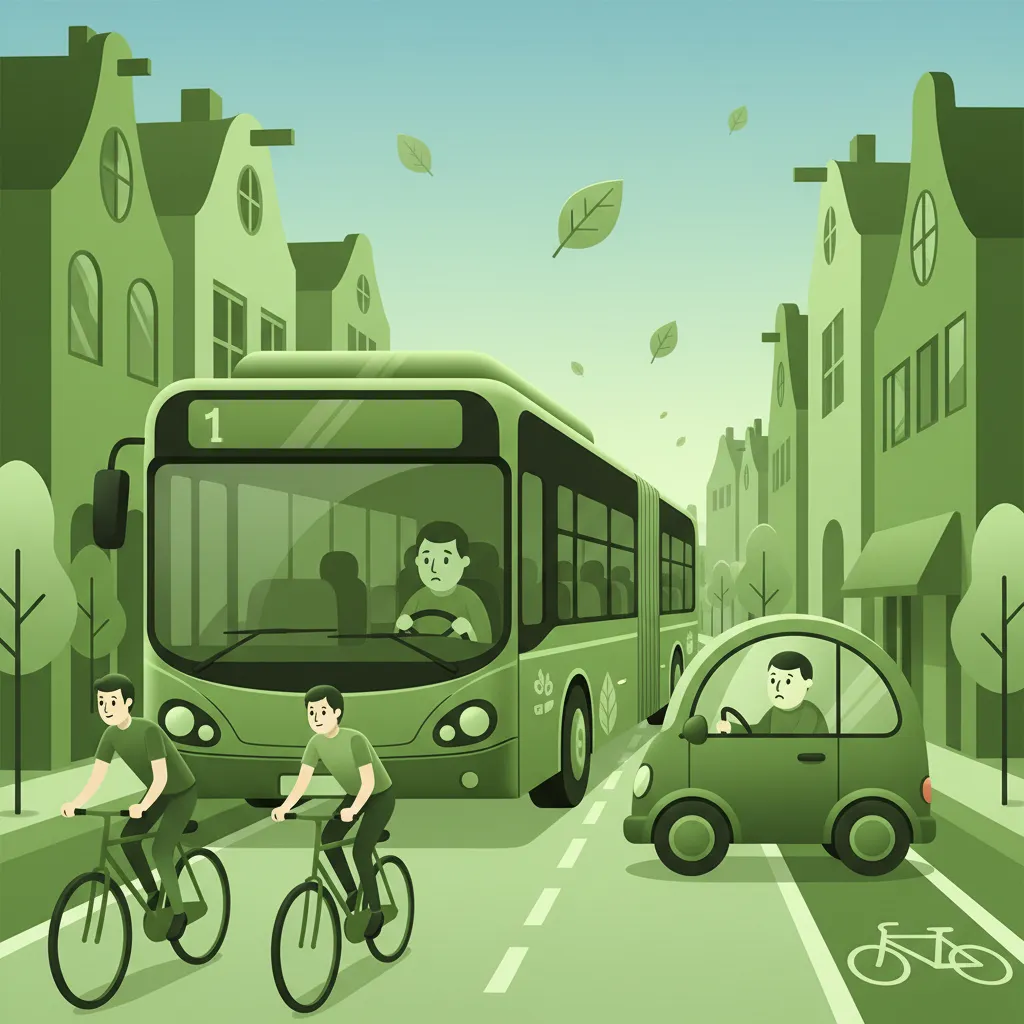
This lesson covers strategies for safely navigating around vehicles at both ends of the size spectrum. It details the large blind spots ('no-zones') around trucks and buses and advises on where to position a motorcycle to remain visible. Equally, it emphasizes the duty of care towards vulnerable road users, teaching riders to anticipate the movements of pedestrians and cyclists and to always provide them with ample space when passing.

This lesson is critical for driving in the Netherlands, a country with more bicycles than people. You will learn about the different types of cycle paths and how priority rules apply, especially at junctions. The content stresses the importance of checking the blind spot for cyclists before turning right ('dode hoek'). It also covers the rules for different types of mopeds (snorfiets and bromfiets) and the importance of giving all two-wheeled road users ample space when overtaking.
Find clear answers to common questions learners have about Rider Liability and Duty of Care (zorgplicht). Learn how the lesson is structured, which driving theory objectives it supports, and how it fits into the overall learning path of units and curriculum progression in the Netherlands. These explanations help you understand key concepts, lesson flow, and exam focused study goals.
Zorgplicht, or duty of care, means you must always ride in a manner that does not endanger or hinder other road users. For motorcyclists, this translates to being extra vigilant, maintaining safe distances, anticipating others' actions, and being prepared for sudden situations, especially when near pedestrians or cyclists. It's about proactive safety and avoiding preventable harm.
While 'zorgplicht' applies to all road users, it's often interpreted more strictly for operators of larger or faster vehicles, including Category A motorcycles. This is particularly true in incidents involving vulnerable road users, where the presumption of liability can shift more easily towards the motorcyclist due to the greater potential for harm their vehicle can cause.
'Zorgplicht' is about preventing danger, while 'schuld' is about who caused the accident. Even if another party is primarily at fault, a motorcyclist might still be held partially liable if they failed to exercise their 'zorgplicht' to prevent or mitigate the incident. The two concepts are interconnected when determining the overall legal outcome of an accident.
Yes, the CBR exam frequently includes scenario-based questions where you need to apply the principle of 'zorgplicht'. These might involve judging correct behaviour in ambiguous situations, assessing responsibility after a simulated incident, or understanding the legal consequences of actions that endanger or hinder others. Knowing this principle is crucial for accurate answers.