
This lesson is crucial for Category A motorcycle riders, focusing on how your body position and lean angle directly influence control and stability, especially when cornering. Mastering these techniques is essential for safe motorcycle operation and passing your CBR theory exam. It builds upon fundamental riding principles and prepares you for advanced maneuvers.

Riding a motorcycle safely and proficiently, especially when navigating turns, relies heavily on more than just steering and throttle control. Your body is an integral part of the machine, and how you position it significantly impacts the motorcycle's stability, grip, and overall cornering ability. This lesson in the Dutch Motorcycle Theory – Category A Comprehensive Preparation course delves into the critical role of the rider's body in influencing the motorcycle’s dynamics, particularly during cornering maneuvers.
By understanding and applying correct body positioning techniques, you can alter the combined centre of gravity (CG) of the motorcycle-rider system. This allows for more precise control, enhances stability, and maximizes available tire grip. We will explore how these principles enable you to negotiate corners more safely and efficiently, while adhering to Dutch traffic regulations that mandate constant effective control of your vehicle.
The relationship between the rider and the motorcycle is a dynamic one. Every movement, however subtle, affects how the machine responds. At its core, motorcycle cornering involves leaning the bike into the turn to counteract centrifugal force. The rider's body positioning plays a crucial role in modifying this lean, directly influencing the forces at play and the motorcycle’s interaction with the road.
The combined centre of gravity (CG) refers to the theoretical point where the entire mass of the motorcycle and rider system can be considered to act. This point is critical because it dictates the roll moment required to achieve a particular lean angle at a given speed and turn radius.
The weighted average location of the mass of the motorcycle and rider system. It determines the roll moment needed for a given lean angle.
For a stationary motorcycle with an upright rider, we refer to the static CG. However, during riding, especially when cornering, braking, or accelerating, the CG becomes dynamic. By shifting your body mass laterally or longitudinally, you directly change this combined CG. A lower or more inward CG reduces the amount the motorcycle itself needs to lean for a specific cornering force, thereby affecting stability and the speed at which a corner can be taken safely. Ignoring the rider’s mass, which typically ranges from 70–80 kg or more, would lead to an inaccurate assessment of the motorcycle's true dynamic behaviour. Under Dutch law (RVV 1990, Art. 43), maintaining effective control means actively managing this dynamic CG.
When a motorcycle leans into a turn, its frame creates a frame lean angle relative to the road surface. However, the effective lean angle is the aggregate lean angle of the entire motorcycle-rider system. These two are not always the same.
The resultant lean angle of the combined motorcycle and rider system relative to the road surface, which can be lower than the motorcycle’s frame-lean angle when the rider shifts their mass inside the turn.
By shifting your body to the inside of a turn, you effectively move the combined CG further inward and downward. This allows the motorcycle to negotiate the corner with a lower frame lean angle than it would otherwise need if the rider remained perfectly upright. A lower frame lean angle is advantageous because it increases the available tire contact patch, placing less stress on the tires and enhancing available grip. This translates into greater stability and a larger margin of safety, especially on surfaces with reduced traction. For instance, at 80 km/h on a 50-meter radius curve, a rider who shifts their torso 15 cm inside might reduce the required frame lean angle from 45° to approximately 38°, preserving valuable tire grip.
Weight transfer refers to the redistribution of load between the tires, influencing how much grip each tire can provide. This phenomenon is caused by acceleration, braking, and, significantly, by the rider's body movements.
Understanding and managing weight transfer is crucial for maintaining tire grip. Excess weight transfer can overload a single tire, causing it to exceed its grip circle or traction circle limits and slip. Balanced weight transfer, on the other hand, ensures that available grip is maximized across both tires. Dutch regulations, such as RVV 1990, Art. 6, regarding balanced braking, indirectly address longitudinal weight transfer by requiring the use of both front and rear brakes to prevent sudden load shifts that could destabilize a leaned motorcycle.
Effective body positioning is not a static concept; it involves continuous, deliberate adjustments throughout a corner. Mastering these techniques transforms the rider into an active participant in the motorcycle's dynamics, offering superior control and safety.
Foot-peg weighting is a specialized technique where the rider purposefully places increased pressure on the inside foot-peg during a turn. This action serves multiple critical purposes:
The deliberate application of pressure on the inside foot-peg during a turn to create a lateral counter-moment, lower the combined centre of gravity, and enhance motorcycle stability.
Firstly, pressing down on the inside foot-peg creates a lateral counter-moment that effectively helps to "push" the motorcycle down into the lean, supplementing torso lean and reducing the overall lean angle required for a given speed. Secondly, it contributes to lowering the combined CG, further improving stability. Lastly, it provides tactile feedback, allowing the rider to better sense the motorcycle’s lean angle and tire grip.
This technique is particularly valuable on low-grip surfaces like wet roads or gravel, where reducing the required lean angle is paramount to maintaining traction. Incorrect foot placement, such as dragging a foot or using it as a brake, can destabilize the bike and interfere with control. Dutch law (RVV 1990, Art. 5) mandates that both feet remain on the foot-pegs unless operating controls, which foot-peg weighting fully complies with and even encourages as a control technique.
Active body positioning refers to the continuous, fluid, and deliberate adjustments of your torso, head, and limbs throughout the entire cornering process. It's not a one-time adjustment but a dynamic dance with the motorcycle.
Continuous, fluid adjustments of the rider’s torso, head, and limbs throughout the entry, apex, and exit phases of a corner to maintain optimal control and balance.
This dynamic approach is typically divided into three phases:
Treating body position as a static adjustment can be detrimental. Sudden, jerky movements can induce rapid CG shifts, potentially causing tire slip or unsettling the motorcycle. Active body positioning, conversely, provides continuous optimal control, allowing the rider to react to unpredictable elements and maintain stability.
Your general riding posture establishes the baseline for your combined CG and dictates the range of motion available for active positioning. Two primary postures are commonly discussed:
Choosing the appropriate posture depends on the riding context. While a racing posture offers superior dynamic control, it can lead to fatigue on longer rides. For a motorway exit ramp, a neutral, comfortable posture might suffice, but for a tight hairpin, switching to a racing posture to lower the CG significantly enhances control. Dutch law (RVV 1990, Art. 5) permits adopting an aggressive posture as long as both hands remain on the handlebars and effective control is maintained.
Adhering to correct body positioning and lean angle management isn't just about performance; it's also about safety and compliance with Dutch traffic laws. These regulations are designed to ensure riders maintain control and predictability on the road.
Article 43 of the Dutch traffic regulations (RVV 1990) states that the rider must keep the motorcycle under effective control at all times. This fundamental rule encompasses all riding situations, including cornering. Proper body positioning is a primary means of achieving and demonstrating this control. A rider who fails to manage their body position effectively, leading to instability or loss of grip, could be deemed to have lost effective control, with potential legal consequences.
Correct Example: A rider leans inside the turn, adjusts foot-peg weighting, and smoothly maintains the cornering line, demonstrating full control over the vehicle's dynamics. Incorrect Example: A rider remains rigidly upright, relying solely on the motorcycle's lean, exceeds tire grip limits, and slides out of the turn, indicating a loss of control.
Article 5 of the RVV 1990 requires that both hands must be on the handlebars and both feet on the foot-pegs unless operating controls. This rule ensures that the rider can react promptly to any situation and maintain stability. Foot-peg weighting, as described earlier, is permissible under this article because the feet remain on the foot-pegs and contribute to controlling the vehicle, rather than being used for other, unauthorized purposes like dragging a foot on the ground.
Correct Example: A rider places their inside foot firmly on the foot-peg while initiating a turn, with both hands maintaining a secure grip on the handlebars. Incorrect Example: A rider places a foot on the ground while attempting to turn, significantly reducing stability and control.
While not explicit traffic laws, motorcycle manufacturer guidelines provide crucial safety parameters. These often include recommendations for maximum lean angles, which, if exceeded, can lead to mechanical failure (e.g., scraping hard parts) or tire overload. Smart riders use body positioning to reduce the required frame lean angle of the bike, thereby staying within manufacturer-specified limits while still achieving desired cornering speeds.
Additionally, RVV 1990, Article 2, dictates that the vehicle must not be overloaded beyond its permissible weight. Overloading, whether with passengers or luggage, significantly raises the combined CG, negatively impacting cornering capability and requiring more exaggerated body shifts to maintain stability. Riders must always be aware of their vehicle's load capacity.
Article 6 emphasizes the importance of balanced braking, requiring the use of both front and rear brakes unless vehicle condition prevents it. This is particularly relevant during cornering or when preparing for a turn, as balanced braking minimizes sudden longitudinal weight transfer. Abruptly applying only the front brake while leaned can cause severe front-wheel overload, potentially leading to a dangerous front-wheel slide or a high-side incident where the front wheel regains grip, violently throwing the rider off.
Effective body positioning is not a fixed technique but a dynamic skill that must be adapted to various riding conditions. Environmental factors, road characteristics, and the motorcycle's state all demand different approaches to ensure optimal control and safety.
Understanding the theory of body positioning is the first step; applying it effectively requires practice and an awareness of common pitfalls.
Let's illustrate these principles with some practical examples:
Scenario 1: Dry Urban Hairpin Corner
Scenario 2: Wet Motorway Exit Ramp
Scenario 3: Cross-wind on an Open Road Curve
Even experienced riders can fall prey to common errors in body positioning. Awareness is key to mitigating risks:
Proprioceptive Feedback: Active body positioning enhances your proprioceptive feedback – your body's ability to sense its position and movement. This improved "feel" allows you to sense the limits of traction earlier, enabling you to react proactively rather than reactively.
Mastering body positioning and lean angle management is fundamental to safe and proficient motorcycle riding. It transforms the rider from a passive passenger to an active, controlling element of the dynamic system.
By diligently applying these principles, you will enhance your control, increase your safety margin, and become a more skilled and confident motorcyclist on Dutch roads and beyond.
Lesson content overview
Explore all units and lessons included in this driving theory course.
Explore search topics learners often look for when studying Body Positioning and Lean Angle Management. These topics reflect common questions about road rules, driving situations, safety guidance, and lesson level theory preparation for learners in the Netherlands.
Browse additional driving theory lessons that cover connected traffic rules, road signs, and common driving situations related to this topic. Improve your understanding of how different rules interact across everyday traffic scenarios.
Explore how advanced body positioning and weight transfer techniques, including foot-peg weighting, enhance motorcycle stability and control during cornering. Learn to adapt these skills for various road conditions as per Dutch traffic law.

This lesson explains how you, the rider, are an active part of the motorcycle's dynamics. You will learn how shifting your body weight into the turn can reduce the required lean angle of the motorcycle itself, increasing the margin of safety and grip. The content covers correct posture, the importance of looking through the turn with your head up, and how to stay relaxed on the controls to allow the bike to work effectively.

This lesson demystifies the concept of counter-steering, the primary method for steering a motorcycle at speed. It explains how a small push on the handlebar initiates a lean, allowing the bike to turn effectively. The lesson also details how a rider's body position and weight shifting are used in conjunction with steering inputs to control the motorcycle's center of gravity, ensuring stability and precision while cornering.

This lesson provides a foundational understanding of the physics that govern motorcycle cornering. It explains how leaning the motorcycle shifts its center of gravity, creating a centripetal force that counteracts the outward centrifugal force of the turn. Learners will explore the relationship between speed, turn radius, and the required lean angle, as well as the critical role of tire traction in this dynamic balance.

Proper cornering technique is vital for safety and stability on a two-wheeler. This lesson explains the physics of turning, including the concepts of lean angle and counter-steering. You will learn the importance of adjusting your speed before the turn, looking where you want to go, and maintaining a smooth throttle through the corner. These techniques help you maximize grip and maintain control, ensuring you can navigate bends safely.

This lesson focuses on the importance of proper rider posture and ergonomics for maintaining control, comfort, and alertness. It explains how to achieve a relaxed but engaged posture, with appropriate bend in the arms and legs, to absorb bumps and react quickly. A correct ergonomic setup reduces physical fatigue on longer rides, which is crucial for sustaining concentration and ensuring safe operation of the motorcycle over time.

This lesson explains the principle of counter-steering, the primary method for steering a motorcycle at speeds above a walking pace. You will learn that to turn right, you must momentarily press forward on the right handlebar, and to turn left, you press the left one. The content demystifies the physics behind this technique, explaining how it uses gyroscopic forces to initiate a lean, which is what actually makes the motorcycle turn.

This lesson explains that where you ride in your lane is a critical safety choice. You will learn to avoid lingering in the blind spots ('dode hoek') of cars and trucks, and how to position yourself to be clearly visible in their mirrors. The content teaches you to constantly adjust your lane position to create a space cushion and ensure you always have a planned escape path in case of an emergency.
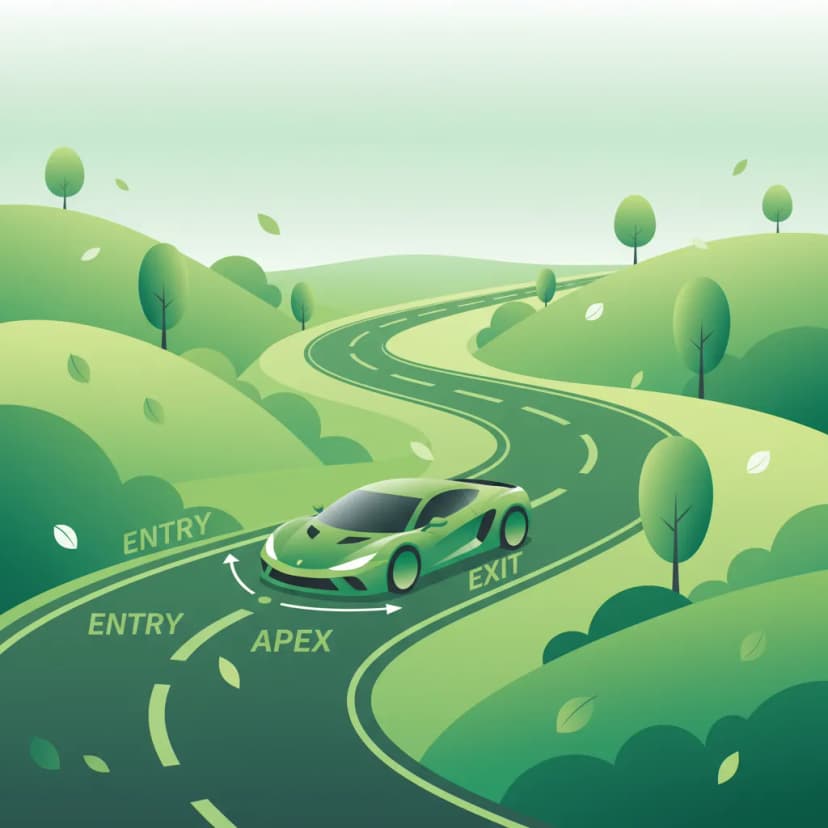
This lesson teaches a systematic approach to cornering by breaking it down into three distinct phases: entry, apex, and exit. It explains how to choose the correct road position and entry speed, identify the safest apex (not always the geometric one), and apply the throttle smoothly on exit to maximize stability and safety. This 'slow in, fast out' methodology provides a structured, repeatable process for navigating any corner with confidence and control.

This lesson provides critical instruction on managing blind spots ('dode hoek') to prevent collisions, particularly during lane changes. It covers the correct setup and use of mirrors, but stresses their limitations and the absolute necessity of the 'lifesaver' shoulder check before any lateral movement. Furthermore, it teaches riders how to be aware of the large blind spots around cars and especially trucks, and how to position themselves on the road to remain visible to other drivers at all times.

This lesson explains the concept of strategic lane positioning, moving beyond simply staying in the center of the lane. It details how to select a position—typically in the left or right wheel track of cars—to be more visible in other drivers' mirrors, avoid the slippery center strip, and maintain a space cushion. The content emphasizes constantly adjusting position based on traffic, road conditions, and potential hazards.
Understand the legal framework in the Netherlands regarding effective motorcycle control (RVV 1990, Art. 43) and correct use of foot-pegs and handlebars. Learn how adherence to these rules ensures rider safety and compliance.

This lesson details the specific actions required at intersections controlled by 'Stop' and 'Give Way' signs. You will learn the legal requirement to come to a complete stop at a stop line (BORD 44) and the obligation to yield to all crossing traffic when encountering give-way markings ('haaientanden'). The content covers safe approach speeds and effective scanning techniques for motorcyclists to accurately assess gaps in traffic before proceeding.

This lesson reinforces the fundamental rule of Dutch highway driving: use the rightmost lane available and use the lanes to the left only for overtaking. You will learn the complete, safe overtaking procedure: check mirrors, signal, perform a shoulder check for the blind spot, smoothly move over, accelerate past the vehicle, and then return to the right lane when safe.

This lesson provides a detailed framework for how motorcyclists must safely and legally interact with diverse road users, including cars, trucks, cyclists, and pedestrians. It covers the required communication signals, anticipatory behaviors, and specific positioning techniques necessary to coexist in complex traffic environments like urban centers and shared spaces. Emphasis is placed on legal expectations and practical methods that actively reduce collision risk and promote smooth traffic flow.

This lesson examines the statutory duties imposed on motorcyclists, with a strong emphasis on the 'duty of care' (zorgplicht) and the conditions under which legal liability arises after a traffic incident. It clarifies the relationship between personal responsibility, mandatory insurance coverage, and the legal expectation for proactive risk mitigation to prevent accidents. The content also analyzes scenarios to illustrate how liability is typically determined within Dutch traffic jurisprudence, preparing riders for their legal responsibilities.

This lesson provides a step-by-step guide to executing a safe and legal overtaking maneuver. It covers the entire process: assessing the situation for a sufficient gap in oncoming traffic, performing necessary mirror and shoulder checks, signaling intent, and accelerating decisively. The lesson also highlights situations where overtaking is prohibited by law, such as before pedestrian crossings or where there are solid white lines.

This lesson provides an in-depth exploration of Article 5 of the Dutch Road Traffic Act, which establishes the general 'duty of care' ('zorgplicht'). It explains that every road user has a fundamental obligation to behave in a way that does not cause danger or hindrance to others. The curriculum clarifies how this broad principle is applied in determining legal liability after an accident, especially in incidents involving vulnerable road users, reinforcing the rider's constant accountability.

This lesson addresses interactions with other types of road users. You will learn about motorcyclists, who can accelerate and brake quickly and may filter through slow traffic. The curriculum explains how to anticipate their movements and check for them carefully at junctions. It also covers how to safely approach and overtake slow-moving vehicles, such as agricultural tractors, and how to behave around horse riders, which requires slowing down and giving a very wide berth.
This lesson provides critical instruction on managing blind spots ('dode hoek') to prevent collisions, particularly during lane changes. It covers the correct setup and use of mirrors, but stresses their limitations and the absolute necessity of the 'lifesaver' shoulder check before any lateral movement. Furthermore, it teaches riders how to be aware of the large blind spots around cars and especially trucks, and how to position themselves on the road to remain visible to other drivers at all times.

This lesson covers the specific articles of the Dutch Road Traffic Act that apply to motorways, with a primary focus on the strict rule of keeping to the rightmost available lane unless overtaking. It explains the legal and safety reasons for only passing on the left and discusses the correct positioning within a lane for maximum visibility and safety. The content also addresses the nuances of lane usage during heavy congestion, ensuring riders comply with the law and contribute to smooth traffic flow.

This lesson prepares riders for the possibility of a routine police check ('verkeerscontrole'). It explains what officers typically inspect, which includes the required documentation, the roadworthiness of the motorcycle (e.g., tire tread depth, exhaust legality), and the rider's sobriety. The curriculum provides guidance on how to interact calmly and cooperatively with law enforcement, ensuring the stop proceeds smoothly and efficiently while being aware of one's basic rights.
Find clear answers to common questions learners have about Body Positioning and Lean Angle Management. Learn how the lesson is structured, which driving theory objectives it supports, and how it fits into the overall learning path of units and curriculum progression in the Netherlands. These explanations help you understand key concepts, lesson flow, and exam focused study goals.
For the Dutch CBR theory exam, understanding this is key. Shifting your body weight slightly in the direction of the turn helps initiate and maintain the motorcycle's lean angle. This active positioning, combined with the motorcycle's natural tendency to lean when turning, allows for stable cornering at the required speed and adherence to road rules.
Passive lean angle is when the motorcycle leans due to centrifugal force during a turn at a given speed. Active lean angle is when the rider intentionally shifts their weight or uses steering inputs to influence the motorcycle's lean, allowing for finer control, higher cornering speeds, or stability adjustments. Both are crucial concepts for Category A riders in the Netherlands.
Weighting the outside footpeg helps to 'push' the motorcycle down into the turn, increasing stability and grip. This technique, often used in conjunction with body lean, assists in managing the lean angle and maintaining control, especially during faster cornering as assessed in the Dutch Category A theory exam.
Yes, absolutely. This is where 'active' body positioning comes in. Subtle shifts in your weight, pressure on the handlebars, or even small movements of your head can help fine-tune the motorcycle's lean angle and balance, providing greater control and confidence, which is a vital part of safe riding tested in the CBR exam.
While the theory exam focuses on knowledge, safe practice is essential. Start with small adjustments at low speeds in a safe, open area. Focus on feeling how your body movements affect the bike's balance and lean. Always prioritize safety and gradually build up your confidence and understanding.