
Safely managing speed is crucial for any Category A motorcyclist, especially at higher speeds. This lesson delves into the critical techniques of high-speed braking, focusing on the effective and balanced application of both your front ('voorrem') and rear ('achterrem') brakes. Understanding how to decelerate quickly and under control is vital for avoiding hazards and passing your CBR theory exam.
Effective braking is a fundamental skill for any motorcyclist, especially when operating at high speeds on public roads. This comprehensive lesson, tailored for the Dutch Motorcycle Theory – Category A preparation, delves into the critical techniques for stopping quickly and safely. We will explore the physics behind deceleration, the coordinated use of the front (voorrem) and rear (achterrem) brakes, and the legal obligations under Dutch traffic law.
Mastering high-speed braking not only enhances your safety but also ensures you can confidently navigate various road conditions and respond to unexpected hazards. From understanding weight transfer to leveraging modern safety systems like ABS, this guide will equip you with the knowledge to bring your motorcycle to a controlled stop from any speed.
To brake effectively, a rider must understand the forces at play. Deceleration involves managing the transfer of weight, respecting tire traction limits, and applying brakes progressively. This section lays the groundwork for understanding the mechanics.
Braking is often the most critical action a rider takes to avoid collisions and reduce stopping distances. At high speeds, the kinetic energy of a motorcycle is substantial, requiring significant force to bring it to a halt. Proper braking technique ensures stability, prevents skids, and maximizes the motorcycle's stopping capability. In the context of the Dutch Category A theory exam, demonstrating knowledge of correct braking technique is a required competency for both safety and legal compliance.
When a motorcycle decelerates, its center of gravity shifts forward. This phenomenon, known as weight transfer, significantly increases the load on the front wheel (voorwiel) while simultaneously reducing the load on the rear wheel (achterwiel). The amount of weight transferred is governed by physics, specifically the formula ΔF = (m·a·h)/L, where:
m is the total mass of the motorcycle and rider.a is the rate of deceleration.h is the height of the center of gravity.L is the wheelbase of the motorcycle.This dynamic shift means that the front tire gains significantly more grip potential during braking, while the rear tire's grip is diminished. For instance, braking from 100 km/h, a substantial portion of the motorcycle's total weight (e.g., 30% or more) can be transferred to the front wheel.
Due to the significant weight transfer to the front wheel during deceleration, the front brake (voorrem) becomes the primary source of stopping power. The increased normal load on the front tire allows it to generate far greater braking force before losing traction. On most motorcycles, especially sport models, the front brake can provide anywhere from 70% to 80% of the total stopping power on a dry surface. Attempting to stop quickly without adequate front brake application means leaving a large portion of your available braking power unused.
While the front brake is dominant, the rear brake (achterrem) is by no means useless at high speeds. It plays a crucial supplementary role, contributing to overall stopping power (typically 20-30% on dry roads) and, importantly, enhancing stability. Engaging the rear brake can help settle the chassis, preventing excessive forward pitch and reducing the risk of the rear wheel lifting during very hard braking. Proper use of the rear brake helps balance the motorcycle and ensures a more controlled deceleration.
Effective high-speed braking is a skill that combines an understanding of physics with precise control inputs. These techniques are vital for maximizing deceleration while maintaining stability and control.
Progressive braking is the technique of gradually increasing brake pressure from a light initial touch to full application, rather than abruptly grabbing the lever or stomping the pedal. This gradual increase allows the motorcycle's suspension to compress smoothly, the tires to adapt to the increasing load, and the rider to "feel" the available grip. It prevents sudden weight shifts that could overwhelm a tire's friction limit and cause a lock-up. A smooth, progressive application ultimately leads to shorter stopping distances and greater control than an immediate, "hard" brake application that might exceed the tire's initial traction.
Practice progressive braking by starting with a light squeeze on the front lever and a gentle press on the rear pedal. Gradually increase pressure on both until you achieve the desired deceleration, always feeling for the limits of traction.
Brake modulation is the continuous fine-tuning of brake pressure to keep the tires operating at the very edge of their traction limit without actually locking them up. This requires a sensitive feel through your fingers on the front brake lever and your toe on the rear brake pedal. Riders should pay attention to tactile feedback, such as a slight vibration or change in steering feel, which indicates the tire is approaching its slip threshold. By subtly easing pressure at this point, you can maintain maximum deceleration while preserving control. This fundamental skill is crucial for both motorcycles equipped with and without Anti-lock Braking Systems (ABS).
Brake bias refers to the intentional proportion of total braking effort applied to the front versus the rear brake. While a typical dry-road high-speed stop might use a 70-80% front / 20-30% rear bias, this proportion needs to be adjusted based on road conditions. On wet or slippery surfaces, where overall traction (wrijvingscoëfficiënt) is significantly reduced, the front brake's dominance is somewhat lessened. In these conditions, a slightly increased contribution from the rear brake (e.g., 60% front / 40% rear) can help maintain stability and prevent front wheel lock-up. The rider must actively modulate both controls to achieve this optimal balance.
The traction circle, also known as the friction circle, is a conceptual tool that illustrates the combined longitudinal (braking/acceleration) and lateral (cornering) forces a tire can generate before it begins to slip.
In a straight line, the tire's full grip capacity is available for braking. However, when leaning into a corner, a portion of the traction circle is already being used for lateral (cornering) grip. This means that the amount of available braking force is reduced. Attempting to brake aggressively while leaned over can easily exceed the tire's combined grip limit, leading to a loss of traction and a skid. Dutch traffic law (RVV 1990) prohibits braking aggressively while turning if it results in loss of traction, underscoring the importance of understanding this principle. Therefore, it is generally safer to complete most of your braking before entering a turn and gradually release the brakes as you lean into the curve.
Rider body position plays a subtle but important role in maximizing braking effectiveness, particularly during hard stops. By shifting your weight slightly rearward and bracing against the handlebars (but not gripping them tightly), you can help counteract the motorcycle's natural tendency to pitch forward. This slight rearward shift can help maintain more load on the rear wheel, making the rear brake more effective and reducing the risk of the front wheel diving excessively or the rear wheel lifting off the ground (stoppie). However, excessive rearward shifting can reduce front wheel load too much, compromising steering and front brake effectiveness, and can even be illegal if it causes the front wheel to lift off the road and lose control.
Modern motorcycles often incorporate advanced safety features, and understanding how these interact with your braking technique is essential. Additionally, riders must be aware of potential issues like brake fade that can compromise performance.
Anti-Lock Braking Systems (ABS) are electronic safety systems designed to prevent wheel lock-up during hard braking. When a wheel's rotation speed indicates it is about to lock, the ABS rapidly pulses the brake pressure to that wheel, allowing it to continue rotating while still providing maximum stopping force. This prevents skidding, helps maintain steering control, and significantly improves safety, especially on slippery surfaces.
Since 2019, all new motorcycles over 125 cc registered in the Netherlands must be equipped with ABS. While ABS is a powerful safety aid, it does not replace the need for proper technique. Riders should still apply brakes progressively and maintain an appropriate front-bias. ABS provides a safety net, allowing you to brake harder without fear of immediate lock-up, but it's not a license to neglect good practice.
Brake fade is a reduction in braking performance caused by the overheating of brake components, such as pads, discs, or brake fluid. Prolonged or aggressive braking, especially on long descents or during repeated hard stops, can generate excessive heat. Symptoms of brake fade include:
To prevent brake fade, riders should:
If you experience brake fade, reduce your speed immediately and give your brakes time to cool down. Continuing to ride with compromised brakes is extremely dangerous and a violation of road-worthiness regulations.
Dutch traffic legislation, primarily the Reglement Verkeersregels en Verkeerstekens 1990 (RVV 1990), outlines specific duties for drivers, including motorcyclists, regarding vehicle control and braking. Understanding these rules is crucial for legal compliance and safe riding in the Netherlands.
§24 (1) – Duty to brake safely: This fundamental rule states that drivers must brake "in a manner that prevents loss of control of the vehicle." This places a direct legal obligation on the rider to use techniques that maintain stability and avoid skidding or crashing. A front-wheel lock-up or loss of rear-wheel traction resulting in a crash would be a violation of this duty.
§24 (2) – Use of both brakes: Where a vehicle, such as a motorcycle, is equipped with separate front and rear braking devices, the driver must use both "as far as practicable" (voor zover mogelijk). This clause mandates the use of balanced braking to maximize stopping performance and stability, reinforcing the importance of coordinated front (voorrem) and rear (achterrem) brake application.
§24 (3) – Prohibited sudden braking: "Sudden or abrupt braking that endangers other road users is prohibited." This regulation is particularly relevant in urban areas or heavy traffic, where abrupt deceleration can lead to rear-end collisions or panic reactions from following vehicles. Riders are expected to anticipate traffic flow and brake progressively and predictably.
§24 (6) – Brake inspection: This article specifies that brakes must be in a road-worthy condition and wear must not exceed manufacturer limits. Regularly inspecting brake pads, discs, and fluid levels, and replacing components before they reach their wear limits, is not only crucial for safety but also a legal requirement. Riding with worn or malfunctioning brakes is a breach of road-worthiness and can lead to severe penalties or accidents.
To enhance safety, the Netherlands, in alignment with European regulations, made ABS mandatory for new motorcycles over 125 cc registered since 2019. This legislative requirement underscores the recognized safety benefits of ABS in preventing wheel lock-up and reducing accident severity. While ABS significantly aids emergency braking, riders must still apply correct braking techniques; the system is a supplement, not a replacement, for skilled riding.
Braking is not a one-size-fits-all technique. Environmental factors, road conditions, and the presence of other road users all necessitate adjustments to your braking strategy.
wrijvingscoëfficiënt) on wet asphalt can be significantly lower (e.g., μ≈0.5-0.6) than on dry surfaces. This means tires have less grip. Reduce front-brake pressure and slightly increase the rear-brake contribution (e.g., 60% front / 40% rear bias) to maintain stability. Progressive application is even more critical to avoid lock-up.snelwegen), speeds are high, requiring greater stopping distances. You'll typically use a more pronounced front-brake bias (70-80% front) for maximum deceleration. However, maintain generous following distances to allow for smooth, progressive braking rather than panic stops.stedelijke gebieden) involve frequent stop-and-go traffic, intersections, and a higher density of other road users. Braking should be earlier, smoother, and more modulated. A slightly higher rear-brake usage can enhance low-speed stability, especially when coming to a complete stop. Always be prepared for sudden braking due to traffic or unexpected pedestrian movements.Carrying a heavy load or a passenger significantly increases the motorcycle's overall mass. This means:
zwaartepunt) rearward. During braking, this may allow for slightly more rear-brake contribution without immediate lock-up, but the fundamental principle of front-brake dominance remains.beladingslimieten) to ensure safe vehicle handling, as required by RVV 1990 §9 (2).When braking near cyclists (fietsers) or pedestrians (voetgangers), extra caution is paramount.
Understanding common errors is as important as learning correct techniques. Avoiding these pitfalls can prevent serious accidents.
volgafstand), and account for your perception-reaction time (typically 1.5 seconds) before you even begin braking.remblokken) below manufacturer limits significantly reduces braking effectiveness and increases stopping distances.
Mastering high-speed braking on a motorcycle, encompassing the precise use of the voorrem and achterrem, is an indispensable skill for safe and responsible riding in the Netherlands. It demands not only a theoretical understanding of weight transfer, traction limits, and brake bias but also disciplined practice of progressive application and modulation.
Adhering to Dutch traffic laws, particularly RVV 1990 §24, means consistently braking in a controlled manner, utilizing both brakes appropriately, and maintaining your vehicle's roadworthiness. By internalizing these principles and adapting your technique to varying conditions, from dry motorways to wet urban streets, you will enhance your ability to react safely to any situation, significantly reducing the risk of accidents and fostering a confident riding experience.
Lesson content overview
Explore all units and lessons included in this driving theory course.
Explore search topics learners often look for when studying Braking Techniques at High Speed (voor- en achterrem). These topics reflect common questions about road rules, driving situations, safety guidance, and lesson level theory preparation for learners in the Netherlands.
Browse additional driving theory lessons that cover connected traffic rules, road signs, and common driving situations related to this topic. Improve your understanding of how different rules interact across everyday traffic scenarios.
Explore the physics of high-speed braking including weight transfer and optimal brake bias. Learn advanced modulation techniques to maximize deceleration while maintaining stability and control on Dutch roads.

This lesson provides a comprehensive guide to safe and effective deceleration on a motorcycle. You will learn the principles of controlled braking, including the progressive application of both the front and rear brakes to maximize stopping power while maintaining stability. The content also explains the role of engine braking in managing speed and how the Anti-lock Braking System (ABS) helps prevent wheel lock-up during hard braking.

This lesson teaches the technique of progressive braking, which involves applying the brakes smoothly and gradually rather than abruptly. This method allows the motorcycle's weight to transfer forward in a controlled manner, compressing the front suspension and increasing the size of the front tire's contact patch. This, in turn, maximizes available grip and allows for harder, safer braking without unsettling the chassis or locking a wheel.

This lesson focuses on the physical skill of an emergency stop, building on previous braking lessons. You will learn to adopt a braced body position, keeping your arms straight and looking ahead, not down. The content details the technique of applying both brakes rapidly but progressively to the point of maximum traction, and how to trust and utilize ABS if your motorcycle is equipped with it.

This lesson moves beyond basic braking to teach advanced techniques for optimal stopping performance. You will learn that the front brake provides the majority of your stopping power due to forward weight transfer, but that skillful application of the rear brake is crucial for stability. The content covers the concept of progressive braking—squeezing the levers smoothly—to manage traction and prevent wheel lock, especially on motorcycles without ABS.

This lesson outlines the step-by-step procedure for executing a controlled emergency stop in a straight line. It emphasizes keeping the motorcycle upright, looking ahead, and applying both brakes firmly and progressively up to the point of maximum traction (or ABS activation). Understanding this technique is critical for minimizing stopping distance in a sudden hazard scenario and is a key skill assessed in practical motorcycle training.

This lesson teaches the principles of performing a controlled emergency stop ('noodsremmen') to achieve the shortest possible stopping distance without losing control. It details the technique of applying both brakes firmly and progressively, managing the forward weight transfer, and maintaining an upright body posture to maximize braking efficiency. The content emphasizes braking in a straight line and looking ahead to where you want to stop, not at the obstacle.
This lesson explores the dynamic differences between using the front and rear brakes on a motorcycle. It explains that due to forward weight transfer under deceleration, the front brake provides the majority (around 70-80%) of the stopping power. The content details how to use both brakes in a coordinated manner for stable, effective braking, and clarifies the specific situations where the rear brake is particularly useful, such as for fine-tuning speed at low RPMs.

This lesson prepares you for a critical situation: performing a maximum-force emergency stop. You will learn the correct body posture and braking technique to stop in the shortest possible distance without losing control. The content provides a clear explanation of how ABS works by rapidly pulsing the brakes to prevent the wheels from locking, allowing you to maintain steering control even during a panic stop.
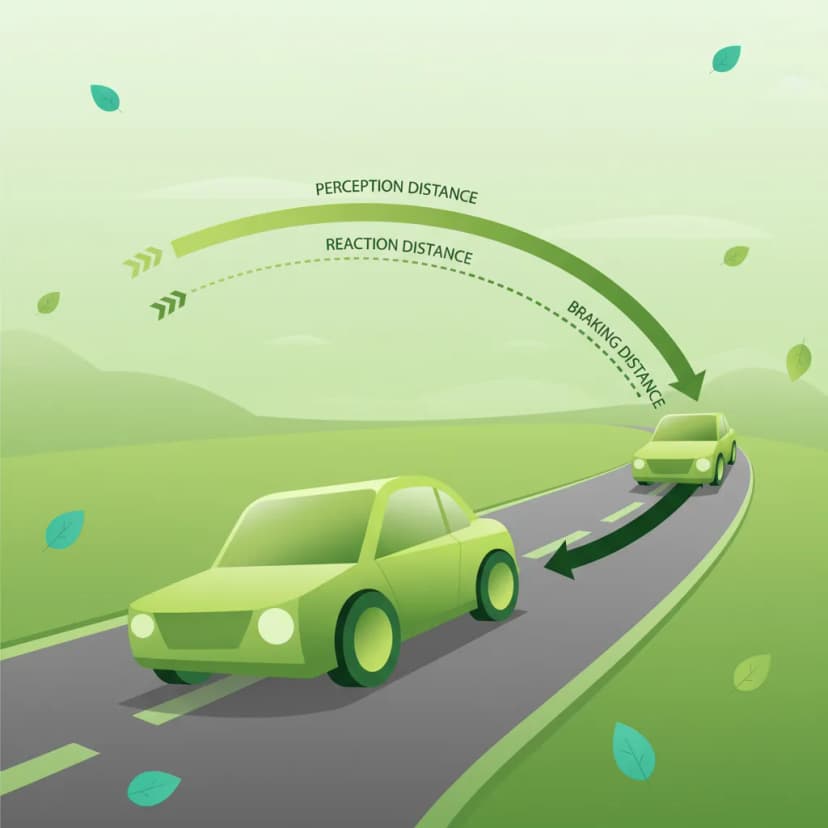
This lesson breaks down the concept of total stopping distance into its two key parts: the distance traveled during your reaction time and the distance the motorcycle travels after the brakes are applied. You will learn the formulas and rules of thumb for estimating these distances at various speeds. The content highlights how factors like rider fatigue, road surface conditions, and tyre quality can significantly increase your overall stopping distance.

This lesson focuses on how you must adapt your riding style when the motorcycle is heavily loaded. You will learn that your braking distances will be significantly longer, requiring you to increase your following distance and begin braking earlier. The content also explains that acceleration will be slower, and cornering will require smoother, more deliberate inputs to avoid upsetting the motorcycle's altered balance.
Understand how to adapt braking techniques to various road conditions like wet or gravel surfaces and learn about the role of ABS and preventing brake fade according to Dutch traffic regulations (RVV 1990).

This lesson explains the phenomenon of brake fade, a temporary loss of braking performance caused by overheating, and how to avoid it. It also details the essential maintenance and pre-ride inspection points for a motorcycle's braking system. Learners will understand how to check brake fluid levels, inspect brake pads for wear, and assess the overall condition of brake lines and levers to ensure the system is always in safe, working order.
This lesson provides a comprehensive guide to safe and effective deceleration on a motorcycle. You will learn the principles of controlled braking, including the progressive application of both the front and rear brakes to maximize stopping power while maintaining stability. The content also explains the role of engine braking in managing speed and how the Anti-lock Braking System (ABS) helps prevent wheel lock-up during hard braking.

This lesson explains the function of an Anti-lock Braking System (ABS) on a motorcycle, detailing how it prevents wheel lock-up during heavy braking, thereby allowing the rider to maintain steering control. It clarifies that while ABS is a powerful safety aid, it does not defy physics and may sometimes increase stopping distances on loose surfaces. The content teaches riders to trust the system and apply the brakes fully and firmly in an emergency, letting the ABS manage traction.
This lesson prepares you for a critical situation: performing a maximum-force emergency stop. You will learn the correct body posture and braking technique to stop in the shortest possible distance without losing control. The content provides a clear explanation of how ABS works by rapidly pulsing the brakes to prevent the wheels from locking, allowing you to maintain steering control even during a panic stop.

This lesson covers braking techniques beyond simply applying the brake levers. You will learn about the concept of engine braking (decelerating by releasing the throttle or downshifting) for controlled slowing. It also explains the function of an Anti-lock Braking System (ABS), a safety feature on some models that prevents wheels from locking during hard braking, allowing you to maintain steering control and reduce the chance of a skid.

This lesson explains the mechanical and hydraulic principles behind the common types of motorcycle brakes. It compares the operation and performance characteristics of disc brakes and drum brakes. The function of an Anti-lock Braking System (ABS) is also detailed, explaining how it prevents wheel lock-up during hard braking, thereby allowing the rider to maintain steering control and reduce stopping distances in many situations.
This lesson moves beyond basic braking to teach advanced techniques for optimal stopping performance. You will learn that the front brake provides the majority of your stopping power due to forward weight transfer, but that skillful application of the rear brake is crucial for stability. The content covers the concept of progressive braking—squeezing the levers smoothly—to manage traction and prevent wheel lock, especially on motorcycles without ABS.
This lesson focuses on the physical skill of an emergency stop, building on previous braking lessons. You will learn to adopt a braced body position, keeping your arms straight and looking ahead, not down. The content details the technique of applying both brakes rapidly but progressively to the point of maximum traction, and how to trust and utilize ABS if your motorcycle is equipped with it.
This lesson teaches the technique of progressive braking, which involves applying the brakes smoothly and gradually rather than abruptly. This method allows the motorcycle's weight to transfer forward in a controlled manner, compressing the front suspension and increasing the size of the front tire's contact patch. This, in turn, maximizes available grip and allows for harder, safer braking without unsettling the chassis or locking a wheel.
This lesson teaches the principles of performing a controlled emergency stop ('noodsremmen') to achieve the shortest possible stopping distance without losing control. It details the technique of applying both brakes firmly and progressively, managing the forward weight transfer, and maintaining an upright body posture to maximize braking efficiency. The content emphasizes braking in a straight line and looking ahead to where you want to stop, not at the obstacle.
Find clear answers to common questions learners have about Braking Techniques at High Speed (voor- en achterrem). Learn how the lesson is structured, which driving theory objectives it supports, and how it fits into the overall learning path of units and curriculum progression in the Netherlands. These explanations help you understand key concepts, lesson flow, and exam focused study goals.
During braking, weight shifts forward, loading the front suspension and thus the front tire. This allows the front brake to handle a significantly larger portion of the braking force, often up to 70-80%, for effective deceleration. The rear brake plays a supporting role and helps stabilize the motorcycle.
Applying the front brake too aggressively, especially at higher speeds or on poor surfaces, can overwhelm the front tire's grip. This can lead to the front wheel locking up, causing a skid and potentially a loss of control or a 'high-side' crash. Smooth, progressive application is key.
Braking distance increases exponentially with speed, not linearly. At higher speeds, you need to initiate braking earlier and apply brakes more progressively to manage the increased energy. The effects of weight transfer and tire grip also become more critical.
Yes, for maximum effectiveness and stability, you should generally use both brakes when stopping from high speed. The front brake provides the primary stopping force, while the rear brake assists and helps keep the motorcycle stable. The key is to apply them in a coordinated and progressive manner.
Counter-braking is a technique used primarily during cornering, not emergency stops. In emergency braking situations from high speed, the focus is on coordinated, progressive application of both brakes to maximize stopping power while maintaining stability, not on inducing a lean.