
Welcome to the Advanced Riding Techniques unit! This lesson focuses on Throttle Control and Power Delivery, a crucial skill for Category A motorcycle riders in the Netherlands. Mastering 'vermogenbeheer' is key to managing your motorcycle's power effectively, ensuring stability and traction, especially when navigating corners. This knowledge is vital for both passing your CBR theory exam and for safe, confident riding on Dutch roads.

Mastering throttle control, known as vermogenbeheer in Dutch, is fundamental for every Category A motorcycle rider. It's not merely about accelerating or decelerating; it's the art of harmonizing your motorcycle's power output with its dynamic stability and the prevailing road conditions. This advanced riding technique ensures optimal chassis balance, maximizes rear-wheel traction, and is crucial for safe, confident, and legally compliant motorcycling, especially when navigating corners or adjusting speed.
Effective vermogenbeheer allows you to precisely manage the power delivered to the rear wheel, preventing sudden, destabilizing forces that can lead to loss of control. It directly impacts your safety, the comfort of your ride, and your ability to comply with Dutch road traffic legislation, particularly regarding maintaining adequate control over your vehicle. This lesson will delve into the core principles, practical applications, and legal implications of fine-tuned throttle control.
Prerequisites for this Lesson: To fully grasp the concepts discussed here, you should be familiar with basic motorcycle dynamics, including traction, weight transfer, and suspension behavior. Prior knowledge from lessons on speed management, advanced braking techniques, and body positioning (such as "Body Positioning and Lean Angle Management," "Counter-Steering and Rapid Direction Changes," and "Corner Entry, Apex, and Exit Strategies") will also be beneficial. Additionally, familiarity with Dutch traffic law concepts like "safe operation" (Art. 8.1 Wegenverkeerswet 1990) and "adequate control of the vehicle" (Art. 7.5 Reglement Verkeersregels en Verkeerstekens 1990) is assumed.
Throttle control is the deliberate and progressive modulation of engine power to ensure that your motorcycle's longitudinal, lateral, and vertical dynamics remain in sync. Proper power delivery stabilizes the suspension system, maintains optimal rear-wheel grip, and allows for precise speed adjustments without over-relying on the friction brakes. This harmony is essential for smooth riding and avoiding dangerous situations.
The underlying logic for precise vermogenbeheer is rooted in both physics and safety. Sudden changes in power generate abrupt torque spikes that can easily exceed the limits of tire adhesion, leading to dangerous wheel-spin or unsettling the chassis. Conversely, progressive throttle application reduces differential torque, limiting rapid weight transfer and allowing the suspension to absorb and distribute forces evenly across both wheels. From a legal standpoint, Dutch traffic law mandates that every driver operates a vehicle "in a manner that does not endanger other road users" (Art. 8.1 Wegenverkeerswet 1990). Controlled power delivery is a direct manifestation of this fundamental duty.
Progressive throttle application is the gradual increase of the throttle opening from a low or closed position to the desired level, executed over a period sufficient to allow the motorcycle’s dynamics to adjust smoothly. This technique is crucial for maintaining control and stability during acceleration. It ensures that the torque delivered to the rear wheel does not exceed the available traction, preventing unwanted wheel-spin or sudden weight transfer that can unsettle the chassis.
When exiting a corner, for example, a rider should gently "roll on" the throttle, gradually increasing power while feeling for the rear wheel's grip threshold. This is opposed to "snapping" the throttle open, which can cause an immediate and potentially dangerous loss of traction. This careful modulation helps to progressively load the rear tire, improving grip as the bike moves towards an upright position.
Common Misunderstanding: Many new riders mistakenly believe that "full throttle equals quicker exit" from a corner. In reality, abrupt throttle application often leads to wheel-spin, loss of control, and a slower, less safe exit as the rider struggles to regain stability. It also risks violating the legal duty to operate the vehicle safely (Art. 8.1 Wegenverkeerswet 1990).
Maintenance throttle, also known as steady throttle through a turn, involves holding a constant, modest throttle input while navigating a curve. This input should be just enough to maintain momentum and prevent the motorcycle from disrupting its balance, without either accelerating sharply or decelerating significantly. This technique provides a continuous, subtle drive to the rear wheel, which helps to stabilize the chassis and prevent speed decay that would necessitate sudden braking or acceleration later.
Maintaining a steady throttle input through a corner reduces unnecessary brake usage, preserves tire grip across the entire contact patch, and minimizes fluctuations in lean angle. For instance, when riding through a long, sweeping corner on a motorway, keeping a steady throttle allows the rider to maintain momentum smoothly, preparing for the next straight section without unsettling the motorcycle.
Crucial Point: Avoiding throttle entirely in a corner (coasting) can lead to instability. A controlled, steady throttle often results in a more stable trajectory than coasting or braking, as it keeps the suspension loaded and the tires engaged with the road surface.
Engine braking is the deceleration force produced by closing or partially closing the throttle, which causes the engine's resistance to forward motion to increase. This effectively slows the motorcycle without directly applying the friction brakes. Engine braking is an invaluable technique for controlling speed, preserving the temperature and effectiveness of your friction brakes, smoothing deceleration, and aiding in chassis stabilization.
When approaching a stop sign, for example, a rider can progressively reduce throttle, allowing the engine's natural resistance to slow the bike down while maintaining rear-wheel traction. This method reduces wear on brake pads and rotors and can be particularly effective on long descents or in heavy traffic where repeated friction braking might lead to overheating.
Important Caution: Excessive engine braking, especially when combined with a sudden downshift or on low-grip surfaces (like wet roads or gravel), can lead to rear-wheel lock-up and a loss of control. Always manage engine braking progressively and be mindful of available traction.
Traction management is the ongoing process of balancing the engine's applied torque with the available friction between the tires and the road surface. The goal is to prevent wheel-spin, skidding, or any loss of directional control. This skill is paramount for maximizing usable grip and avoiding sudden traction loss, which can have severe consequences.
When accelerating out of a corner, for instance, a skilled rider will gently increase throttle until they feel a slight indication of rear-wheel slip. At this point, they will slightly reduce throttle input to stay just within the limits of available traction. This continuous feedback loop of feel and adjustment is vital for safe and efficient riding.
Suspension stabilization via power delivery involves synchronizing your throttle input with the motorcycle's suspension travel to avoid sudden load spikes that could destabilize the chassis. The engine's torque profoundly influences how the suspension behaves, particularly the rear suspension. Smooth, controlled power application helps to distribute forces evenly across the front and rear wheels, preventing chassis oscillation and improving overall ride quality and predictable handling.
For example, when accelerating sharply on a sportbike with a stiff rear spring, a rider might momentarily 'pre-load' the rear suspension (by gently applying the rear brake for an instant before opening the throttle) to soften the initial shock of torque delivery. This subtle technique helps the suspension to absorb the forces more effectively, maintaining a stable and controlled posture.
Effective throttle control is not just a matter of advanced riding technique; it is a legal requirement under Dutch traffic law. Riders are expected to operate their motorcycles in a manner that is safe, controlled, and does not pose a risk to other road users.
Even experienced riders can sometimes make mistakes with throttle control, but being aware of common pitfalls can significantly improve safety.
Motorcycle throttle control is not a one-size-fits-all skill. It requires constant adaptation based on prevailing environmental and vehicle conditions.
Understanding the physics and human factors involved in throttle control can deepen a rider's appreciation for its importance.
Let's explore some real-world situations where effective throttle control makes a critical difference.
Setting: You are taking a 30 km/h right-hand turn on a city street with dry pavement and moderate traffic. Decision Point: How to apply throttle upon exiting the corner to accelerate smoothly.
Setting: You are on a motorway with a 5% downhill gradient, traveling at 80 km/h, and the road is wet due to rain. You need to reduce speed for an upcoming exit ramp. Decision Point: How to reduce speed effectively and safely for the exit.
Setting: You are riding through a series of fast, 100 km/h sweeps on a mountain pass. The surface is dry but a bit dusty. Decision Point: How to maintain speed and stability through successive bends.
Setting: You are on a rural two-lane road, approaching a cyclist traveling at 30 km/h while you are at 50 km/h. Decision Point: How to adjust your speed safely before initiating the overtaking maneuver.
Setting: You are on a city straight with a motorcycle carrying a passenger and luggage, preparing to accelerate from a stop to join traffic. Decision Point: How to accelerate smoothly and safely given the increased weight.
Throttle control, or vermogenbeheer, is a critical skill for any Category A motorcycle rider in the Netherlands. It involves the intentional and precise modulation of engine power to maintain stability, optimize traction, and regulate speed safely and effectively.
The core elements of effective vermogenbeheer include:
Key Legal and Safety Considerations:
Practical Riding Practices:
Contextual Adjustments are Essential:
Mastery of vermogenbeheer is not merely about technical skill; it's about developing a deeper connection with your motorcycle's dynamics, understanding the physics of riding, and upholding your legal and ethical responsibilities as a road user. It is a fundamental building block for advanced riding techniques and a cornerstone of safe motorcycling on Dutch roads and beyond.
Lesson content overview
Explore all units and lessons included in this driving theory course.
Explore search topics learners often look for when studying Throttle Control and Power Delivery (vermogenbeheer). These topics reflect common questions about road rules, driving situations, safety guidance, and lesson level theory preparation for learners in the Netherlands.
Browse additional driving theory lessons that cover connected traffic rules, road signs, and common driving situations related to this topic. Improve your understanding of how different rules interact across everyday traffic scenarios.
Explore advanced techniques for motorcycle throttle control (vermogenbeheer) to enhance stability, manage power delivery, and optimize traction. Essential for safe cornering and ride dynamics in Dutch traffic law.

This lesson focuses on the critical skill of throttle control, which directly influences the motorcycle's stability and traction. It covers the techniques for smooth roll-on and roll-off of the throttle to prevent abrupt weight shifts and potential loss of grip. Learners will understand the relationship between throttle input, engine response, and power delivery to the rear wheel, a concept essential for safe riding in all conditions, especially during cornering and on wet surfaces.

This lesson provides a comprehensive guide to safe and effective deceleration on a motorcycle. You will learn the principles of controlled braking, including the progressive application of both the front and rear brakes to maximize stopping power while maintaining stability. The content also explains the role of engine braking in managing speed and how the Anti-lock Braking System (ABS) helps prevent wheel lock-up during hard braking.

This lesson provides theoretical knowledge on how to manage a loss of traction, covering both rear-wheel and the more critical front-wheel skids. It explains the typical causes, such as harsh braking or acceleration, and the correct, often counter-intuitive, recovery inputs. The importance of looking in the desired direction of travel to avoid target fixation and using smooth, measured controls to help the tires regain grip is strongly emphasized.

This lesson addresses the specific challenge of cornering when road grip is compromised. It teaches riders how to identify potential low-traction surfaces like wet manhole covers, painted lines, gravel, or oil patches. The content focuses on techniques to mitigate risk, such as reducing speed, minimizing lean angle, and applying all control inputs—braking, steering, and throttle—with exceptional smoothness to avoid overwhelming the available grip.

This lesson focuses on the specific skills needed to maintain balance and control while riding at very low speeds, such as when filtering between lanes of slow-moving or stationary traffic. It details the coordinated use of the clutch friction zone, gentle throttle, and light application of the rear brake to achieve maximum stability. Proper upright posture and keeping your head up to scan for hazards are also emphasized as key components of safe filtering.
This lesson focuses on managing the unique acceleration characteristics of a 35 kW A2 motorcycle. You will learn about the relationship between engine power, torque, and acceleration, and how to apply throttle smoothly to maintain traction and stability. The content provides techniques for effective gear selection to ensure you have responsive power when needed for overtaking, while also preventing jerky or uncontrolled acceleration.

This lesson explains the function of the clutch and gearbox in managing the motorcycle's power and speed. It details the correct techniques for upshifting and downshifting, including the concept of rev-matching for smoother transitions. The principles of engine braking are also covered, illustrating how releasing the throttle in gear provides controlled deceleration, which is a key skill for managing speed and reducing brake wear.

Controlling a two-wheeled vehicle at very low speeds is a challenging but essential skill. This lesson focuses on the delicate interplay between the clutch, throttle, and rear brake to maintain balance and control without putting your feet down. You will learn the techniques for a smooth take-off from a standstill and how to come to a gentle, controlled stop, which are fundamental skills for navigating city traffic and junctions safely.
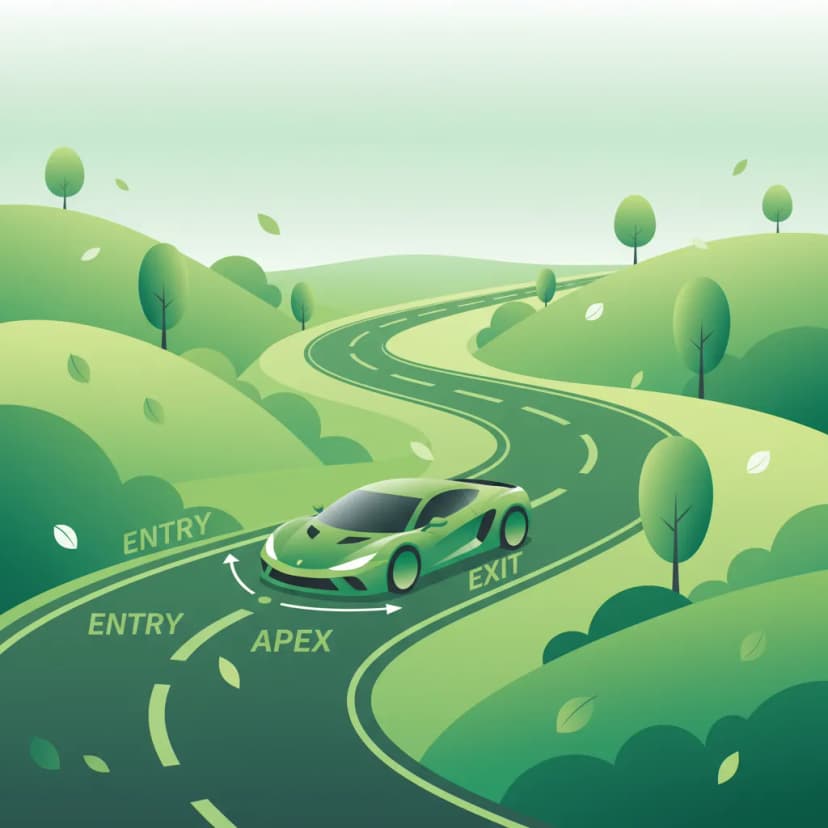
This lesson teaches a systematic approach to cornering by breaking it down into three distinct phases: entry, apex, and exit. It explains how to choose the correct road position and entry speed, identify the safest apex (not always the geometric one), and apply the throttle smoothly on exit to maximize stability and safety. This 'slow in, fast out' methodology provides a structured, repeatable process for navigating any corner with confidence and control.

This lesson prepares you for the challenge of riding in strong winds. You will learn to anticipate areas prone to gusts, such as exiting a tunnel or passing a large truck. The content explains how to maintain a relaxed grip on the handlebars and use subtle counter-steering inputs and body lean to counteract the force of the wind, keeping the motorcycle on its intended path.
Understand the principles of engine braking, effective traction management, and the specific Dutch traffic laws that govern motorcycle power delivery and rider responsibility for safe vehicle control.
This lesson provides a comprehensive guide to safe and effective deceleration on a motorcycle. You will learn the principles of controlled braking, including the progressive application of both the front and rear brakes to maximize stopping power while maintaining stability. The content also explains the role of engine braking in managing speed and how the Anti-lock Braking System (ABS) helps prevent wheel lock-up during hard braking.
This lesson explains the function of the clutch and gearbox in managing the motorcycle's power and speed. It details the correct techniques for upshifting and downshifting, including the concept of rev-matching for smoother transitions. The principles of engine braking are also covered, illustrating how releasing the throttle in gear provides controlled deceleration, which is a key skill for managing speed and reducing brake wear.
This lesson focuses on managing the unique acceleration characteristics of a 35 kW A2 motorcycle. You will learn about the relationship between engine power, torque, and acceleration, and how to apply throttle smoothly to maintain traction and stability. The content provides techniques for effective gear selection to ensure you have responsive power when needed for overtaking, while also preventing jerky or uncontrolled acceleration.
This lesson focuses on the critical skill of throttle control, which directly influences the motorcycle's stability and traction. It covers the techniques for smooth roll-on and roll-off of the throttle to prevent abrupt weight shifts and potential loss of grip. Learners will understand the relationship between throttle input, engine response, and power delivery to the rear wheel, a concept essential for safe riding in all conditions, especially during cornering and on wet surfaces.

This lesson outlines the rider's responsibility for ensuring their motorcycle's engine and exhaust system comply with Dutch legal standards. It covers basic but vital pre-ride checks, such as verifying engine oil and coolant levels. A significant focus is placed on exhaust compliance, explaining the regulations regarding noise levels ('geluidseisen') and the rules surrounding aftermarket exhaust systems, including the requirement for approved markings and the use of 'dB-killers'.

This lesson teaches the technique of progressive braking, which involves applying the brakes smoothly and gradually rather than abruptly. This method allows the motorcycle's weight to transfer forward in a controlled manner, compressing the front suspension and increasing the size of the front tire's contact patch. This, in turn, maximizes available grip and allows for harder, safer braking without unsettling the chassis or locking a wheel.

This lesson provides a detailed breakdown of high-speed braking techniques, emphasizing the correct balance and application of the front ('voorrem') and rear ('achterrem') brakes. It explains the physics of weight transfer under braking and why the front brake provides the majority of stopping power. Techniques for progressive, smooth application to avoid overloading the front tire and losing traction are covered, ensuring riders can slow down quickly and safely from any speed.
This lesson covers the mandatory lighting and signaling equipment for A2 motorcycles under Dutch law, ensuring you remain visible and communicate your intentions correctly. You will learn the rules for using headlights, taillights, turn signals, and brake lights in various conditions, including daytime and adverse weather. The content also addresses the importance of maintaining this equipment and using hand signals as a valid secondary method of communication in traffic.

This lesson covers braking techniques beyond simply applying the brake levers. You will learn about the concept of engine braking (decelerating by releasing the throttle or downshifting) for controlled slowing. It also explains the function of an Anti-lock Braking System (ABS), a safety feature on some models that prevents wheels from locking during hard braking, allowing you to maintain steering control and reduce the chance of a skid.

This lesson addresses the unique challenges and characteristics of riding large displacement, heavy motorcycles ('grote motoren'). It covers techniques for managing their significant mass during slow-speed maneuvers, such as U-turns, and strategies for smoothly applying their high power and torque without losing traction. The content helps riders build confidence by understanding how to work with the bike's weight and power, rather than fighting against them, ensuring both safety and enjoyment.
Find clear answers to common questions learners have about Throttle Control and Power Delivery (vermogenbeheer). Learn how the lesson is structured, which driving theory objectives it supports, and how it fits into the overall learning path of units and curriculum progression in the Netherlands. These explanations help you understand key concepts, lesson flow, and exam focused study goals.
'Vermogenbeheer' translates to power management or throttle control. It refers to the precise and nuanced way a rider operates the throttle to control the engine's power output. This is crucial for maintaining stability, traction, and controlling speed, especially during cornering and acceleration phases.
Smooth throttle application when exiting a corner helps maintain consistent forward drive and prevents sudden weight transfer to the rear, which can destabilize the chassis. It allows the suspension to work effectively and maximizes rear-wheel traction, reducing the risk of a slide or low-side crash.
Engine braking occurs when you downshift and release the clutch, using the engine's resistance to slow the motorcycle. It's a controlled way to reduce speed without excessive use of the brakes, especially useful when approaching a corner. It helps maintain stability and prepares the bike for the turn.
Yes, throttle control significantly affects lean angle and stability during cornering. A steady or slightly increasing throttle (maintenance throttle) helps keep the bike stable and upright during the lean, while abrupt changes can upset the balance and reduce traction.
Yes, the CBR Category A theory exam includes questions that assess your understanding of fundamental motorcycle control principles. These often relate to how throttle inputs affect stability, traction, and speed management in various scenarios, including cornering.