
Welcome to the lesson on Acceleration Management and Power Limitation for your A2 motorcycle license. This section delves into how to effectively manage the power of your 35 kW motorcycle, a critical aspect for both safety and passing your Dutch CBR theory exam. Understanding these principles will help you navigate traffic situations confidently.
Welcome to this in-depth lesson on acceleration management and the crucial 35 kW power limitation for Category A2 motorcycles in the Netherlands. As a rider preparing for your Dutch motorcycle license, understanding how to control your bike's acceleration is paramount for safety, stability, and compliance with legal requirements. This lesson will equip you with the knowledge to manage the unique characteristics of an A2 motorcycle, ensuring you can apply throttle smoothly, maintain traction, and ride confidently in all conditions.
We will explore the relationship between engine power, torque, and acceleration, and delve into practical techniques for effective gear selection and throttle modulation. Proper acceleration control is not just about speed; it's about maintaining balance, preventing loss of control, and responding safely to changing road conditions and traffic situations. This knowledge builds upon your understanding of speed management and deceleration techniques, and forms a critical foundation for advanced riding skills like cornering and emergency manoeuvres.
The Category A2 motorcycle license in the Netherlands, governed by national and European regulations, comes with specific power restrictions designed to ensure the safety of less-experienced riders. These limitations cap the kinetic energy that can be delivered by the motorcycle, thereby reducing its maximum acceleration potential.
For your A2 license, your motorcycle must not have a maximum continuous power output exceeding 35 kilowatts (kW). This is approximately equivalent to 47 horsepower (hp). This isn't just a recommendation; it's a legal requirement enforced by Dutch regulation (RVV 1990, Article 19 (1)). The term "continuous power" refers to the sustained output of the engine, meaning that even if an engine can produce higher peak power momentarily, it must be restricted to 35 kW for continuous operation. This restriction fundamentally limits how quickly your motorcycle can accelerate and reach higher speeds.
Definition: Continuous Power refers to the engine output that can be sustained over an extended period without overheating or causing damage. For A2 motorcycles, this value must not exceed 35 kW.
To ensure compliance with the 35 kW continuous power limit, most A2-compliant motorcycles, especially those derived from higher-power models, are fitted with Power Limitation Devices (PLDs). These devices electronically or mechanically restrict the engine's output.
There are various types of PLDs:
It is crucial that any PLD is permanently installed and tamper-proof. Removing or re-programming a limiter to gain extra power invalidates your A2 license usage and can lead to severe legal consequences, including fines and license suspension. While a PLD prevents the engine from exceeding 35 kW, it does not automatically guarantee safe acceleration on all surfaces. The rider still has primary responsibility for managing throttle and gear selection.
In addition to the absolute power limit, Dutch law also specifies a power-to-weight ratio (PWR) limit for A2 motorcycles: it must not exceed 0.2 kW per kilogram (kg) (RVV 1990, Article 19 (2)). This ratio considers the motorcycle's total mass, including the rider, passenger, fuel, and any luggage.
The ratio of a motorcycle’s maximum power (kW) to its total mass (kg). For A2 motorcycles, this ratio must not exceed 0.2 kW/kg.
This second safety metric is vital because a lighter motorcycle, even with 35 kW, can accelerate much faster than a heavier one. By capping the PWR, the law further ensures that the acceleration potential remains within safe limits for less-experienced riders. When riding with a passenger or heavy luggage, you must be aware that the effective PWR of your motorcycle increases, potentially pushing it closer to or even over the legal limit. This requires an adjustment in your riding style, demanding even more cautious throttle control.
To effectively manage acceleration, a fundamental understanding of the physics involved is essential. This includes the interplay of engine output, gear selection, and the critical concept of traction.
While often used interchangeably, power and torque are distinct but related concepts:
Your A2 motorcycle's 35 kW limit applies to its continuous power. However, how that power is delivered through torque at the rear wheel is what directly impacts acceleration and, crucially, traction. An engine produces varying torque at different RPMs, often represented by a "torque curve." Understanding where your bike produces peak torque helps you choose the right gear for responsive acceleration without over-stressing the tyres.
Your motorcycle's gearbox is a critical tool for managing acceleration. It uses different gear ratios to convert engine torque into wheel torque.
Choosing the appropriate gear is about matching the engine's torque output to the desired road speed and acceleration. In a low gear, even a small throttle opening can generate substantial torque at the rear wheel, potentially exceeding traction limits. In a higher gear, you'll need more throttle opening to achieve similar acceleration, as the torque multiplication is lower.
Traction is the frictional grip between your motorcycle's tyres and the road surface. It's the maximum force your tyres can transmit to the road before they start to slide. Without traction, you cannot accelerate, brake, or corner safely.
The slip ratio describes the relative difference between the wheel's rotational speed and the vehicle's actual forward speed.
For optimal acceleration, a small amount of slip is actually desirable, typically in the range of 8-15%. This "dynamic traction" allows the tyre tread to deform and grip the road more effectively. However, exceeding this optimal slip ratio leads to excessive wheel spin, which reduces the effective forward force and can cause a loss of control. Factors like road surface (dry, wet, gravel), tyre condition, and load significantly affect the available traction.
Mastering acceleration on your A2 motorcycle involves precise control of both the throttle and gear changes. These techniques ensure smooth power delivery, preserve traction, and enhance stability.
Throttle modulation is the art of gradually increasing or decreasing the throttle opening to control engine torque output smoothly. Abrupt throttle inputs can lead to sudden torque spikes that overwhelm the rear tyre's grip, especially on low-traction surfaces.
Key techniques for smooth throttle modulation include:
Practice Smoothness: Practice gentle throttle application in a safe, open area. Focus on feeling the connection between your wrist, the engine response, and the motorcycle's movement.
The correct gear selection is integral to effective throttle management. It helps you manage the amount of torque delivered to the rear wheel.
Adhering to legal regulations and applying sound safety principles are paramount for every A2 rider.
The regulations concerning A2 motorcycles in the Netherlands are strict and designed for your safety and the safety of other road users.
Beyond these specific A2 rules, the general traffic safety regulation RVV 1990 – Article 12 dictates that drivers must not operate a vehicle in a manner that endangers road users. Reckless acceleration that causes wheel spin or loss of control falls under this general duty of care.
Many accidents or near-misses related to acceleration stem from common rider errors:
Effective acceleration management is highly dependent on the riding environment. You must adjust your techniques based on weather, road type, lighting, and vehicle load.
Reduced visibility, such as at night or in fog, affects your perception of speed and distance. In such conditions, adopt a more conservative approach to acceleration. Gentle, predictable increases in speed are safer than rapid bursts, giving you more time to react to unseen hazards.
When accelerating near pedestrians, cyclists, or other motorcyclists, always be mindful of their presence. Maintain safe following distances and avoid aggressive acceleration that could startle them or cause a chain-reaction incident. Your acceleration should always be predictable and controlled.
Every action you take with the throttle and gears has direct and secondary effects that culminate in a specific overall outcome.
| Action | Direct Effect | Secondary Effect | Overall Outcome |
|---|---|---|---|
| Smooth throttle increase | Gradual rise in engine torque | Wheel slip remains within optimal limits | Stable forward acceleration, rider confidence, lower accident risk. |
| Abrupt full-throttle in low gear | Sudden, high torque at rear wheel | Exceeds tyre-road friction, leading to wheel spin | Loss of traction, possible fall, increased hazard to surrounding traffic. |
| Shifting up too early (low RPM) | Engine operates outside power band | Insufficient acceleration, engine labours | Poor overtaking capability, higher engine wear, less efficient fuel consumption. |
| Neglecting A2 power limiter | Engine delivers > 35 kW | Acceleration capability beyond legal and safe limits | Violation of law, higher crash severity, potential licence loss. |
| Riding with overloaded bike | Increased effective PWR | Lower traction margin, greater torque for same acceleration | Higher likelihood of wheel spin, increased braking distance, instability. |
| Correct gear for road gradient | Engine torque matched to road load | Maintains traction on inclines/declines | Smooth climb or descent, reduced need for corrective braking. |
| Using rear brake to aid stability on low-grip surfaces (advanced) | Transfers load to front wheel, improves rear traction | Allows slightly higher throttle without wheel spin | Controlled acceleration, stable handling in challenging conditions. |
Let's look at a few common riding scenarios and how to apply the principles of acceleration management.
Setting: You are riding at 30 km/h on a wet, two-lane city road with light traffic. You are alone on your A2 motorcycle and wish to overtake a slower car on the right lane.
Decision Point: How to accelerate safely to overtake.
Correct Behaviour:
Incorrect Behaviour: Snapping the throttle to full in 1st gear. This would almost certainly cause the rear wheel to spin out of control on the wet surface, leading to a skid or even a fall, and potentially a collision with the vehicle you are trying to overtake.
Setting: You are entering an autosnelweg (motorway) at 80 km/h, with a passenger, bringing your total laden weight to 180 kg. Your motorcycle has its 35 kW limiter.
Decision Point: You need to accelerate to 110 km/h to merge safely onto the fast lane.
Correct Behaviour:
Incorrect Behaviour: Abruptly twisting to full throttle in 2nd gear. The combined effect of high torque multiplication from the low gear and the increased PWR from the passenger would likely cause wheel spin, making it impossible to merge safely and creating a significant hazard for other vehicles.
Setting: You are in a parking lot, and the surface is still wet after heavy rain. You have a passenger.
Decision Point: Starting from a standstill.
Correct Behaviour:
Incorrect Behaviour: Pulling the throttle to a moderate or full opening right away. This would almost certainly cause the rear wheel to lose traction and spin excessively, potentially leading to a low-speed fall, especially with the added instability of a passenger.
Mastering acceleration management and understanding the 35 kW power limitation is crucial for your Dutch A2 motorcycle license. Here's a recap of the essential points:
By integrating these principles, you will develop the precise control necessary to operate your A2 motorcycle safely and confidently on Dutch roads, mastering the dynamic interplay of power, torque, and traction.
Lesson content overview
Explore all units and lessons included in this driving theory course.
Explore search topics learners often look for when studying Acceleration Management and Power Limitation (35 kW). These topics reflect common questions about road rules, driving situations, safety guidance, and lesson level theory preparation for learners in the Netherlands.
Browse additional driving theory lessons that cover connected traffic rules, road signs, and common driving situations related to this topic. Improve your understanding of how different rules interact across everyday traffic scenarios.
Explore the interplay of engine power, torque, and gear selection for A2 motorcycles. Learn how these dynamics affect acceleration and how to manage them safely on Dutch roads according to theory.

This lesson focuses on the critical skill of throttle control, which directly influences the motorcycle's stability and traction. It covers the techniques for smooth roll-on and roll-off of the throttle to prevent abrupt weight shifts and potential loss of grip. Learners will understand the relationship between throttle input, engine response, and power delivery to the rear wheel, a concept essential for safe riding in all conditions, especially during cornering and on wet surfaces.

This lesson explains the function of the clutch and gearbox in managing the motorcycle's power and speed. It details the correct techniques for upshifting and downshifting, including the concept of rev-matching for smoother transitions. The principles of engine braking are also covered, illustrating how releasing the throttle in gear provides controlled deceleration, which is a key skill for managing speed and reducing brake wear.

This lesson details the precise technical and legal definitions distinguishing Category A motorcycles from other vehicle classes in the Netherlands. It explores key parameters such as engine capacity, minimum power output, and power-to-weight ratios, clarifying how these factors dictate licensing requirements for unrestricted bikes. Learners will also gain insight into the European harmonisation of motorcycle categories and its implications for vehicle registration and cross-border travel.

This lesson explains the precise legal definition of a Category A1 motorcycle, including the maximum 125cc displacement and 11 kW power output. It outlines the entire CBR licensing pathway, from meeting the minimum age requirement to passing both the theory and practical exams. Key administrative obligations such as vehicle registration (kenteken), mandatory insurance, and roadworthiness inspections (APK) are also detailed, ensuring a full understanding of legal compliance.

This lesson provides a comprehensive guide to safe and effective deceleration on a motorcycle. You will learn the principles of controlled braking, including the progressive application of both the front and rear brakes to maximize stopping power while maintaining stability. The content also explains the role of engine braking in managing speed and how the Anti-lock Braking System (ABS) helps prevent wheel lock-up during hard braking.

This lesson focuses on the fine art of throttle control ('vermogenbeheer'), which is critical for managing the power of a Category A motorcycle and maintaining chassis stability. It explains how smooth, progressive throttle application stabilizes the suspension and maximizes rear-wheel traction, particularly when exiting a corner. The concept of 'maintenance throttle' through a turn and the use of engine braking for speed regulation are also covered in detail.
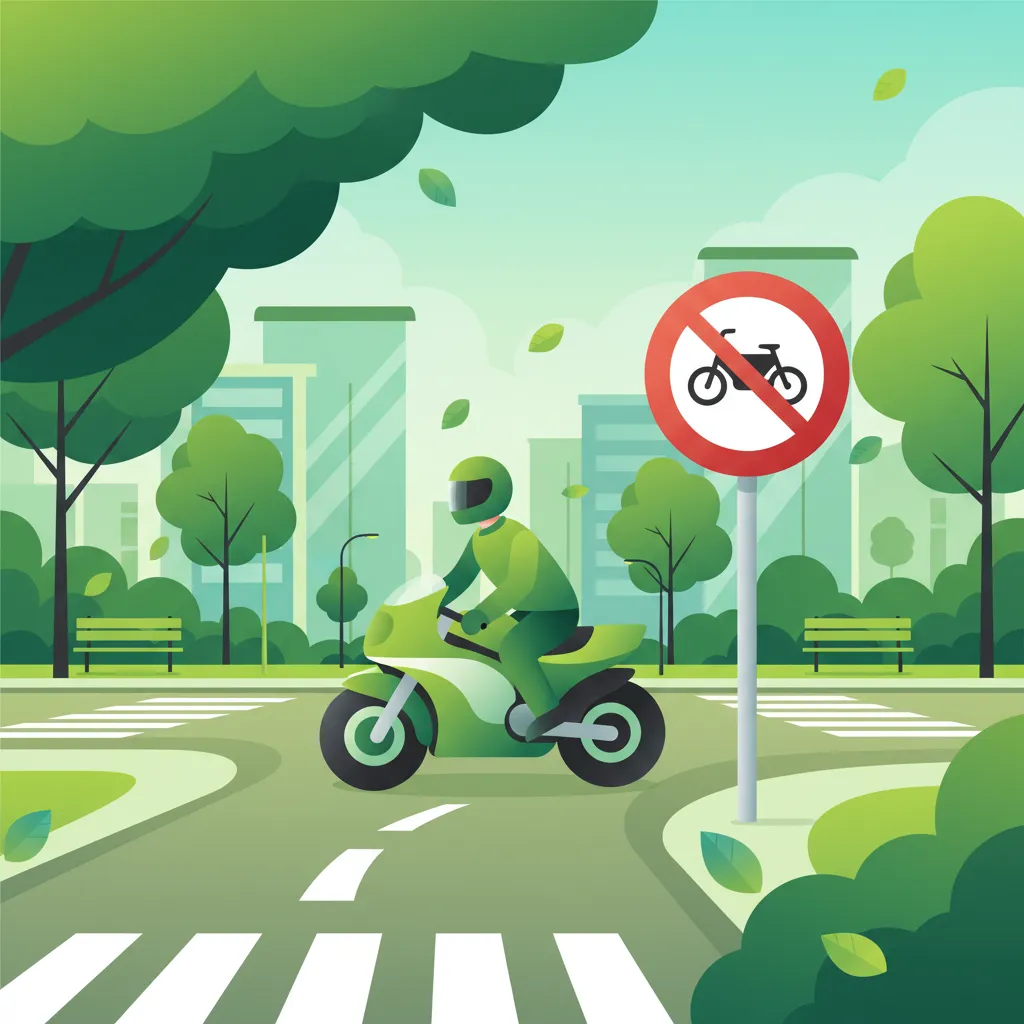
This lesson focuses on Dutch regulatory signs that enforce mandatory rules and restrictions, particularly those impacting A2 motorcyclists. You will learn to recognize and obey prohibition signs, such as those indicating a motorcycle ban (BORD 40), speed limits, and overtaking restrictions (BORD 21). The content explains the legal consequences of non-compliance and how to apply these rules in practical riding scenarios to ensure full adherence to Dutch traffic law.

This lesson details the interpretation of Dutch warning signs, which alert riders to potential dangers and changing road conditions. You will study signs indicating sharp curves, road narrowing (BORD 30), and temporary hazards like road works (BORD 36), learning to adjust speed and road position proactively. The content emphasizes how the A2 motorcycle's characteristics require earlier hazard recognition and response compared to other vehicles for maintaining control.

This lesson focuses on how you must adapt your riding style when the motorcycle is heavily loaded. You will learn that your braking distances will be significantly longer, requiring you to increase your following distance and begin braking earlier. The content also explains that acceleration will be slower, and cornering will require smoother, more deliberate inputs to avoid upsetting the motorcycle's altered balance.
This lesson focuses on the specific skills required for managing speed on high-speed highways (autosnelwegen). You will learn the correct technique for accelerating on the on-ramp to smoothly merge with traffic flow. The content covers how to choose an appropriate cruising speed, maintain a safe following distance, and manage the aerodynamic effects of wind and turbulence from larger vehicles at high speeds.
Learn to identify and avoid common acceleration hazards on your A2 motorcycle. This lesson covers essential techniques for maintaining traction and control in various conditions, aligning with Dutch theory exam requirements.

This lesson prepares you to deal with sudden changes in road surface that can cause a loss of traction. You will learn to scan for these hazards and, if they cannot be avoided, how to ride over them safely. The key technique is to keep the motorcycle upright and maintain smooth, steady control inputs—no abrupt braking, accelerating, or steering—to minimize the risk of a skid.
This lesson focuses on the critical skill of throttle control, which directly influences the motorcycle's stability and traction. It covers the techniques for smooth roll-on and roll-off of the throttle to prevent abrupt weight shifts and potential loss of grip. Learners will understand the relationship between throttle input, engine response, and power delivery to the rear wheel, a concept essential for safe riding in all conditions, especially during cornering and on wet surfaces.
This lesson provides a comprehensive guide to safe and effective deceleration on a motorcycle. You will learn the principles of controlled braking, including the progressive application of both the front and rear brakes to maximize stopping power while maintaining stability. The content also explains the role of engine braking in managing speed and how the Anti-lock Braking System (ABS) helps prevent wheel lock-up during hard braking.

This lesson teaches the crucial skill of assessing road surfaces and adjusting speed accordingly to maintain maximum traction. It covers a variety of hazardous conditions, including wet asphalt, loose gravel, oil patches, metal manhole covers, and painted road markings, all of which can significantly reduce grip. Riders will learn to constantly scan the road ahead, identify potential traction-reducing surfaces, and proactively manage their speed to prevent slides and loss of control.
This lesson focuses on the specific skills required for managing speed on high-speed highways (autosnelwegen). You will learn the correct technique for accelerating on the on-ramp to smoothly merge with traffic flow. The content covers how to choose an appropriate cruising speed, maintain a safe following distance, and manage the aerodynamic effects of wind and turbulence from larger vehicles at high speeds.

Riding on two wheels requires special care on surfaces with reduced grip. This lesson teaches you how to handle challenging conditions like rain, ice, wet leaves, or tram tracks. Key principles include reducing speed significantly, making all control inputs (braking, accelerating, steering) much more smoothly and gradually, and increasing your following distance to allow for much longer stopping distances. Recognizing potentially slippery areas is a critical part of proactive hazard perception.
This lesson details the interpretation of Dutch warning signs, which alert riders to potential dangers and changing road conditions. You will study signs indicating sharp curves, road narrowing (BORD 30), and temporary hazards like road works (BORD 36), learning to adjust speed and road position proactively. The content emphasizes how the A2 motorcycle's characteristics require earlier hazard recognition and response compared to other vehicles for maintaining control.

This lesson explains the physics of why wet roads offer significantly less traction than dry ones, highlighting particular hazards like the first rain after a dry spell. It defines aquaplaning (when a tire rides on a layer of water instead of the road) and explains how speed and tire condition contribute to this dangerous phenomenon. The content provides clear strategies for riding in the rain, including reducing speed and applying all controls with extra smoothness.

This lesson provides a detailed guide to riding in wet and low-visibility conditions. You will learn to make all your control inputs—braking, accelerating, and steering—exceptionally smooth to avoid breaking traction on slippery surfaces. The content covers the dangers of painted lines and manhole covers when wet, and the importance of increasing your following distance dramatically to account for longer braking distances.

This lesson addresses the specific challenge of cornering when road grip is compromised. It teaches riders how to identify potential low-traction surfaces like wet manhole covers, painted lines, gravel, or oil patches. The content focuses on techniques to mitigate risk, such as reducing speed, minimizing lean angle, and applying all control inputs—braking, steering, and throttle—with exceptional smoothness to avoid overwhelming the available grip.
Find clear answers to common questions learners have about Acceleration Management and Power Limitation (35 kW). Learn how the lesson is structured, which driving theory objectives it supports, and how it fits into the overall learning path of units and curriculum progression in the Netherlands. These explanations help you understand key concepts, lesson flow, and exam focused study goals.
The 35 kW (approximately 47 hp) power limit means your motorcycle's engine output is restricted. This affects how quickly it can accelerate, especially compared to unrestricted bikes. You need to select the correct gear to ensure sufficient power is available for overtaking or merging, without exceeding the bike's performance capabilities or your own control limits.
Choosing the right gear is crucial for effective acceleration. Lower gears provide more torque and quicker acceleration from a standstill or at low speeds, ideal for quick manoeuvres. Higher gears are for cruising and efficiency, offering less rapid acceleration. For overtaking, you'll often need to downshift to a lower gear to access the motorcycle's available power band.
A common mistake is expecting the same acceleration as a more powerful motorcycle, leading to misjudging overtaking gaps. Others include jerky throttle application, which can unsettle the bike, or being in too high a gear, resulting in sluggish acceleration when needed. This lesson helps you anticipate and avoid these errors.
The CBR theory exam includes questions on vehicle dynamics, safe riding techniques, and understanding speed and power. Understanding how to manage your A2 motorcycle's acceleration is directly tested, particularly in scenarios involving overtaking, merging, and general road safety for this specific license category.
While the 35 kW limit is a legal restriction, proper management of throttle, gear selection, and understanding your bike's power band can maximize its performance. This lesson focuses on *managing* the existing power effectively, not increasing it beyond legal limits, ensuring safe and efficient riding.