
Riding a moped or scooter on wet, icy, or otherwise slippery surfaces requires extra caution. This lesson focuses on the specific techniques and rules you need to know to maintain control and safety in low-grip conditions, preparing you for challenging road scenarios and related exam questions.

Riding a moped or scooter, classified under Category AM in the Netherlands, offers freedom and flexibility. However, these two-wheeled vehicles demand particular skill and caution, especially when road surfaces present reduced grip. Conditions like rain, ice, snow, wet leaves, or even metal tram tracks can dramatically diminish the tires' ability to maintain traction, posing significant risks to rider safety. This lesson, part of your Dutch Driving License Theory Course for Category AM, provides essential knowledge and techniques to navigate such challenging environments safely and confidently.
Understanding how to adjust your riding style, speed, and hazard perception on slippery surfaces is not only crucial for passing your theory exam but also for your day-to-day safety on Dutch roads. We will explore the physics behind reduced grip, the core principles of safe riding, relevant Dutch traffic regulations, and practical strategies to minimize risks.
The fundamental challenge on wet, icy, or otherwise slippery roads lies in the altered interaction between your vehicle's tires and the road surface. This interaction is governed by the friction coefficient (μ), which represents the ratio of the frictional force preventing slip to the normal force pressing the tire onto the road. On dry asphalt, this coefficient is relatively high, allowing for effective braking, acceleration, and steering.
However, when water, ice, snow, oil, or wet leaves come between the tire and the road, the friction coefficient drops significantly. For instance, dry asphalt typically has a μ of 0.7–0.9, while wet asphalt might reduce it to 0.4–0.6, and ice or packed snow can see it plummet to 0.1–0.3. This drastic reduction means that the same amount of brake pressure will generate far less deceleration, and the tires will lose their grip more easily during cornering or acceleration.
A lower friction coefficient directly translates to:
The Reglement Verkeersregels en Verkeerstekens (RVV 1990), the Dutch traffic code, explicitly mandates that drivers adjust their speed and behavior to prevailing road and traffic conditions (Article 6/19). Ignoring this fundamental change in physics is not only dangerous but also a legal offense.
To counteract the effects of reduced traction, Category AM riders must adopt a systematic approach based on several key principles. These adjustments are vital for maintaining control and minimizing risks in adverse conditions.
Reducing your speed is the single most critical adjustment on slippery roads. The kinetic energy (E = ½ mv²) of your moped or scooter is directly proportional to the square of its speed. This means that even a small reduction in speed leads to a disproportionately large reduction in kinetic energy, which in turn dramatically shortens the distance needed to stop or react.
For example, reducing your speed by 30% on a wet road can more than halve the kinetic energy, making it much easier to stay in control and stop in time. On icy surfaces, you may need to reduce your speed by 50% to 70% compared to dry conditions. Always remember that the posted speed limit is the maximum for ideal conditions, not a target for adverse ones.
With longer braking distances on slippery surfaces, you need more space between your vehicle and the one ahead. This increased following distance provides you with crucial extra time to react to hazards and to bring your vehicle to a safe stop.
A common rule on dry roads is to maintain at least a 2-second gap. On wet roads, this should increase to at least 3-4 seconds, and on icy surfaces, 5 seconds or more might be necessary. To measure this, pick a fixed point (like a lamppost) that the vehicle in front passes, and then count the seconds until your moped or scooter passes the same point. The greater the gap, the safer you will be.
Abrupt inputs are the enemy of traction on slippery surfaces. Every action you take – braking, accelerating, or steering – must be smooth, gentle, and progressive.
Proactive hazard anticipation is vital. Instead of reacting to a slippery patch as you hit it, you should aim to identify potential hazards well in advance. Continuously scan the road surface ahead for visual cues that indicate reduced traction.
Look out for:
By spotting these hazards early, you can adjust your speed and trajectory before you reach them, eliminating the need for sudden maneuvers.
The condition of your moped's or scooter's tires and brakes is always important, but it becomes absolutely critical in slippery conditions.
Some modern Category AM vehicles may be equipped with Anti-lock Braking Systems (ABS) or Traction Control Systems (TCS). While these technologies are valuable safety aids, it's crucial to understand their capabilities and limitations.
These systems assist the rider but are not a substitute for appropriate speed reduction and smooth control inputs. Over-reliance on technology can lead to a false sense of security and dangerous driving behavior.
Delving deeper into specific concepts provides a more nuanced understanding of how to manage your moped or scooter in challenging conditions.
The friction coefficient (μ) is a scientific measure of how much grip your tires have on a given surface. As discussed, it varies wildly:
When μ drops, the amount of force your tires can exert for braking, accelerating, or steering decreases proportionally. This means you must reduce the demands placed on your tires. If you try to brake as hard on ice as you would on dry asphalt, your wheels will lock, and you will skid. Dutch traffic law, specifically RVV 1990 Article 6/19, explicitly requires drivers to adapt their speed to such traction conditions.
Your total stopping distance comprises two main parts: perception-reaction distance and braking distance. On low-friction surfaces, both distances are affected.
RVV 1990 Article 6/27 mandates maintaining a safe distance, which directly relates to having enough space to stop given the prevailing conditions.
Progressive braking is a crucial technique for two-wheelers on any surface, but it's indispensable on low-traction roads. This method involves:
This controlled application allows your tires to maintain grip throughout the braking process, preventing skids and preserving your ability to steer. RVV 1990 Article 6/30 implies this technique by prohibiting actions that could lead to a loss of control.
Your eyes are your primary safety tool. Anticipatory hazard perception means actively looking far ahead and to the sides to identify potential dangers before they become immediate threats. On slippery roads, this includes constant vigilance for surface cues.
By training yourself to spot these indicators, you can reduce speed and prepare for them well in advance, minimizing the need for sudden, risky maneuvers. This aligns with RVV 1990 Article 5/9, which requires drivers to remain vigilant for hazards.
Calculating a safe following distance is even more vital when traction is compromised.
Remember, the goal is to create enough space to react and stop safely if the vehicle ahead brakes suddenly. Your Category AM vehicle is nimble, but it still obeys the laws of physics.
As mentioned, ABS and TCS are designed to assist you, not to replace careful driving.
Even with these systems, RVV 1990 Article 14/31 implies that safety equipment must be used correctly and should not lead to negligent driving. Always reduce speed proactively and use smooth inputs, even if your vehicle has advanced aids.
The Dutch traffic code, the RVV 1990, places clear legal obligations on all drivers, including Category AM riders, regarding adapting to road conditions. Non-compliance can lead to fines, penalties, and legal liability in case of an accident.
Understanding common pitfalls is key to avoiding them. Here are typical errors Category AM riders make and the correct behaviors to adopt.
The necessary adjustments for slippery surfaces are not static; they depend heavily on the specific context.
Understanding the direct links between your actions (or inactions) and their consequences reinforces safe riding practices.
Successfully navigating wet, icy, and slippery roads on your Category AM moped or scooter requires a combination of knowledge, skill, and vigilance.
By internalizing these principles and consistently applying them, you will significantly enhance your safety and confidence as a Category AM rider on Dutch roads, regardless of the weather.
Lesson content overview
Explore all units and lessons included in this driving theory course.
Explore search topics learners often look for when studying Wet, Icy, and Slippery Surface Adjustments. These topics reflect common questions about road rules, driving situations, safety guidance, and lesson level theory preparation for learners in the Netherlands.
Browse additional driving theory lessons that cover connected traffic rules, road signs, and common driving situations related to this topic. Improve your understanding of how different rules interact across everyday traffic scenarios.
Understand the specific Dutch traffic regulations (RVV 1990) and physics behind reduced grip. Learn essential theory for safely adjusting speed, braking, and steering on low-traction surfaces for your AM category theory exam.
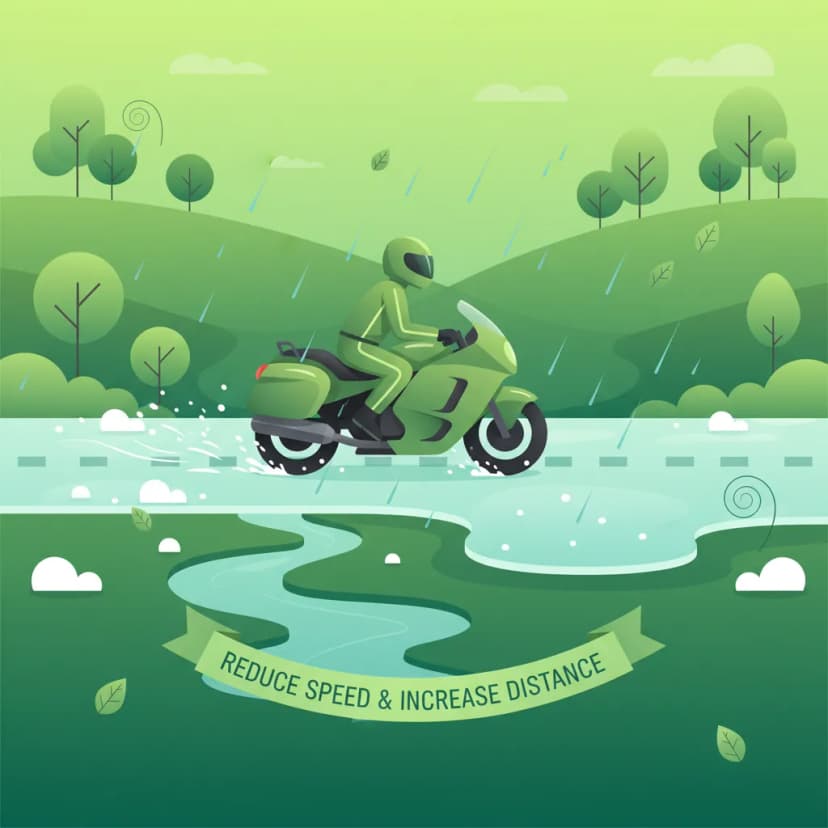
This lesson provides survival strategies for riding in the most challenging weather conditions, including heavy rain, snow, and potential ice. It emphasizes the importance of mental preparation, drastically reduced speeds, and hyper-smooth inputs for throttle, brakes, and steering. The content also covers identifying high-risk areas for 'black ice,' such as bridges and shaded spots, and the critical role of appropriate waterproof and insulated gear in preventing hypothermia and maintaining concentration.

This lesson explains the physics of why wet roads offer significantly less traction than dry ones, highlighting particular hazards like the first rain after a dry spell. It defines aquaplaning (when a tire rides on a layer of water instead of the road) and explains how speed and tire condition contribute to this dangerous phenomenon. The content provides clear strategies for riding in the rain, including reducing speed and applying all controls with extra smoothness.
This lesson provides practical advice for driving in challenging weather. You will learn about the risk of aquaplaning in heavy rain and how to react, as well as how to manage the effects of strong crosswinds. The curriculum covers winter driving, explaining the danger of black ice, the benefits of winter tires, and techniques for avoiding and correcting a skid. A key focus is on adjusting driving style: increasing following distances, reducing speed, and making gentle steering and braking inputs.

This lesson explains the science behind reduced grip on wet surfaces and the dangerous phenomenon of hydroplaning, where a tire rides on a layer of water instead of the road. It details the critical roles of tire tread depth, tire pressure, and riding speed in maintaining contact with the asphalt. Riders will learn techniques for riding in the rain, including using exceptionally smooth control inputs and proactively reducing speed when approaching standing water.
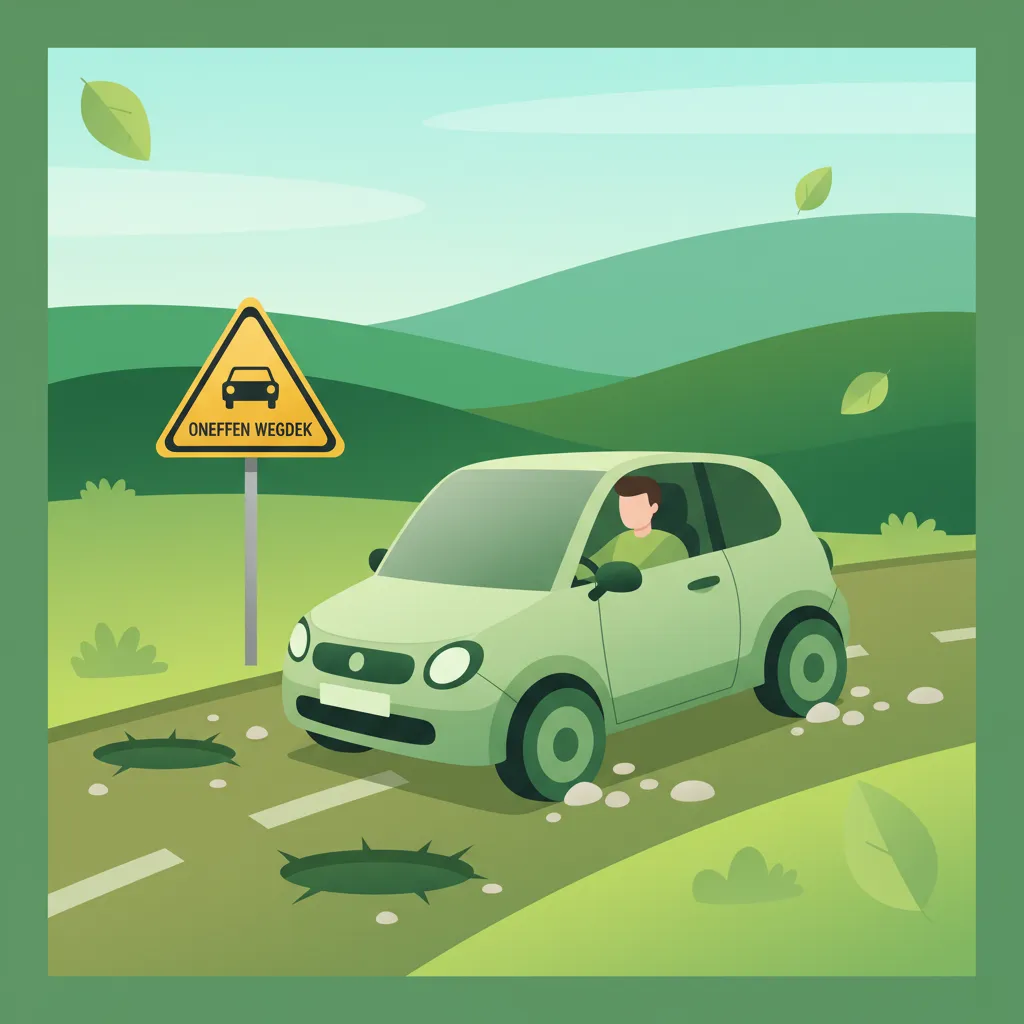
This lesson prepares you to deal with sudden changes in road surface that can cause a loss of traction. You will learn to scan for these hazards and, if they cannot be avoided, how to ride over them safely. The key technique is to keep the motorcycle upright and maintain smooth, steady control inputs—no abrupt braking, accelerating, or steering—to minimize the risk of a skid.
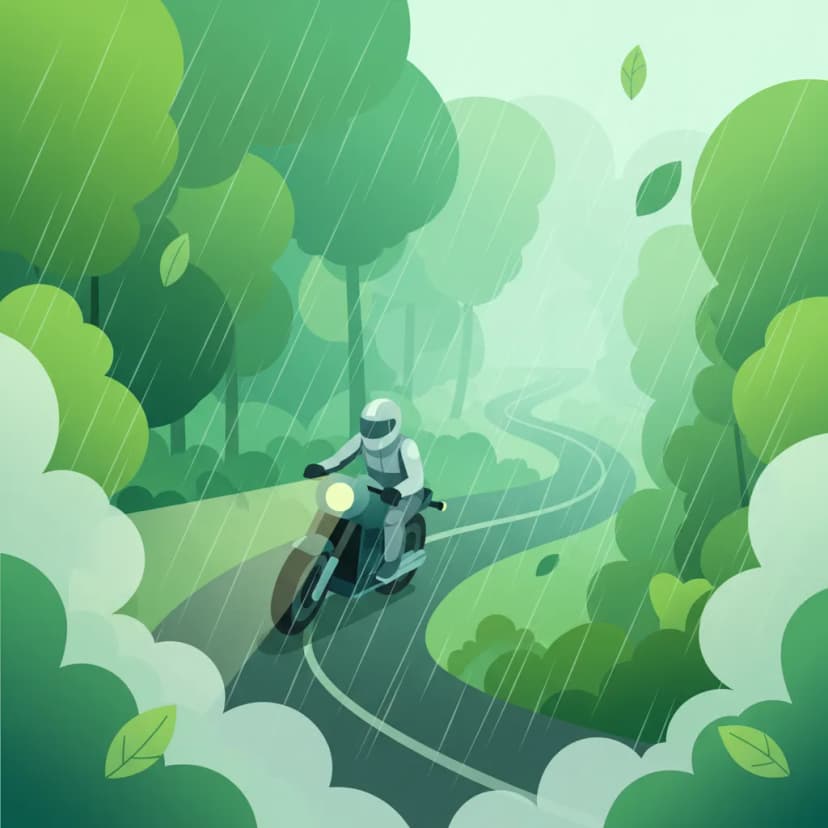
This lesson provides a detailed guide to riding in wet and low-visibility conditions. You will learn to make all your control inputs—braking, accelerating, and steering—exceptionally smooth to avoid breaking traction on slippery surfaces. The content covers the dangers of painted lines and manhole covers when wet, and the importance of increasing your following distance dramatically to account for longer braking distances.

Rain significantly reduces tire grip and rider visibility. This lesson covers the essential adjustments needed for wet-weather riding, including reducing speed, increasing following distance, and applying all controls more smoothly. It explains the danger of hydroplaning (aquaplaning) when tires lose contact with the road over standing water and how to avoid it. You will also learn about the importance of good tire tread depth for channeling water away and maintaining traction.

This lesson teaches the crucial skill of assessing road surfaces and adjusting speed accordingly to maintain maximum traction. It covers a variety of hazardous conditions, including wet asphalt, loose gravel, oil patches, metal manhole covers, and painted road markings, all of which can significantly reduce grip. Riders will learn to constantly scan the road ahead, identify potential traction-reducing surfaces, and proactively manage their speed to prevent slides and loss of control.

This lesson reinforces the critical relationship between adverse conditions, reduced traction, and massively increased stopping distances. It provides a clear framework for how much riders need to increase their following distance and reduce their overall speed to maintain a safe margin for error. The curriculum teaches riders to constantly reassess their speed based on visual feedback from the road surface and the level of visibility, ensuring they can always stop within the distance they can clearly see.

This lesson addresses the specific challenge of cornering when road grip is compromised. It teaches riders how to identify potential low-traction surfaces like wet manhole covers, painted lines, gravel, or oil patches. The content focuses on techniques to mitigate risk, such as reducing speed, minimizing lean angle, and applying all control inputs—braking, steering, and throttle—with exceptional smoothness to avoid overwhelming the available grip.
Develop advanced hazard anticipation skills for wet, icy, or oily road surfaces. Learn to identify critical cues like tram tracks and painted lines, and understand the consequences of incorrect control inputs in low-grip scenarios.
This lesson prepares you to deal with sudden changes in road surface that can cause a loss of traction. You will learn to scan for these hazards and, if they cannot be avoided, how to ride over them safely. The key technique is to keep the motorcycle upright and maintain smooth, steady control inputs—no abrupt braking, accelerating, or steering—to minimize the risk of a skid.
This lesson provides practical advice for driving in challenging weather. You will learn about the risk of aquaplaning in heavy rain and how to react, as well as how to manage the effects of strong crosswinds. The curriculum covers winter driving, explaining the danger of black ice, the benefits of winter tires, and techniques for avoiding and correcting a skid. A key focus is on adjusting driving style: increasing following distances, reducing speed, and making gentle steering and braking inputs.
This lesson introduces warning signs, which are designed to alert drivers to potential dangers or changes in road layout ahead. You will learn to interpret the triangular-shaped signs that indicate hazards such as sharp curves, slippery road surfaces (J27), or upcoming road works (J8). The curriculum explains how these signs help in anticipating risks and adjusting driving behavior accordingly, such as reducing speed or increasing alertness. A thorough understanding of warning signs is vital for proactive and defensive driving in various environments.
This lesson explains the science behind reduced grip on wet surfaces and the dangerous phenomenon of hydroplaning, where a tire rides on a layer of water instead of the road. It details the critical roles of tire tread depth, tire pressure, and riding speed in maintaining contact with the asphalt. Riders will learn techniques for riding in the rain, including using exceptionally smooth control inputs and proactively reducing speed when approaching standing water.
This lesson explains the physics of why wet roads offer significantly less traction than dry ones, highlighting particular hazards like the first rain after a dry spell. It defines aquaplaning (when a tire rides on a layer of water instead of the road) and explains how speed and tire condition contribute to this dangerous phenomenon. The content provides clear strategies for riding in the rain, including reducing speed and applying all controls with extra smoothness.
This lesson provides survival strategies for riding in the most challenging weather conditions, including heavy rain, snow, and potential ice. It emphasizes the importance of mental preparation, drastically reduced speeds, and hyper-smooth inputs for throttle, brakes, and steering. The content also covers identifying high-risk areas for 'black ice,' such as bridges and shaded spots, and the critical role of appropriate waterproof and insulated gear in preventing hypothermia and maintaining concentration.

This lesson introduces the Dutch concept of 'voorspellend rijgedrag,' or anticipatory riding, a proactive approach to safety. It teaches motorcyclists how to look beyond the immediate vehicle in front and scan for clues that predict the actions of other road users, such as turn signals, wheel direction, and driver head movement. By anticipating potential conflicts before they happen, riders can position themselves to avoid danger and ensure a smoother, safer journey through complex traffic.
This lesson teaches the crucial skill of assessing road surfaces and adjusting speed accordingly to maintain maximum traction. It covers a variety of hazardous conditions, including wet asphalt, loose gravel, oil patches, metal manhole covers, and painted road markings, all of which can significantly reduce grip. Riders will learn to constantly scan the road ahead, identify potential traction-reducing surfaces, and proactively manage their speed to prevent slides and loss of control.
This lesson addresses the specific challenge of cornering when road grip is compromised. It teaches riders how to identify potential low-traction surfaces like wet manhole covers, painted lines, gravel, or oil patches. The content focuses on techniques to mitigate risk, such as reducing speed, minimizing lean angle, and applying all control inputs—braking, steering, and throttle—with exceptional smoothness to avoid overwhelming the available grip.
This lesson emphasizes the critical importance of adapting your speed to prevailing conditions, which may require driving slower than the legal limit. You will learn how factors like rain, fog, snow, and darkness significantly increase braking distances and reduce visibility. The curriculum explains the dangers of aquaplaning on wet roads and black ice in winter. The core principle taught is that a safe driver always adjusts their speed to ensure they can stop within the distance they can see to be clear.
Find clear answers to common questions learners have about Wet, Icy, and Slippery Surface Adjustments. Learn how the lesson is structured, which driving theory objectives it supports, and how it fits into the overall learning path of units and curriculum progression in the Netherlands. These explanations help you understand key concepts, lesson flow, and exam focused study goals.
Common slippery surfaces include rain-slicked roads, icy patches (especially in shaded areas or on bridges), wet leaves, mud, gravel, sand, and surfaces with reduced grip like tram tracks, painted lines, manhole covers, and diesel spills. Recognizing these is key to adapting your riding.
Braking distance can roughly double on a wet road compared to a dry one. On ice or snow, it can increase by a factor of ten or more. This is why significantly reducing your speed and increasing following distance is critical.
Yes, you must brake much more gently and progressively. Avoid sudden, hard braking, especially with the front brake, as this can easily lock the wheel and cause a skid. Apply both brakes smoothly and allow more time to stop.
Tram tracks present a significant hazard because the metal rails are extremely slippery, and the grooves can catch your tires. Always try to cross tram tracks at a perpendicular angle (as close to 90 degrees as possible) and avoid accelerating or braking while crossing.
Strong winds can make maintaining balance on a slippery surface even more challenging. Be extra vigilant about keeping your speed low, looking ahead for potential hazards, and making smooth steering corrections to counteract wind gusts.
Painted lines (like lane markings or pedestrian crossings) and metal surfaces like manhole covers offer very little grip, especially when wet or icy. Treat them with extreme caution, avoid braking or accelerating while on them, and try to cross them at a straight angle.