
This unit covers the crucial aspects of speed management and braking for AM license holders in the Netherlands. You'll learn how to calculate stopping distances, understand the impact of various factors on braking, and master essential braking techniques to ensure safety on Dutch roads. Prepare thoroughly for the CBR theory exam by mastering these vital skills.
Browse all lessons that make up Speed Management & Braking. Each lesson focuses on specific topics, learning objectives, and core concepts, helping you build essential knowledge and follow a clear, structured progression toward your study goals in the Netherlands.
The posted speed limit is a maximum, not a target. This lesson teaches the crucial skill of adapting your speed to prevailing conditions. You will learn how to assess factors like traffic density, poor weather (rain, fog), limited visibility (at night), and slippery road surfaces. Adjusting your speed downwards in these situations provides you with more time to react to hazards and significantly reduces the risk of losing control or being involved in a collision.
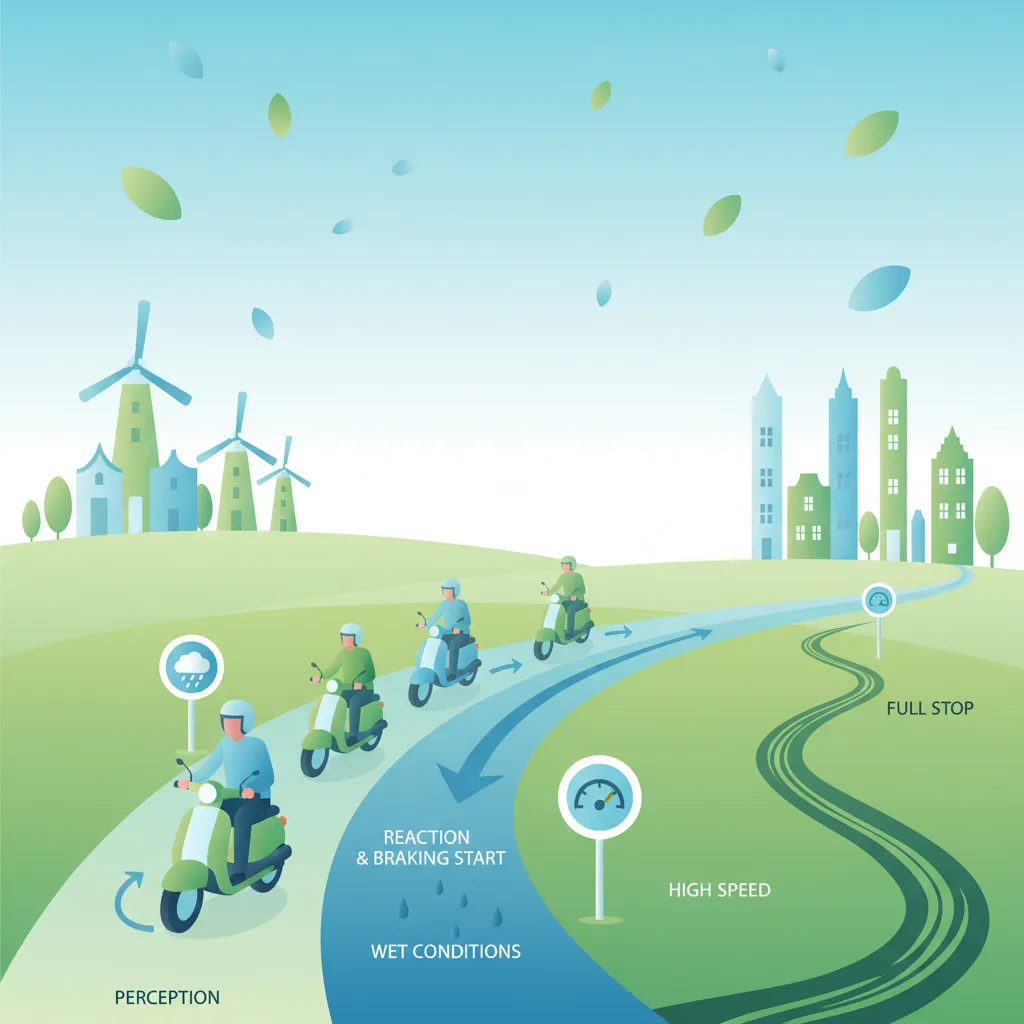
This lesson explains the components of the total stopping distance: the reaction distance (distance traveled before you start braking) and the braking distance (distance traveled while braking). You will learn the general formulas and rules of thumb for estimating these distances at different speeds. Understanding that braking distance increases exponentially with speed is a critical piece of knowledge that reinforces the importance of maintaining safe speeds and following distances.
Your ability to react quickly to danger depends on your reaction time, which is affected by alertness, fatigue, and distractions. This lesson explores these factors and teaches proactive hazard perception skills. You will learn how to scan the road ahead, identify potential risks early (e.g., a child near the road, a car waiting to pull out), and predict the actions of other road users. This anticipatory mindset is more effective than simply reacting to events as they happen.
This lesson covers braking techniques beyond simply applying the brake levers. You will learn about the concept of engine braking (decelerating by releasing the throttle or downshifting) for controlled slowing. It also explains the function of an Anti-lock Braking System (ABS), a safety feature on some models that prevents wheels from locking during hard braking, allowing you to maintain steering control and reduce the chance of a skid.
Riding on two wheels requires special care on surfaces with reduced grip. This lesson teaches you how to handle challenging conditions like rain, ice, wet leaves, or tram tracks. Key principles include reducing speed significantly, making all control inputs (braking, accelerating, steering) much more smoothly and gradually, and increasing your following distance to allow for much longer stopping distances. Recognizing potentially slippery areas is a critical part of proactive hazard perception.
Explore high-intent keywords and long-tail search topics learners use when researching Speed Management & Braking. These terms reflect how people search for reliable study materials, structured explanations, and unit-level theory preparation support in the Netherlands.
Find clear answers to the most common questions learners ask about Speed Management & Braking. Understand how the unit is organized, what learning goals it supports, and how it contributes to your study progression with structured explanations and practical guidance tailored for learners in the Netherlands.
Reaction distance is the distance your vehicle travels from the moment you perceive a hazard until you apply the brakes. Braking distance is the distance your vehicle travels from when you apply the brakes until it comes to a complete stop. Your total stopping distance is the sum of these two.
Braking distance increases exponentially with speed. Doubling your speed quadruples your braking distance, and tripling your speed increases it ninefold. This is a critical concept tested in the Dutch theory exam.
ABS (Anti-lock Braking System) prevents your wheels from locking up during hard braking, allowing you to maintain steering control and potentially reduce stopping distance, especially on slippery surfaces. It's an important safety feature, and understanding its function is relevant for the theory exam.
Wet roads can significantly increase braking distance, often by doubling it or more, due to reduced tire grip. Icy conditions are far more dangerous, drastically extending braking distance and making controlled stopping extremely difficult. Always adjust your speed and braking accordingly.
Dutch roads can present varied conditions due to weather and traffic density. Adapting your speed ensures you maintain sufficient control, have adequate reaction time, and can stop safely. This proactive approach is a key expectation for safe riders and is assessed in the theory exam.
Yes, engine braking, by downshifting or simply releasing the throttle, can help slow down your vehicle gradually, especially on descents. It complements your primary brakes and can help maintain control, particularly in situations where relying solely on friction brakes might be risky.
All included lessons
Lessons in Speed Management & Braking
See who benefits most from studying Speed Management & Braking. This overview explains how the unit supports different learning needs, what level of knowledge is helpful before starting, and how it fits into the overall study path in the Netherlands.
This unit is essential for all learners preparing for the Dutch Category AM (Moped & Scooter) theory exam. It's particularly beneficial for those who want to fully grasp the physics of stopping distances and how to apply them safely in real-world Dutch traffic situations, helping to avoid common exam errors.

See how Dutch Driving Theory AM is structured, with key topics, learning objectives, and a step-by-step path for theory preparation in the Netherlands.
Explore all units and lessons included in this driving theory course.