
Riding in the rain requires specific adjustments to ensure safety and maintain control. This lesson is part of Unit 7, 'Environmental & Weather Influences,' which prepares you for various road conditions. We'll focus on the particular challenges of wet roads for AM category vehicles, including hydroplaning risks and essential speed and braking adaptations, building on your foundational knowledge of road rules.
Rain is a frequent occurrence on Dutch roads and presents significant challenges for all drivers, especially those on two-wheel vehicles like mopeds and scooters (Category AM). The unique characteristics of mopeds – lighter weight, narrower tires, and exposed rider – amplify the risks associated with wet conditions, making them more susceptible to loss of grip and control. This lesson delves into the crucial adjustments and knowledge needed to navigate rainy weather safely, focusing on maintaining traction, ensuring visibility, and adhering to Dutch traffic laws.
Understanding these principles is not just about avoiding fines; it's about preventing serious accidents. Wet roads dramatically increase stopping distances and the likelihood of dangerous phenomena like hydroplaning, where tires lose all contact with the road surface. By the end of this chapter, you will be equipped with the knowledge to adapt your riding behavior, maintain your vehicle appropriately, and make informed decisions to minimize risks in wet conditions, thereby protecting yourself and other road users.
When water is present on the road surface, it creates a lubricating film between your tires and the asphalt. This film significantly reduces the friction coefficient (µ) – the measure of how much grip your tires have. On a dry road, the friction coefficient for a typical moped tire might be around 0.9, allowing for strong braking and confident cornering. However, in wet conditions, this can drop to 0.5-0.6, or even lower in heavy rain or on slippery surfaces like painted road markings.
This reduction in grip has direct practical implications:
The severity of grip reduction varies not only with the amount of rain but also with the road surface material. Asphalt generally offers better grip than concrete in the wet, and painted road markings (like stop lines, arrows, or bicycle lanes) become exceptionally slippery when wet due to their non-porous surface. Always be extra cautious when crossing these areas in the rain.
Hydroplaning, also known as aquaplaning, is a critical hazard in wet weather. It occurs when a layer of water builds up between your tires and the road surface, causing the tires to completely lose contact with the road. Instead of rolling on the asphalt, your moped essentially "rides" on top of the water, like a water ski. When this happens, you lose all control over steering, braking, and acceleration.
For cars, hydroplaning is often associated with high speeds, typically above 70-80 km/h. However, for lightweight Category AM vehicles with narrow tires, hydroplaning can occur at much lower speeds, sometimes as low as 45-50 km/h, especially if there's significant standing water or if the tires are worn.
There are different types of hydroplaning:
When hydroplaning occurs, the sensation can be startling:
What to do if you hydroplane: The most crucial action is to remain calm. Do not make any sudden movements.
Safe riding in the rain requires a holistic approach, adjusting not only your speed but also your riding technique, following distance, and vehicle preparation.
This is perhaps the single most critical adjustment. Dutch traffic law (RVV 1990, Article 4) explicitly states that "The driver must adapt his speed to road, traffic and weather conditions." This means that the posted speed limit is a maximum for ideal conditions, not a target for all conditions.
Important: For mopeds, even if the posted limit is 45 km/h, this speed is often dangerously high in heavy rain. You must calculate a "wet-weather safe speed" that is significantly lower.
Why speed reduction is vital:
Practical application: In light rain, you might only need to reduce your speed by 10-15%. In heavy rain with standing water, a reduction of 30% or more (e.g., from 45 km/h down to 30 km/h or even 20 km/h) is often necessary to maintain safety.
RVV 1990, Article 9 mandates that "A driver must keep a safe distance to the vehicle in front, taking into account speed, road conditions, and weather." The standard "2-second rule" for dry conditions is insufficient in the rain. Because braking distances are extended and perception-reaction times can be longer, you need more space.
Aim for a 3-4 second following distance in wet conditions, and even longer in heavy downpours or when visibility is severely reduced. To measure this, pick a fixed point (like a sign or tree) that the vehicle ahead passes. Count "one-thousand-one, one-thousand-two, one-thousand-three, one-thousand-four." You should only reach that point after you finish counting.
Aggressive or sudden actions are a primary cause of loss of control on wet surfaces. RVV 1990, Article 15 (paragraph 2) states that "Drivers must not undertake actions that lead to loss of control of the vehicle."
Your moped's condition plays a significant role in wet-weather safety. Regular checks, especially before the rainy season, are essential.
The tread pattern on your tires is specifically designed to channel water away from the contact patch, allowing the rubber to grip the road. As tires wear down, their ability to displace water decreases dramatically, increasing the risk of hydroplaning and reducing wet grip.
Tip: Regularly inspect your tires for cuts, cracks, bulges, or embedded objects. Damaged tires are a severe safety hazard, especially in wet conditions.
Maintaining correct tire pressure, as specified by your moped's manufacturer, is crucial.
Load distribution on a moped is equally important. An unevenly distributed load, especially a heavy load placed far back on the rear seat or in a top case, can:
Always keep cargo balanced and within the manufacturer's maximum weight limits.
Seeing and being seen are critical for safety in the rain. Reduced visibility due to rain, spray from other vehicles, and overcast skies makes it harder for you to spot hazards and for others to see you.
RVV 1990, Article 39.1 states that "Head-lamps must be switched on when visibility is reduced by weather conditions below 150 m."
Puddles and areas of standing water are prime locations for hydroplaning.
The Dutch road traffic regulations (Reglement Verkeersregels en Verkeerstekens 1990 - RVV 1990) place clear obligations on all drivers, including Category AM riders, to adapt to weather conditions.
| Regulation | Rule Statement | Applicability | Rationale | Correct Example | Incorrect Example |
|---|---|---|---|---|---|
| RVV 1990 Art. 4 | "The driver must adapt his speed to road, traffic and weather conditions." | All vehicles; mandatory whenever rain, standing water, reduced visibility, or slippery surfaces are present. | Prevents loss of control, ensures sufficient stopping distance. | Rider reduces speed from 45 km/h to 25 km/h when entering a street with heavy rain and puddles. | Rider maintains 45 km/h despite deep puddles, causing hydroplaning. |
| RVV 1990 Art. 9 | "A driver must keep a safe distance to the vehicle in front, taking into account speed, road conditions, and weather." | All road users; mandatory in wet weather. | Provides extra reaction time on low-grip surfaces. | Rider leaves a 4-second gap at 30 km/h in heavy rain. | Rider follows at a 1-second gap, fails to stop in time on a wet road. |
| RVV 1990 Art. 39.1 | "Head-lamps must be switched on when visibility is reduced by weather conditions below 150 m." | Night or heavy-rain conditions; applies to all Category AM vehicles. | Improves detection of road users and hazards. | Rider turns on dipped beam when rain reduces visibility to 100 m. | Rider keeps lights off because it is "daylight," but heavy rain reduces visibility to 80 m. |
| RVV 1990 Art. 44 | "All tyres must be in a condition that guarantees adequate road holding." | Applies to tire tread depth, inflation, and overall condition; checked during vehicle inspections. | Guarantees tire performance in all conditions, especially wet. | Rider's tire shows 2.0 mm tread depth and correct pressure. | Rider's tire is at 1.4 mm tread depth and still used in rain, increasing hydroplaning risk. |
| RVV 1990 Art. 15 (para. 2) | "Drivers must not undertake actions that lead to loss of control of the vehicle." | Relates to abrupt throttle, braking, steering on wet surfaces. | Directly addresses hydroplaning risk caused by aggressive inputs. | Rider applies brakes progressively when approaching a puddle. | Rider slams brakes sharply on a wet road, causing wheel lock-up and loss of grip. |
Many accidents in the rain stem from predictable errors. Being aware of these common pitfalls can help you develop safer habits.
Safe wet-weather riding isn't a one-size-fits-all approach; it depends on the specific conditions you encounter.
Understanding the direct consequences of your actions is key to developing safe riding habits.
| Cause (Correct Action) | Effect (Positive Outcome) | Underlying Reasoning |
|---|---|---|
| Reduce speed to 25 km/h in heavy rain | Stopping distance reduces significantly; hydroplaning unlikely. | Lower kinetic energy; tire can channel water more effectively. |
| Increase following distance to 4 seconds | Additional reaction time allows safe braking even on a slick surface. | Human perception-reaction time (~1s) plus extra margin for delayed braking effect. |
| Use smooth, progressive braking | Wheel slip avoided; tire maintains contact, preserving lateral grip. | Gradual pressure lets tire water-channeling grooves work, preventing lock-up. |
| Maintain tread depth ≥ 2.5 mm | Water is expelled efficiently; hydroplaning threshold speed rises. | Deeper grooves increase water displacement capacity. |
| Balance load evenly on scooter | Tire pressure distribution stays optimal; grip remains consistent. | Uniform load avoids squatting, preserving tire contact geometry. |
| Cause (Violation) | Effect (Negative Outcome) | Underlying Reasoning |
|---|---|---|
| Riding at 45 km/h in standing water 5 mm deep | Hydroplaning occurs; loss of steering, possible crash. | Water film exceeds tire’s evacuation ability at that speed. |
| Abrupt hard brake on wet road | Wheel lock-up, sliding, possible skid into obstacle. | Sudden friction exceeds tire’s maximum static friction coefficient. |
| Riding with tread < 1.6 mm | Hydroplaning at lower speeds, increased stopping distance. | Insufficient groove depth to channel water. |
| No headlights in low visibility rain | Late detection of obstacles; delayed response; higher collision risk. | Reduced luminous flux to the eye, longer visual reaction time. |
| Overloaded rear seat | Rear tire squats, reducing contact patch and water channeling → earlier hydroplaning. | Excess weight deforms tire, altering the geometry needed for water evacuation. |
Lesson content overview
Explore all units and lessons included in this driving theory course.
Explore search topics learners often look for when studying Rain, Puddles, and Hydroplaning Risks. These topics reflect common questions about road rules, driving situations, safety guidance, and lesson level theory preparation for learners in the Netherlands.
Browse additional driving theory lessons that cover connected traffic rules, road signs, and common driving situations related to this topic. Improve your understanding of how different rules interact across everyday traffic scenarios.
Understand the risks of rain, puddles, and hydroplaning on Dutch roads. Learn how reduced tire grip affects braking and control, and discover essential techniques for safe wet-weather moped and scooter riding.

This lesson explains the physics of why wet roads offer significantly less traction than dry ones, highlighting particular hazards like the first rain after a dry spell. It defines aquaplaning (when a tire rides on a layer of water instead of the road) and explains how speed and tire condition contribute to this dangerous phenomenon. The content provides clear strategies for riding in the rain, including reducing speed and applying all controls with extra smoothness.

This lesson explains the science behind reduced grip on wet surfaces and the dangerous phenomenon of hydroplaning, where a tire rides on a layer of water instead of the road. It details the critical roles of tire tread depth, tire pressure, and riding speed in maintaining contact with the asphalt. Riders will learn techniques for riding in the rain, including using exceptionally smooth control inputs and proactively reducing speed when approaching standing water.

Riding on two wheels requires special care on surfaces with reduced grip. This lesson teaches you how to handle challenging conditions like rain, ice, wet leaves, or tram tracks. Key principles include reducing speed significantly, making all control inputs (braking, accelerating, steering) much more smoothly and gradually, and increasing your following distance to allow for much longer stopping distances. Recognizing potentially slippery areas is a critical part of proactive hazard perception.
This lesson provides practical advice for driving in challenging weather. You will learn about the risk of aquaplaning in heavy rain and how to react, as well as how to manage the effects of strong crosswinds. The curriculum covers winter driving, explaining the danger of black ice, the benefits of winter tires, and techniques for avoiding and correcting a skid. A key focus is on adjusting driving style: increasing following distances, reducing speed, and making gentle steering and braking inputs.
This lesson prepares you to deal with sudden changes in road surface that can cause a loss of traction. You will learn to scan for these hazards and, if they cannot be avoided, how to ride over them safely. The key technique is to keep the motorcycle upright and maintain smooth, steady control inputs—no abrupt braking, accelerating, or steering—to minimize the risk of a skid.
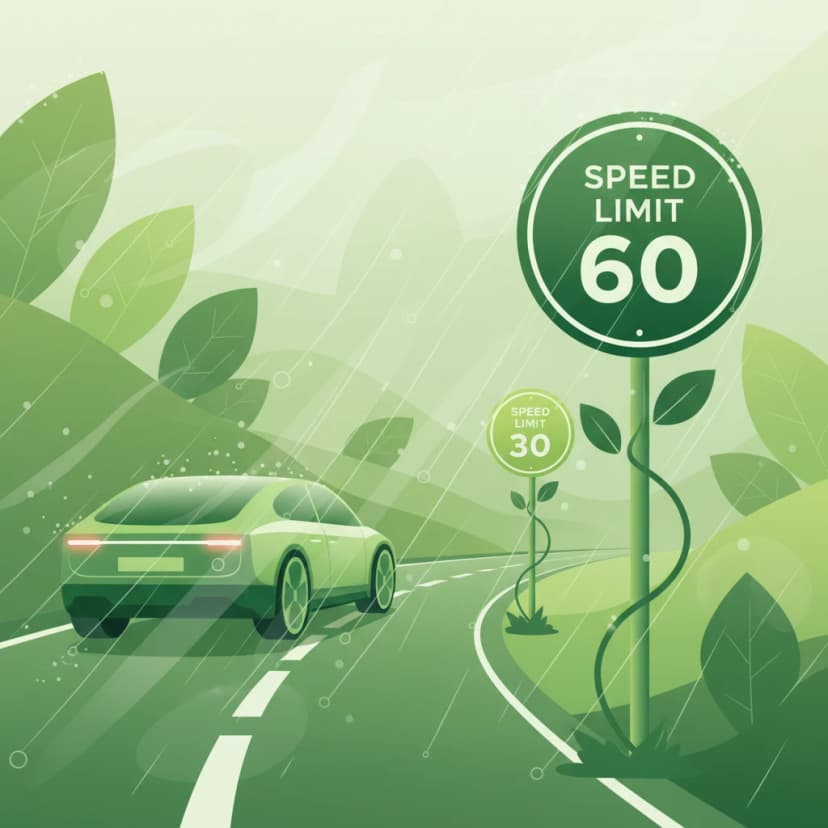
This lesson emphasizes the critical importance of adapting your speed to prevailing conditions, which may require driving slower than the legal limit. You will learn how factors like rain, fog, snow, and darkness significantly increase braking distances and reduce visibility. The curriculum explains the dangers of aquaplaning on wet roads and black ice in winter. The core principle taught is that a safe driver always adjusts their speed to ensure they can stop within the distance they can see to be clear.
This lesson provides a detailed guide to riding in wet and low-visibility conditions. You will learn to make all your control inputs—braking, accelerating, and steering—exceptionally smooth to avoid breaking traction on slippery surfaces. The content covers the dangers of painted lines and manhole covers when wet, and the importance of increasing your following distance dramatically to account for longer braking distances.
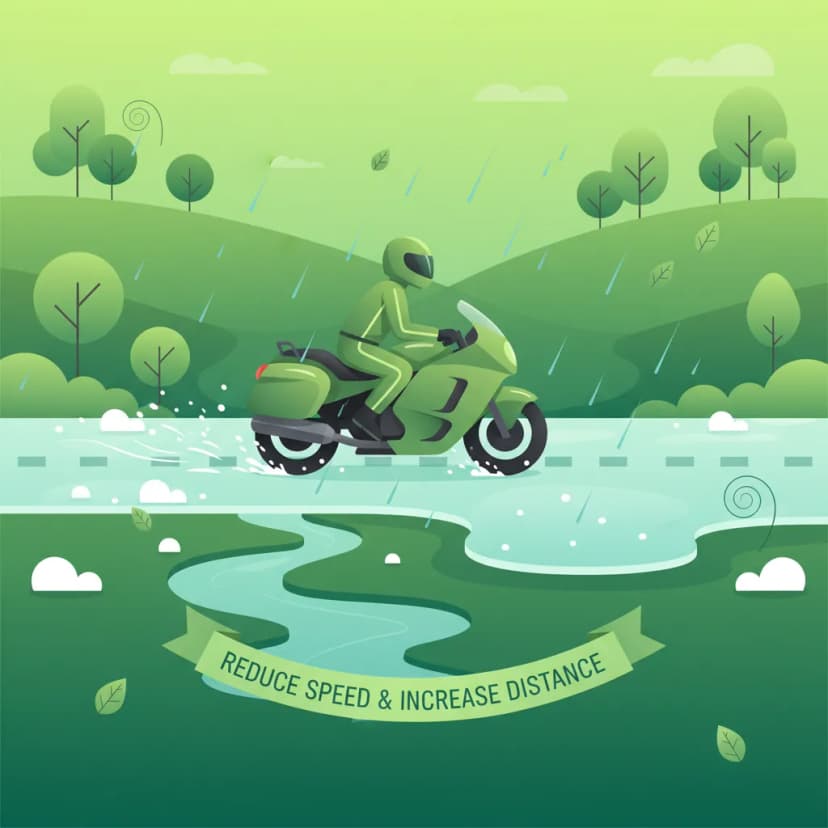
This lesson provides survival strategies for riding in the most challenging weather conditions, including heavy rain, snow, and potential ice. It emphasizes the importance of mental preparation, drastically reduced speeds, and hyper-smooth inputs for throttle, brakes, and steering. The content also covers identifying high-risk areas for 'black ice,' such as bridges and shaded spots, and the critical role of appropriate waterproof and insulated gear in preventing hypothermia and maintaining concentration.
This lesson addresses the specific challenge of cornering when road grip is compromised. It teaches riders how to identify potential low-traction surfaces like wet manhole covers, painted lines, gravel, or oil patches. The content focuses on techniques to mitigate risk, such as reducing speed, minimizing lean angle, and applying all control inputs—braking, steering, and throttle—with exceptional smoothness to avoid overwhelming the available grip.

This lesson teaches the crucial skill of assessing road surfaces and adjusting speed accordingly to maintain maximum traction. It covers a variety of hazardous conditions, including wet asphalt, loose gravel, oil patches, metal manhole covers, and painted road markings, all of which can significantly reduce grip. Riders will learn to constantly scan the road ahead, identify potential traction-reducing surfaces, and proactively manage their speed to prevent slides and loss of control.
Learn about Dutch traffic law (RVV 1990) regarding speed adaptation in rain and the importance of headlights for visibility. Master safe riding adjustments for wet conditions and reduced visibility to pass your theory exam.

Riding at night presents two main challenges: seeing the road and being seen by others. This lesson covers the legal requirements for your vehicle's lighting system and how to use it effectively, including when to use high beams. It also emphasizes strategies to increase your own conspicuity, such as wearing bright or reflective clothing. You will learn how darkness affects your perception of speed and distance and how to adapt your riding to compensate for these limitations.
Riding on two wheels requires special care on surfaces with reduced grip. This lesson teaches you how to handle challenging conditions like rain, ice, wet leaves, or tram tracks. Key principles include reducing speed significantly, making all control inputs (braking, accelerating, steering) much more smoothly and gradually, and increasing your following distance to allow for much longer stopping distances. Recognizing potentially slippery areas is a critical part of proactive hazard perception.
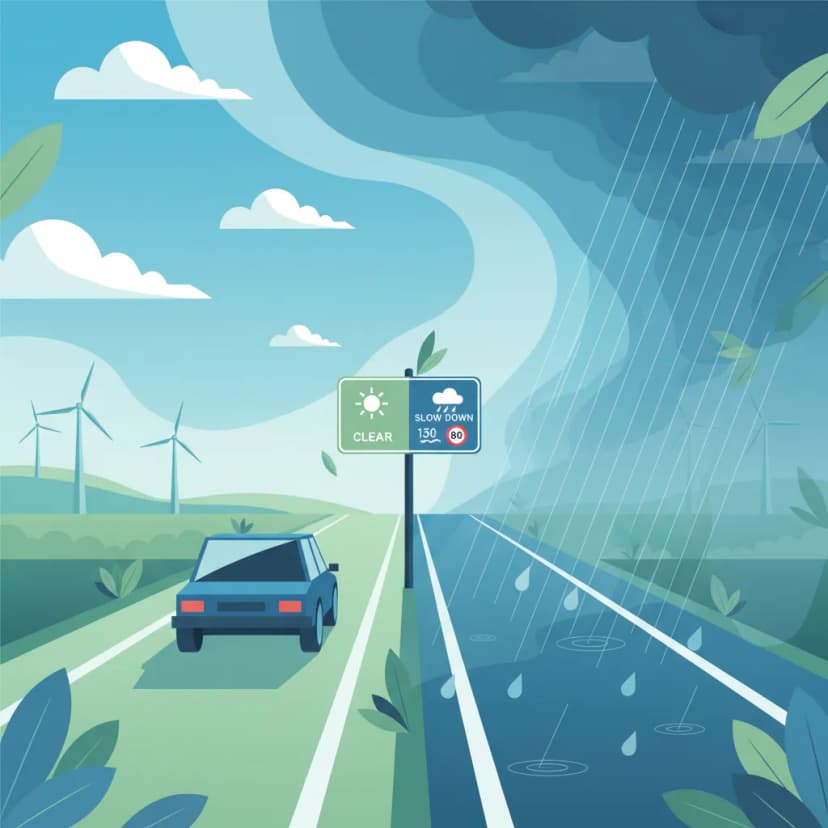
The posted speed limit is a maximum, not a target. This lesson teaches the crucial skill of adapting your speed to prevailing conditions. You will learn how to assess factors like traffic density, poor weather (rain, fog), limited visibility (at night), and slippery road surfaces. Adjusting your speed downwards in these situations provides you with more time to react to hazards and significantly reduces the risk of losing control or being involved in a collision.
This lesson provides a detailed guide to riding in wet and low-visibility conditions. You will learn to make all your control inputs—braking, accelerating, and steering—exceptionally smooth to avoid breaking traction on slippery surfaces. The content covers the dangers of painted lines and manhole covers when wet, and the importance of increasing your following distance dramatically to account for longer braking distances.

This lesson addresses the dual challenge of poor visibility: being able to see the road ahead and ensuring other road users can see you. It covers techniques for riding in fog and heavy rain, such as using appropriate lights and reducing speed to match sight distance. The lesson also discusses practical issues like helmet visor fogging and the importance of wearing high-visibility or reflective clothing to enhance conspicuity in low-light conditions.

Your vehicle's lights and horn are your primary tools for seeing, being seen, and communicating warnings. This lesson guides you through a simple but vital check of all electrical components before you ride. You will learn how to verify the function of your headlight (high and low beam), taillight, brake light (using both front and rear brake levers), and turn signals. It also covers checking the horn's operation and ensuring all mandatory reflectors are clean and intact.
Effective communication with other road users is vital for safety. This lesson details the legal requirements and proper use of your vehicle's signaling equipment, including headlights, brake lights, and turn signals (indicators). It also explains the specific situations in which using the horn is permitted to avert danger. Finally, it covers the mandatory placement and type of reflectors that ensure your vehicle remains visible to others, especially in low-light conditions.
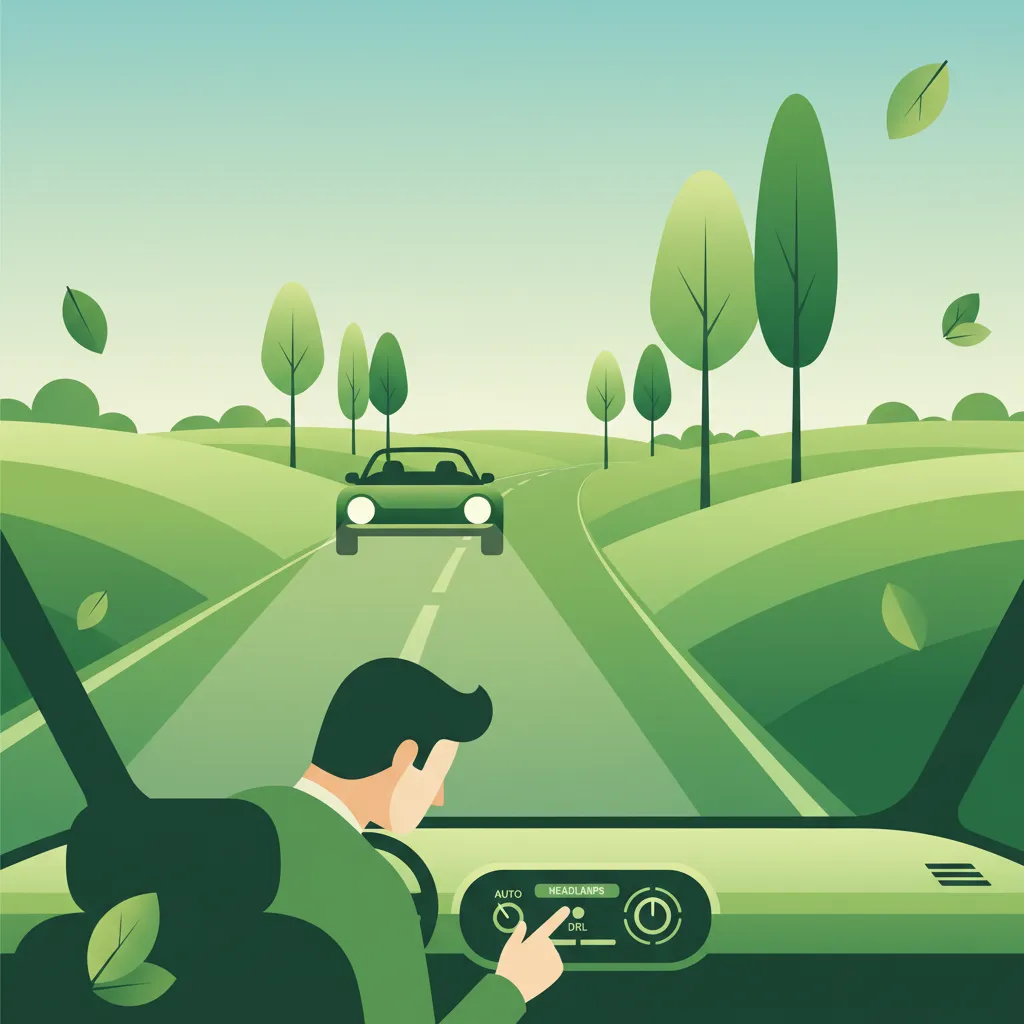
This lesson focuses on the dual challenge of visibility: seeing the road ahead and ensuring other drivers see you. It covers the legal requirements and tactical use of headlights ('koplampen'), including when to use high and low beams, and the importance of daytime running lights. Additionally, it explores strategies for enhancing personal conspicuity through high-visibility and reflective clothing, and using lane positioning to stand out in traffic and avoid blind spots.
This lesson emphasizes the critical importance of adapting your speed to prevailing conditions, which may require driving slower than the legal limit. You will learn how factors like rain, fog, snow, and darkness significantly increase braking distances and reduce visibility. The curriculum explains the dangers of aquaplaning on wet roads and black ice in winter. The core principle taught is that a safe driver always adjusts their speed to ensure they can stop within the distance they can see to be clear.
Each season brings unique challenges for riders. This lesson discusses common seasonal hazards, such as wet autumn leaves that are as slippery as ice, the risk of black ice in winter, and increased agricultural traffic in the summer. It also highlights the importance of seasonal vehicle maintenance. For example, after winter, it is crucial to wash away corrosive road salt, and before winter, to check antifreeze and battery health, ensuring your vehicle is prepared for the conditions ahead.
Find clear answers to common questions learners have about Rain, Puddles, and Hydroplaning Risks. Learn how the lesson is structured, which driving theory objectives it supports, and how it fits into the overall learning path of units and curriculum progression in the Netherlands. These explanations help you understand key concepts, lesson flow, and exam focused study goals.
Hydroplaning, or aquaplaning, happens when your tires lose contact with the road surface because of a layer of water. To avoid it, reduce your speed significantly in standing water, ensure your tires have adequate tread depth to channel water away, and steer smoothly. Sudden braking or sharp turns in wet conditions increase the risk.
Rain can increase braking distance by 50% or more. This is because the water acts as a lubricant between your tires and the road, reducing friction. Always increase your following distance to at least double what you would use in dry conditions, and anticipate stops much earlier.
Yes, the CBR exam frequently includes questions about riding in adverse weather conditions. You can expect scenarios testing your knowledge of reduced grip, increased braking distances, the risks of hydroplaning, and necessary speed adjustments when riding in rain.
Tire tread depth is crucial in wet conditions as the grooves are designed to channel water away from the contact patch between the tire and the road. Sufficient tread ensures better grip and reduces the risk of hydroplaning. Bald or worn tires lose this ability, making them dangerous in rain.
Yes, you must use your brakes much more gently and progressively in the rain. Avoid sudden braking, as this can easily lock the wheels (if you don't have ABS) or cause a skid due to reduced grip. Apply both brakes gently and smoothly, anticipating stops well in advance.