
Strong winds can be a significant challenge for two-wheeled vehicles like mopeds and scooters. This lesson in Unit 7 focuses specifically on how wind can affect your stability on Dutch roads. Understanding these effects and learning proactive control techniques is crucial for safe riding and passing your Category AM theory exam.
Riding a two-wheeled vehicle offers a unique sense of freedom and agility, but it also comes with specific challenges, especially when encountering adverse weather conditions. Among these, wind stands out as a significant environmental factor that can dramatically affect the stability and control of mopeds (bromfietsen), light mopeds (snorfietsen), and speed pedelecs. This lesson delves into how wind influences your ride and, crucially, how to master techniques to maintain safety and control on Dutch roads. Understanding these principles is vital for passing your Dutch Category AM theory exam and ensuring safe riding practices in all conditions.
Wind is more than just a nuisance; it exerts measurable forces on your vehicle, directly impacting its stability. Unlike cars, two-wheeled vehicles rely on dynamic balance, which strong lateral (sideways) forces can easily disrupt. This section explains the fundamental physics behind how wind interacts with your moped or scooter, preparing you to anticipate and react effectively.
When wind strikes a moving two-wheel vehicle, it generates aerodynamic forces that can push, pull, or destabilize it. These forces are primarily determined by the wind's speed and direction, the vehicle's speed, and the exposed surface area of both the vehicle and the rider. A deeper understanding of these physical principles empowers you to predict how wind will affect your ride and apply appropriate countermeasures.
The most impactful wind effect for two-wheeled vehicles is the lateral aerodynamic force. This is the sideward push generated by wind acting on the exposed surfaces of your vehicle and body. It's the force that makes you feel like your bike is drifting or being pushed out of its lane. The magnitude of this force is proportional to the square of the relative wind velocity and the side-force coefficient (Cy), a value that describes how much lateral force a given vehicle shape experiences. Vehicles with larger, flatter side profiles, like many scooters with extensive fairings, typically have a higher side-force coefficient, making them more susceptible to being pushed sideways.
The wind you experience while riding isn't just the ambient wind speed reported by a weather forecast. It's the relative wind vector, which is the vector sum of the true wind speed and direction, combined with your vehicle's forward speed. For instance, if you are riding at 40 km/h into a headwind of 10 km/h, you experience a total wind speed of 50 km/h. Conversely, if you have a tailwind of 10 km/h, you only experience 30 km/h of wind. This concept is crucial for crosswinds: a crosswind from your side can feel stronger or weaker depending on your own speed and the exact angle, and sometimes even a higher forward speed can increase the relative crosswind component, leading to greater lateral force.
Not all wind is the same, and different types require distinct reactions:
Understanding the difference helps you anticipate whether you need to make continuous, subtle corrections for a steady push or prepare for an abrupt, strong jolt.
To safely navigate windy conditions on your Category AM vehicle, proactive techniques are indispensable. These methods involve adjusting your speed, body position, and steering inputs to counteract the destabilizing effects of wind.
One of the most effective and legally required strategies for managing wind is speed adaptation. Dutch traffic law, specifically RVV 1990 Article 7.5, mandates that drivers adapt their speed to prevailing conditions, including weather. Since the lateral force of wind increases with the square of the relative wind speed, even a small reduction in your forward speed can significantly decrease the wind's pushing effect.
When encountering strong crosswinds or anticipating gusts, proactively reduce your speed. A reduction of even 10-20% can make a substantial difference in maintaining control and provides more reaction time to sudden changes.
This reduction helps to:
Your body makes up a significant portion of the exposed surface area on a two-wheeled vehicle. Adjusting your rider body position can dramatically influence how wind affects your stability.
Counter-steering is a fundamental technique for controlling two-wheeled vehicles, and it's particularly vital for managing wind effects. When a crosswind or gust pushes your vehicle sideways, it causes the bike to roll in the direction of the push. To counteract this roll and maintain your trajectory:
Counter-steering for wind compensation should always be subtle and brief. Excessive or abrupt steering inputs can destabilize the vehicle further, especially when combined with wind forces. Think of it as a quick, gentle tap rather than a hard turn.
A relaxed grip on the handlebars is paramount when riding in windy conditions. Many riders instinctively clench the handlebars tightly when they feel unstable. However, a tight grip:
Instead, keep your grip light and relaxed, allowing the bike to "float" slightly underneath you. This allows the vehicle to absorb some of the wind's impact and helps you make smoother, more controlled steering inputs when necessary.
The best defense against wind is anticipation. By identifying wind-exposed areas before you reach them, you can prepare proactively, reducing the element of surprise.
Before your ride, check weather forecasts for wind warnings. While riding, visually scan the environment ahead for potential wind traps. This allows you to reduce speed, adjust your posture, and prepare for counter-steering before the wind hits.
In the Netherlands, specific articles within the Reglement verkeersregels en verkeerstekens 1990 (RVV 1990) govern a driver's responsibility under various conditions, including strong winds. Adherence to these regulations is not only a legal obligation but also crucial for your safety and the safety of other road users.
The core principle guiding your actions in windy conditions is enshrined in:
Beyond direct control, other regulations play a role in wind safety:
In specific locations prone to high winds, such as large bridges or exposed stretches of road, you may encounter signage related to wind:
Complying with these regulations and heeding any wind-related signage is paramount for safe riding and to meet the legal requirements for operating Category AM vehicles in the Netherlands.
Even experienced riders can make errors when facing strong winds. Being aware of these common pitfalls can help you maintain control and ensure your safety.
The optimal way to manage wind effects can vary significantly depending on the specific riding context. Combining wind with other hazards or environmental factors demands additional vigilance and adjusted techniques.
Understanding concepts is one thing; applying them in real-world scenarios is another. Here are a few practical examples to illustrate how to react to wind effects.
Setting: You are riding a 125 cc moped and approach a 500-meter long, open bridge. The weather forecast indicates a steady crosswind from the right at 30 km/h. Traffic is moderate, and the lane width is 3 meters.
Correct Behaviour: Well before entering the bridge, you reduce your speed by about 15-20% (e.g., from 60 km/h to 48-50 km/h). You lean slightly forward and subtly into the wind (to the right). You maintain a relaxed grip on the handlebars, allowing the bike to move slightly, and apply continuous, subtle left counter-steer inputs to counteract the constant rightward push, keeping your moped centred in your lane.
Incorrect Behaviour: You maintain the posted speed limit, grip the handlebars tightly, and do not adjust your posture. As you enter the bridge, the steady crosswind pushes your moped significantly to the left. Due to the tight grip, your attempts to correct are jerky and exaggerated, causing the bike to wobble and drift dangerously close to the adjacent lane, startling oncoming traffic.
Setting: You are riding a speed pedelec at 35 km/h on an urban street lined with shops and parked cars. A large delivery truck overtakes you rapidly, generating a sudden gust of approximately 45 km/h from your left.
Correct Behaviour: As the truck passes, you anticipate the gust. You immediately relax your grip on the handlebars, allowing your speed pedelec to absorb the initial jolt. You then apply a very brief, subtle push on the right handlebar (counter-steering to the left) for a fraction of a second to counteract the sudden leftward push. The bike leans slightly right, quickly regaining its straight line without any dramatic swerve.
Incorrect Behaviour: You hold your handlebars tightly. When the gust hits, you are surprised and instinctively try to "fight" it by sharply turning the handlebars to the right. This over-correction causes your speed pedelec to wobble violently, momentarily losing stability and making you feel like you might fall or hit a parked car.
Setting: You are on a bromfiets riding a rural road at night. The wind forecast is variable, ranging from 20-35 km/h with occasional gusts. The road is only illuminated by your vehicle's headlights.
Correct Behaviour: Recognizing the combined risks of wind and low visibility, you significantly reduce your speed (e.g., to 40 km/h). You ensure your high-visibility lighting is active. You adopt a slightly forward posture, increase your lateral safety margin from the road edge, and continuously scan the road surface and distant environmental cues (like swaying trees) for signs of gusts. You focus intently on maintaining your lane position, using gentle corrections as needed.
Incorrect Behaviour: You ride at 60 km/h, relying solely on your headlights, and do not increase your safety margins. A sudden, un-anticipated gust pushes your bromfiets towards the unlit road shoulder. Your delayed reaction due to poor visibility and high speed almost leads you off the road, necessitating an emergency manoeuvre to recover.
Setting: You are carrying a heavy cargo box (e.g., 10 kg) on the rear rack of your snorfiets. You are on a section of road exposed to a 25 km/h crosswind, and it has just started to rain lightly.
Correct Behaviour: Understanding the compounded risk (raised CoG from cargo, reduced traction from rain, lateral force from wind), you immediately reduce your speed significantly (well below 50 km/h). You actively shift your body weight forward by tucking your elbows and sliding your hips slightly forward on the seat. You maintain a very relaxed grip and prepare for gentle, smooth steering corrections, being acutely aware of the reduced traction.
Incorrect Behaviour: You maintain your usual speed and upright posture. The heavy rear load, combined with the crosswind, causes the rear of your snorfiets to feel unstable and light. When the rain makes the road slick, a slight gust causes the rear wheel to momentarily lose traction and slide sideways, leading to a dangerous wobble or potential fall.
Mastering wind effects is a crucial step towards becoming a safe and confident rider of Category AM vehicles. Continue to build upon this knowledge by exploring related topics and practicing regularly.
Lesson content overview
Explore all units and lessons included in this driving theory course.
Explore search topics learners often look for when studying Wind Effects on Two‑Wheel Stability. These topics reflect common questions about road rules, driving situations, safety guidance, and lesson level theory preparation for learners in the Netherlands.
Browse additional driving theory lessons that cover connected traffic rules, road signs, and common driving situations related to this topic. Improve your understanding of how different rules interact across everyday traffic scenarios.
Understand the forces of crosswinds and gusts on mopeds and scooters. Learn essential driving theory for safe riding and vehicle control in windy conditions on Dutch roads. Includes rider posture and steering techniques.

This lesson explains how to counteract the effects of strong winds, which can easily upset a motorcycle's stability. It covers techniques like maintaining a relaxed grip on the handlebars and leaning into a steady crosswind. The lesson also addresses the impact of temperature, explaining how cold weather affects both the rider (risk of hypothermia, reduced concentration) and the motorcycle (reduced tire grip until warmed up), and emphasizes the need for appropriate protective gear.

This lesson prepares you for the challenge of riding in strong winds. You will learn to anticipate areas prone to gusts, such as exiting a tunnel or passing a large truck. The content explains how to maintain a relaxed grip on the handlebars and use subtle counter-steering inputs and body lean to counteract the force of the wind, keeping the motorcycle on its intended path.
This lesson provides practical advice for driving in challenging weather. You will learn about the risk of aquaplaning in heavy rain and how to react, as well as how to manage the effects of strong crosswinds. The curriculum covers winter driving, explaining the danger of black ice, the benefits of winter tires, and techniques for avoiding and correcting a skid. A key focus is on adjusting driving style: increasing following distances, reducing speed, and making gentle steering and braking inputs.
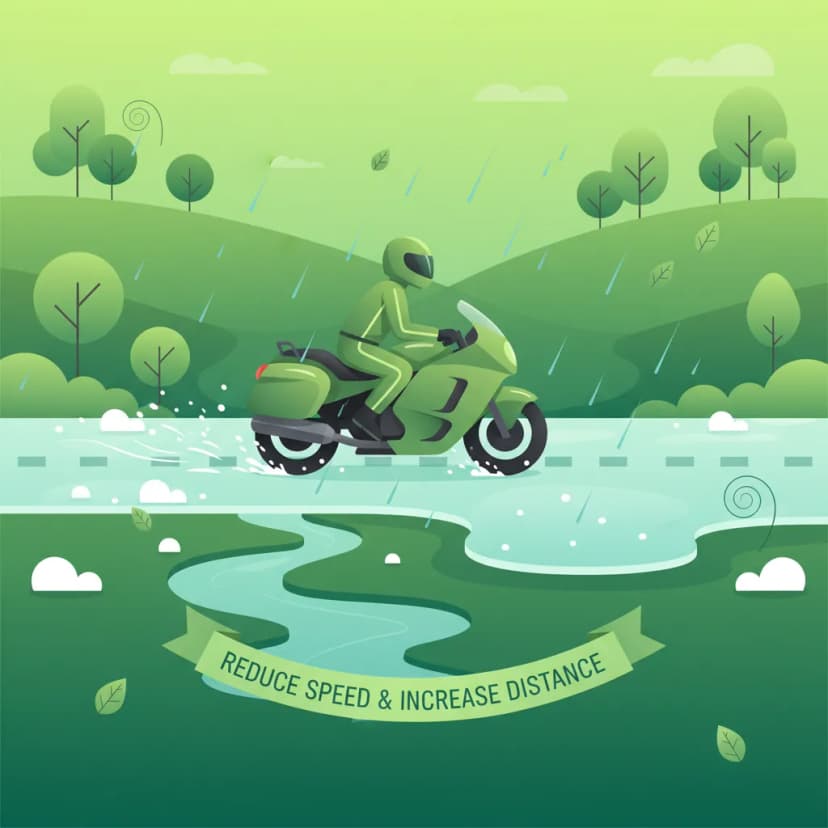
This lesson provides survival strategies for riding in the most challenging weather conditions, including heavy rain, snow, and potential ice. It emphasizes the importance of mental preparation, drastically reduced speeds, and hyper-smooth inputs for throttle, brakes, and steering. The content also covers identifying high-risk areas for 'black ice,' such as bridges and shaded spots, and the critical role of appropriate waterproof and insulated gear in preventing hypothermia and maintaining concentration.
This lesson reinforces the critical relationship between adverse conditions, reduced traction, and massively increased stopping distances. It provides a clear framework for how much riders need to increase their following distance and reduce their overall speed to maintain a safe margin for error. The curriculum teaches riders to constantly reassess their speed based on visual feedback from the road surface and the level of visibility, ensuring they can always stop within the distance they can clearly see.
This lesson emphasizes the critical importance of adapting your speed to prevailing conditions, which may require driving slower than the legal limit. You will learn how factors like rain, fog, snow, and darkness significantly increase braking distances and reduce visibility. The curriculum explains the dangers of aquaplaning on wet roads and black ice in winter. The core principle taught is that a safe driver always adjusts their speed to ensure they can stop within the distance they can see to be clear.

Riding on two wheels requires special care on surfaces with reduced grip. This lesson teaches you how to handle challenging conditions like rain, ice, wet leaves, or tram tracks. Key principles include reducing speed significantly, making all control inputs (braking, accelerating, steering) much more smoothly and gradually, and increasing your following distance to allow for much longer stopping distances. Recognizing potentially slippery areas is a critical part of proactive hazard perception.
This lesson provides a detailed guide to riding in wet and low-visibility conditions. You will learn to make all your control inputs—braking, accelerating, and steering—exceptionally smooth to avoid breaking traction on slippery surfaces. The content covers the dangers of painted lines and manhole covers when wet, and the importance of increasing your following distance dramatically to account for longer braking distances.

This lesson explains the science behind reduced grip on wet surfaces and the dangerous phenomenon of hydroplaning, where a tire rides on a layer of water instead of the road. It details the critical roles of tire tread depth, tire pressure, and riding speed in maintaining contact with the asphalt. Riders will learn techniques for riding in the rain, including using exceptionally smooth control inputs and proactively reducing speed when approaching standing water.
This lesson focuses on the unique demands of riding at sustained high speeds on motorways ('snelwegen'). It covers essential topics such as strict lane discipline, safe overtaking procedures, and maintaining a greater following distance to compensate for higher reaction and braking times. The content also addresses the physical and mental challenges, including managing wind blast, increased noise levels, and maintaining heightened situational awareness over long distances to combat fatigue.
Explore how wind, rain, and other environmental factors impact driving safety. This lesson covers essential theory for adapting speed and techniques to various weather conditions for category AM vehicles in the Netherlands.

Rain significantly reduces tire grip and rider visibility. This lesson covers the essential adjustments needed for wet-weather riding, including reducing speed, increasing following distance, and applying all controls more smoothly. It explains the danger of hydroplaning (aquaplaning) when tires lose contact with the road over standing water and how to avoid it. You will also learn about the importance of good tire tread depth for channeling water away and maintaining traction.
This lesson provides survival strategies for riding in the most challenging weather conditions, including heavy rain, snow, and potential ice. It emphasizes the importance of mental preparation, drastically reduced speeds, and hyper-smooth inputs for throttle, brakes, and steering. The content also covers identifying high-risk areas for 'black ice,' such as bridges and shaded spots, and the critical role of appropriate waterproof and insulated gear in preventing hypothermia and maintaining concentration.
Riding on two wheels requires special care on surfaces with reduced grip. This lesson teaches you how to handle challenging conditions like rain, ice, wet leaves, or tram tracks. Key principles include reducing speed significantly, making all control inputs (braking, accelerating, steering) much more smoothly and gradually, and increasing your following distance to allow for much longer stopping distances. Recognizing potentially slippery areas is a critical part of proactive hazard perception.
This lesson provides a detailed guide to riding in wet and low-visibility conditions. You will learn to make all your control inputs—braking, accelerating, and steering—exceptionally smooth to avoid breaking traction on slippery surfaces. The content covers the dangers of painted lines and manhole covers when wet, and the importance of increasing your following distance dramatically to account for longer braking distances.

This lesson addresses the dual challenge of poor visibility: being able to see the road ahead and ensuring other road users can see you. It covers techniques for riding in fog and heavy rain, such as using appropriate lights and reducing speed to match sight distance. The lesson also discusses practical issues like helmet visor fogging and the importance of wearing high-visibility or reflective clothing to enhance conspicuity in low-light conditions.
This lesson covers the critical decision-making process of when to stop riding altogether because weather conditions have become too hazardous to continue safely. It provides procedures for safely pulling off the road, finding suitable shelter, and making yourself and your motorcycle as visible as possible to other traffic. The content emphasizes that there is no shame in stopping, and that rider preservation is the highest priority when faced with extreme conditions like gale-force winds or torrential downpours.
This lesson explains how to counteract the effects of strong winds, which can easily upset a motorcycle's stability. It covers techniques like maintaining a relaxed grip on the handlebars and leaning into a steady crosswind. The lesson also addresses the impact of temperature, explaining how cold weather affects both the rider (risk of hypothermia, reduced concentration) and the motorcycle (reduced tire grip until warmed up), and emphasizes the need for appropriate protective gear.
This lesson explains why the standard two-second rule is insufficient in adverse conditions and requires extension. It details how factors like rain, fog, and darkness reduce both visibility and tire grip, thereby significantly increasing total stopping distance. The content provides practical guidelines, such as extending the following gap to four seconds or more in the wet, to ensure the rider always has enough time and space to stop safely, regardless of the conditions.

Each season brings unique challenges for riders. This lesson discusses common seasonal hazards, such as wet autumn leaves that are as slippery as ice, the risk of black ice in winter, and increased agricultural traffic in the summer. It also highlights the importance of seasonal vehicle maintenance. For example, after winter, it is crucial to wash away corrosive road salt, and before winter, to check antifreeze and battery health, ensuring your vehicle is prepared for the conditions ahead.
This lesson provides practical advice for driving in challenging weather. You will learn about the risk of aquaplaning in heavy rain and how to react, as well as how to manage the effects of strong crosswinds. The curriculum covers winter driving, explaining the danger of black ice, the benefits of winter tires, and techniques for avoiding and correcting a skid. A key focus is on adjusting driving style: increasing following distances, reducing speed, and making gentle steering and braking inputs.
Find clear answers to common questions learners have about Wind Effects on Two‑Wheel Stability. Learn how the lesson is structured, which driving theory objectives it supports, and how it fits into the overall learning path of units and curriculum progression in the Netherlands. These explanations help you understand key concepts, lesson flow, and exam focused study goals.
The most common mistake is gripping the handlebars too tightly. This tension makes it difficult to make small, necessary corrections and can lead to over-steering. A relaxed grip allows the handlebars and the vehicle to move slightly, absorbing the wind's force more effectively.
Strong winds are often encountered on bridges, viaducts, and causeways. You may also experience sudden gusts in open areas like farmlands, large parking lots, or when emerging from behind buildings or large vehicles.
Try to lower your profile and tuck your legs in slightly. Imagine you are becoming more aerodynamic. This reduces the surface area exposed to the wind, making it harder for the wind to push you sideways or disrupt your balance.
While there isn't a universal sign for 'strong wind', warning signs for bridges, exposed sections of road, or areas known for crosswinds (like coastal routes) should alert you to potential wind effects. Always be extra vigilant in such locations.
Direct crosswinds don't significantly alter braking distance itself, but they can affect your vehicle's stability during braking. If a strong gust hits while you're braking, it could potentially destabilize you or push you off your intended line, making it harder to maintain control.