
Navigating intersections and complex road layouts can be challenging, but understanding Dutch right-of-way rules is key to safe motorcycle riding. This unit dives deep into the regulations governing priority situations, ensuring you can confidently determine who proceeds and prevent dangerous conflicts. Master these essential rules to excel in your CBR theory exam and ride with greater awareness.
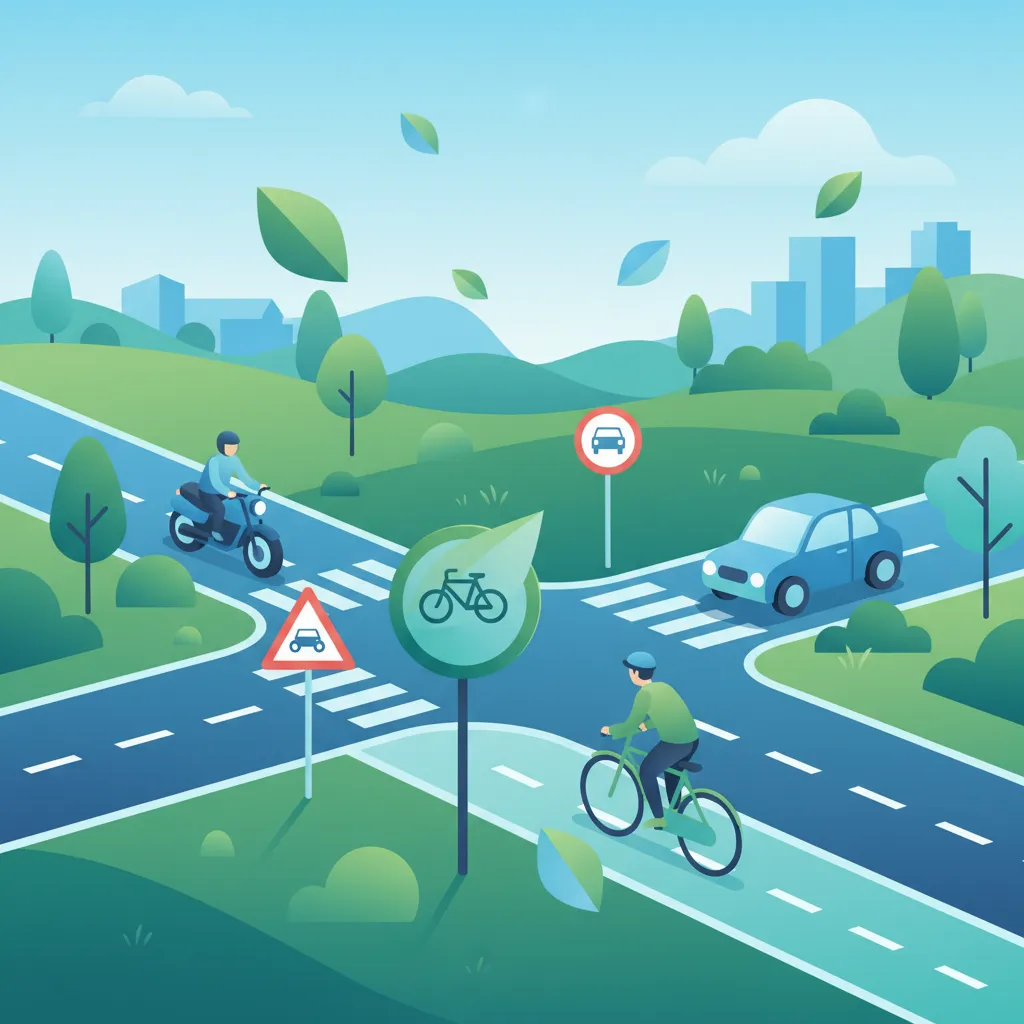
Browse all lessons that make up Rights of Way and Priority Situations. Each lesson focuses on specific topics, learning objectives, and core concepts, helping you build essential knowledge and follow a clear, structured progression toward your study goals in the Netherlands.
This lesson introduces the foundational principles of right-of-way in the Netherlands, starting with the road user hierarchy and the default rule of giving priority to traffic from the right at equal intersections. You will learn to identify a priority road, marked by sign BORD 30, and understand how this designation overrides the default rule. The content establishes the legal framework for making priority decisions in the absence of specific signs or signals.
This lesson details the specific actions required at intersections controlled by 'Stop' and 'Give Way' signs. You will learn the legal requirement to come to a complete stop at a stop line (BORD 44) and the obligation to yield to all crossing traffic when encountering give-way markings ('haaientanden'). The content covers safe approach speeds and effective scanning techniques for motorcyclists to accurately assess gaps in traffic before proceeding.
This lesson focuses on the rules and techniques for safely navigating Dutch roundabouts, a common feature of the road network. You will learn that traffic circulating on the roundabout typically has priority and that you must yield before entering. The content covers correct lane selection for your intended exit, proper use of turn signals, and maintaining awareness of cyclists who may have priority on adjacent paths.
This lesson explains the critical rules of priority involving pedestrians and cyclists to ensure the safety of vulnerable road users. You will learn the absolute requirement to stop for pedestrians on or waiting to use a 'zebrapad' (zebra crossing). The content also covers situations where you must yield to cyclists crossing your path, such as when turning across a dedicated bicycle lane (fietspad).
This lesson addresses the challenge of navigating equal-priority intersections, where no signs or markings dictate the right-of-way. You will master the fundamental Dutch traffic rule of giving priority to all drivers approaching from your right ('rechts voor'). The content focuses on developing advanced observational skills and clear communication to safely manage these situations, which are common in residential and urban areas.
Explore high-intent keywords and long-tail search topics learners use when researching Rights of Way and Priority Situations. These terms reflect how people search for reliable study materials, structured explanations, and unit-level theory preparation support in the Netherlands.
Find clear answers to the most common questions learners ask about Rights of Way and Priority Situations. Understand how the unit is organized, what learning goals it supports, and how it contributes to your study progression with structured explanations and practical guidance tailored for learners in the Netherlands.
A very common mistake is assuming priority when it's not explicitly granted, or misinterpreting the hierarchy between different road users like cyclists and cars. Forgetting that trams often have priority, or not correctly identifying priority roads, also leads to errors. This unit will clarify these common pitfalls and show you how to apply the rules correctly for the CBR exam.
In an 'equal-priority' intersection (gelijkwaardig kruispunt) in the Netherlands, the general rule is that traffic coming from the right has priority. However, you must always assess the situation carefully, look for potential hazards, and be prepared to yield if necessary to avoid a collision. We cover advanced decision-making for these situations in lesson 2.5.
For motorcycles in the Netherlands, roundabout rules generally follow those for other vehicles. You must yield to traffic already on the roundabout when entering. Ensure you signal correctly upon exiting. Lesson 2.3 specifically details how to navigate Dutch roundabouts safely and adhere to right-of-way protocols during your theory test preparation.
Pedestrians generally have priority on designated pedestrian crossings (zebrapaden) and when they are already on the road. As a motorcyclist, you must always be prepared to stop and yield to pedestrians. Lesson 2.4 explains the specific rules and scenarios involving pedestrian crossings and bicycle lanes.
Priority rules are critically important and form a significant part of the CBR theory exam for A2 motorcycle licenses. Many questions will test your ability to interpret diagrams of traffic situations and choose the correct order in which vehicles should proceed. Mastering this unit directly impacts your exam score and your safety on the road.
In any situation where you are unsure, it is always best to err on the side of caution. Look for visual cues, assess the speed and intentions of other road users, and be prepared to yield. In doubt, slow down and let others pass if it ensures safety. Our lessons provide strategies for making these split-second decisions.
All included lessons
Lessons in Rights of Way and Priority Situations
See who benefits most from studying Rights of Way and Priority Situations. This overview explains how the unit supports different learning needs, what level of knowledge is helpful before starting, and how it fits into the overall study path in the Netherlands.
This unit is essential for all aspiring A2 motorcycle license holders in the Netherlands preparing for their CBR theory exam. It is particularly beneficial for learners who find priority rules confusing, struggle with interpreting complex intersection scenarios, or want to ensure they have a solid understanding of Dutch traffic etiquette for safe riding.

See how Dutch Motorcycle Theory (A2) is structured, with key topics, learning objectives, and a step-by-step path for theory preparation in the Netherlands.
Explore all units and lessons included in this driving theory course.