
Welcome to the lesson on Counter-Steering and Body Positioning, a crucial topic within the 'Vehicle Controls and Riding Techniques' unit for your Dutch A1 motorcycle license. This lesson will demystify the advanced physics and practical application of how you control a motorcycle through turns, preparing you for complex questions on the CBR theory exam.

Navigating a motorcycle safely and confidently requires an intuitive understanding of how the machine responds to rider inputs. At speeds above approximately 15 km/h, the primary method for initiating a turn is not by simply turning the handlebars in the direction you wish to go, but through a technique known as counter-steering. This fundamental skill, combined with strategic body positioning, allows riders to control the motorcycle’s lean angle, maintain stability, and execute precise turns.
For aspiring riders seeking their Dutch A1 motorcycle license, mastering counter-steering and body positioning is not merely a theoretical exercise; it is essential for safe cornering, effective hazard avoidance, and complying with Dutch traffic regulations. This lesson will demystify these critical techniques, providing a deep dive into the physics, practical application, and legal context required for competent motorcycling in the Netherlands.
At low speeds, turning the handlebars in the direction you want to go (e.g., turning the handlebars right to go right) effectively steers the motorcycle. However, once a motorcycle gains speed, this intuitive action becomes ineffective and even dangerous. At higher speeds, a different mechanism takes over: counter-steering.
A deliberate, brief steering input applied to the handlebars in the direction opposite to the intended turn, which initiates a lean into the desired turn direction. For example, to turn left, you briefly push the left handlebar forward (or pull the right handlebar back).
This seemingly counter-intuitive action works due to the gyroscopic effect of the spinning wheels and the motorcycle's inherent steering geometry. When you push the left handlebar forward, the front wheel briefly turns slightly to the right. This causes the motorcycle to fall, or lean, to the left. As the motorcycle leans left, the natural forces of gravity and centrifugal force, combined with the tire's grip, guide the bike through a left turn. Once the lean is established, the rider can maintain the desired turn by holding a slight counter-steer pressure or by adjusting it to modify the lean angle.
The immediate benefit of counter-steering is its efficiency. It allows a rider to initiate a lean quickly and precisely, which is crucial for dynamic maneuvers like navigating bends, changing lanes, or performing emergency swerves. Ignoring this principle and attempting to steer directly at speed can lead to instability and loss of control.
The phenomenon of counter-steering is deeply rooted in motorcycle physics:
Understanding these principles helps riders appreciate why counter-steering works and how it efficiently translates rider input into a change in direction.
Once counter-steering initiates the lean, managing the lean angle becomes paramount for smooth, stable, and safe cornering.
The angle between the motorcycle’s vertical axis and the road surface, measured in degrees, indicating how much the bike is tilted into a turn.
The lean angle directly dictates the turning radius and the amount of lateral force generated by the tires. A larger lean angle allows for a tighter turn radius at a given speed, but it also pushes the tires closer to their adhesion limits. Conversely, reducing the lean angle widens the turn or allows for a higher speed through the same curve.
The Lean Angle Principle states that the lean angle must be sufficient to balance the centrifugal force pushing the bike outwards with the gravitational force pulling it downwards. If the lean angle is too shallow for the speed and turn radius, the motorcycle will run wide. If the lean angle is too aggressive for the available traction, the tires may lose grip, potentially leading to a low-side crash. Dutch traffic law, specifically RVV 2008 §27 (Speed Adaptation), mandates that drivers adjust speed to road conditions, especially when negotiating bends, which directly impacts the required lean angle. Furthermore, RVV 2008 §27a specifies that motorcycles must remain within lane markings while turning, requiring precise control over the lean angle and trajectory.
While counter-steering initiates the lean, the rider's body positioning plays a crucial role in refining the turn, enhancing stability, and maximizing tire grip. The rider is a significant portion of the total mass of the motorcycle and rider combined, meaning their movements can profoundly influence the machine's behavior.
The hypothetical point where the entire mass of the motorcycle and rider is considered to be concentrated, and around which all gravitational forces act.
The Centre of Gravity (CoG) Shift Principle highlights that by deliberately moving their body, a rider can alter the combined CoG of the motorcycle-rider system. The goal is to keep this combined CoG aligned within the tire contact patch throughout the turn. This ensures optimal traction and prevents the tires from being overloaded at extreme lean angles. An incorrect CoG shift can lead to instability, causing the bike to either under-steer (run wide) or over-steer (turn more sharply than intended), potentially reducing stability.
Effective body positioning involves a combination of movements:
RVV 2008 §6(8) clearly states: "Motorcycle riders must keep both feet on the footpegs while the motorcycle is in motion, except when stopping." This rule is not just about formality; it’s a critical safety measure. Removing a foot from the peg, especially during a turn, can destabilize the motorcycle, interfere with precise steering inputs, and reduce the rider's ability to control the bike's CoG. Maintaining both feet firmly on the pegs ensures the rider is securely integrated with the motorcycle, allowing for effective body positioning and maximum control.
Motorcycle riding is a highly visual activity. The concept of "Look-Where-You-Want-to-Go" is a fundamental principle that seamlessly integrates with counter-steering and body positioning.
The instinctive practice of focusing the rider’s gaze on the intended path or exit point of a corner, which automatically cues the neuromuscular system to initiate appropriate steering and body lean adjustments.
The human brain and body have a powerful, almost subconscious connection: your motorcycle tends to go where your eyes are looking. By actively scanning ahead and targeting the exit point or apex of a corner, the rider's brain processes the trajectory, speed, and lean angle needed, triggering the appropriate counter-steer input and body positioning without conscious effort. This significantly enhances reaction speed and reduces the likelihood of over-correction, making turns smoother and safer.
RVV 2008 §28a underscores this by requiring drivers to "keep a proper lookout to foresee potential hazards." For motorcyclists, this means not just seeing but actively targeting the safe path through any maneuver.
A common and dangerous misunderstanding is to look at obstacles. If a rider fixates on a pothole, a parked car, or an approaching curb, their motorcycle will often drift towards that obstacle. Instead, riders must train themselves to look through and past potential hazards, focusing on the clear escape path. This allows for timely and accurate counter-steer application, directing the motorcycle away from danger.
Safe and skilled motorcycle riding involves understanding how different inputs and forces interact.
In certain situations, particularly emergency avoidance maneuvers, riders might need to combine front braking with counter-steering. Applying the front brake while initiating a counter-steer can slightly increase the front wheel's slip angle, potentially aiding quicker lean initiation. However, this must be done with extreme care. Heavy front braking causes significant load transfer to the front tire, reducing the grip available for lateral forces (turning). Aggressive counter-steering combined with hard front braking, especially on a slippery surface, can exceed the front tire's adhesion limits, leading to a front-wheel lock-up or a loss of control. RVV 2008 §27 highlights the need to "adapt speed to road conditions and ensure control of the vehicle" when braking.
The dynamic redistribution of vertical forces (weight) between the front and rear tires, or between the left and right tires, during acceleration, braking, or turning.
During a turn, as the motorcycle leans, there is a shift in vertical load from the inside tire to the outside tire. This Load Transfer Principle is important because tire grip is directly related to the load placed upon it. Proper body positioning helps distribute this load optimally, ensuring that the tires, especially the outer ones, have maximum grip to handle the lateral forces required for cornering.
The angle between the plane of a rotating wheel and its actual direction of travel. A larger slip angle indicates that the tire is generating more lateral force but is also closer to its maximum grip limit.
Counter-steering deliberately creates a momentary slip angle at the front wheel, which initiates the lean. As the motorcycle leans through the turn, both tires develop a slip angle to generate the necessary lateral force. Riders must be aware that there are limits to how much slip angle a tire can sustain before it loses grip entirely. Exceeding these limits, especially through aggressive lean or acceleration/braking while leaned, can result in a loss of traction and a crash (either a "low-side" where the bike slides out, or a "high-side" where the rear tire suddenly regains traction, throwing the rider off).
The Dutch traffic laws, particularly the "Reglement Verkeersregels en Verkeerstekens 2008" (RVV 2008), emphasize safe maneuvering and control, which directly relate to the proper application of counter-steering and body positioning.
Throughout any maneuver involving counter-steering and leaning, it is a legal requirement and a critical safety practice to maintain your lane position. Excessive lean or an incorrect counter-steer input can cause the motorcycle to either run wide or cut the corner too sharply, potentially crossing into an adjacent lane or contacting the curb. Maintaining your trajectory within your designated lane is paramount, as dictated by RVV 2008 §22.
Understanding common errors can help riders develop safer habits.
Riding conditions are rarely static. Experienced riders constantly adapt their counter-steering and body positioning techniques based on the environment.
Consistent practice in varied conditions, starting with controlled environments, is crucial for developing the muscle memory and adaptability required for safe motorcycling.
Mastering counter-steering and body positioning is fundamental to safe and proficient motorcycle riding, especially for those pursuing their Dutch A1 license. These techniques allow you to precisely control your motorcycle's lean angle, maintain stability, and navigate corners and obstacles with confidence.
Remember these core principles:
By integrating these principles, you will develop the essential skills for controlled, precise, and safe motorcycling on Dutch roads, forming a solid foundation for more advanced riding techniques and hazard avoidance.
Lesson content overview
Explore all units and lessons included in this driving theory course.
Explore search topics learners often look for when studying Counter-Steering and Body Positioning. These topics reflect common questions about road rules, driving situations, safety guidance, and lesson level theory preparation for learners in the Netherlands.
Browse additional driving theory lessons that cover connected traffic rules, road signs, and common driving situations related to this topic. Improve your understanding of how different rules interact across everyday traffic scenarios.
Explore the deeper physics behind motorcycle counter-steering, gyroscopic effects, and lean angle management. Understand how these dynamics influence stability and cornering control for Dutch A1 licence theory.

This lesson explains the principle of counter-steering, the primary method for steering a motorcycle at speeds above a walking pace. You will learn that to turn right, you must momentarily press forward on the right handlebar, and to turn left, you press the left one. The content demystifies the physics behind this technique, explaining how it uses gyroscopic forces to initiate a lean, which is what actually makes the motorcycle turn.

This lesson demystifies the concept of counter-steering, the primary method for controlling a motorcycle at any speed above a walking pace. It explains the physics behind why pressing on the inside handlebar initiates a lean and turn in that direction. Mastering this non-intuitive but essential skill is fundamental for fluid cornering, precise line control, and the ability to execute rapid, life-saving swerves to avoid unexpected obstacles.

This lesson explains the critical role of the rider's body in controlling the motorcycle's dynamics, especially during cornering. It details how shifting body weight alters the combined center of gravity, allowing for greater cornering speed at a given lean angle or a safer lean angle for a given speed. Techniques for correct posture, footpeg weighting, and active body positioning are covered to enhance stability, maximize grip, and provide more precise control.

This lesson explains how you, the rider, are an active part of the motorcycle's dynamics. You will learn how shifting your body weight into the turn can reduce the required lean angle of the motorcycle itself, increasing the margin of safety and grip. The content covers correct posture, the importance of looking through the turn with your head up, and how to stay relaxed on the controls to allow the bike to work effectively.

This lesson provides a foundational understanding of the physics that govern motorcycle cornering. It explains how leaning the motorcycle shifts its center of gravity, creating a centripetal force that counteracts the outward centrifugal force of the turn. Learners will explore the relationship between speed, turn radius, and the required lean angle, as well as the critical role of tire traction in this dynamic balance.

This lesson explains how to apply the principle of counter-steering decisively in an emergency situation to perform a rapid swerve. It covers the importance of looking where you want to go, avoiding 'target fixation' on the obstacle, and executing a firm push on the appropriate handlebar to initiate a quick lean and change of direction. This skill is a critical component of collision avoidance for any motorcyclist.

Proper cornering technique is vital for safety and stability on a two-wheeler. This lesson explains the physics of turning, including the concepts of lean angle and counter-steering. You will learn the importance of adjusting your speed before the turn, looking where you want to go, and maintaining a smooth throttle through the corner. These techniques help you maximize grip and maintain control, ensuring you can navigate bends safely.

This lesson teaches the technique for swerving when stopping is not possible. You will learn that a swerve is initiated with a decisive counter-steer: press right to go right, press left to go left. The content emphasizes the importance of separating braking from swerving—ideally, you brake first, then release the brakes to execute the swerve, maintaining maximum available traction for steering.
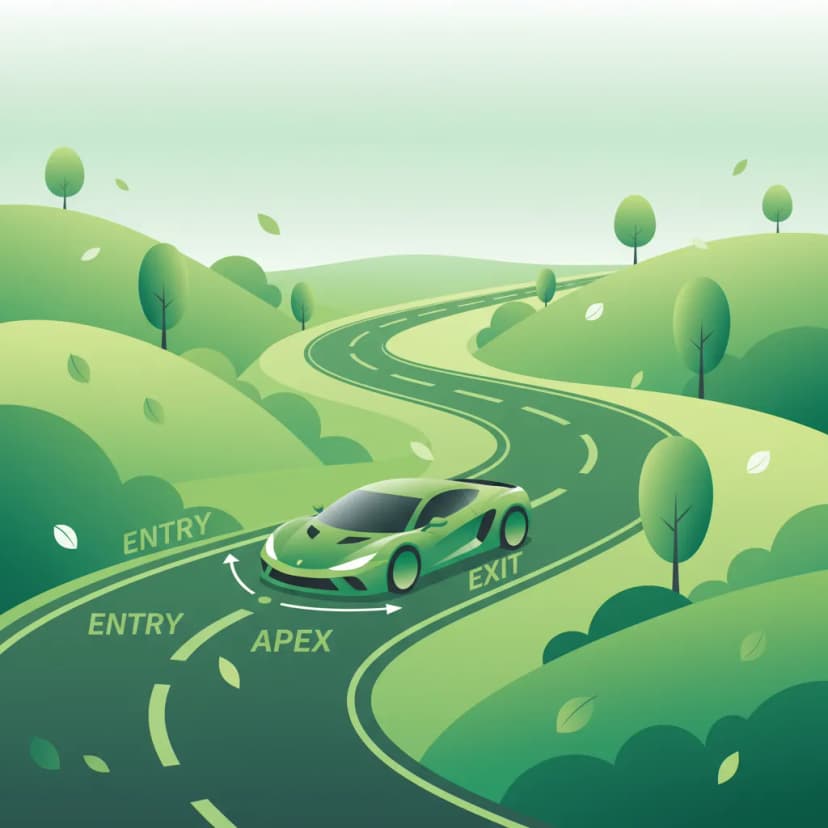
This lesson teaches a systematic approach to cornering by breaking it down into three distinct phases: entry, apex, and exit. It explains how to choose the correct road position and entry speed, identify the safest apex (not always the geometric one), and apply the throttle smoothly on exit to maximize stability and safety. This 'slow in, fast out' methodology provides a structured, repeatable process for navigating any corner with confidence and control.

This lesson focuses on the critical relationship between speed, braking, and throttle control in cornering. You will learn the golden rule: complete your braking while the motorcycle is still upright, before initiating your lean. The content then explains how to use a neutral or slightly positive 'maintenance throttle' to keep the suspension settled mid-corner, followed by smoothly rolling on the throttle as you exit the turn to aid stability.
Learn how rider body positioning impacts motorcycle stability and cornering. This lesson covers essential techniques for shifting weight and controlling the centre of gravity according to Dutch traffic regulations.
This lesson explains the critical role of the rider's body in controlling the motorcycle's dynamics, especially during cornering. It details how shifting body weight alters the combined center of gravity, allowing for greater cornering speed at a given lean angle or a safer lean angle for a given speed. Techniques for correct posture, footpeg weighting, and active body positioning are covered to enhance stability, maximize grip, and provide more precise control.
This lesson explains how you, the rider, are an active part of the motorcycle's dynamics. You will learn how shifting your body weight into the turn can reduce the required lean angle of the motorcycle itself, increasing the margin of safety and grip. The content covers correct posture, the importance of looking through the turn with your head up, and how to stay relaxed on the controls to allow the bike to work effectively.
This lesson teaches a systematic approach to cornering by breaking it down into three distinct phases: entry, apex, and exit. It explains how to choose the correct road position and entry speed, identify the safest apex (not always the geometric one), and apply the throttle smoothly on exit to maximize stability and safety. This 'slow in, fast out' methodology provides a structured, repeatable process for navigating any corner with confidence and control.

This lesson details the correct, systematic procedure for safely navigating a corner. It teaches the 'slow in, fast out' principle, where all necessary braking and downshifting is completed before entering the turn. The content covers how to choose the correct line, identify the apex, and use smooth throttle application on the exit to maintain stability and traction, ensuring a safe and controlled passage through the bend.
Proper cornering technique is vital for safety and stability on a two-wheeler. This lesson explains the physics of turning, including the concepts of lean angle and counter-steering. You will learn the importance of adjusting your speed before the turn, looking where you want to go, and maintaining a smooth throttle through the corner. These techniques help you maximize grip and maintain control, ensuring you can navigate bends safely.

This lesson addresses the specific challenge of cornering when road grip is compromised. It teaches riders how to identify potential low-traction surfaces like wet manhole covers, painted lines, gravel, or oil patches. The content focuses on techniques to mitigate risk, such as reducing speed, minimizing lean angle, and applying all control inputs—braking, steering, and throttle—with exceptional smoothness to avoid overwhelming the available grip.
This lesson focuses on the critical relationship between speed, braking, and throttle control in cornering. You will learn the golden rule: complete your braking while the motorcycle is still upright, before initiating your lean. The content then explains how to use a neutral or slightly positive 'maintenance throttle' to keep the suspension settled mid-corner, followed by smoothly rolling on the throttle as you exit the turn to aid stability.

This lesson explains the concept of strategic lane positioning, moving beyond simply staying in the center of the lane. It details how to select a position—typically in the left or right wheel track of cars—to be more visible in other drivers' mirrors, avoid the slippery center strip, and maintain a space cushion. The content emphasizes constantly adjusting position based on traffic, road conditions, and potential hazards.

This lesson prepares you for real-world cornering challenges where conditions are not always perfect. You will learn how to identify clues that a corner may be tightening (a decreasing radius) and how to adjust your line accordingly. The content covers strategies for dealing with unexpected hazards like gravel or wet patches mid-corner and emphasizes the importance of always riding in a way that leaves you an escape route or a margin for error.
This lesson explains the principle of counter-steering, the primary method for steering a motorcycle at speeds above a walking pace. You will learn that to turn right, you must momentarily press forward on the right handlebar, and to turn left, you press the left one. The content demystifies the physics behind this technique, explaining how it uses gyroscopic forces to initiate a lean, which is what actually makes the motorcycle turn.
Find clear answers to common questions learners have about Counter-Steering and Body Positioning. Learn how the lesson is structured, which driving theory objectives it supports, and how it fits into the overall learning path of units and curriculum progression in the Netherlands. These explanations help you understand key concepts, lesson flow, and exam focused study goals.
Counter-steering is the technique where you push the handlebar in the direction opposite to the turn you want to make. Pushing left on the handlebar briefly causes the bike to lean right, and vice versa. This lean angle is what allows the motorcycle to turn. It's a fundamental principle of steering a two-wheeled vehicle at anything above a walking pace.
Your body position is crucial for initiating and controlling lean angles. Shifting your weight towards the inside of a turn helps the motorcycle lean more easily and maintains stability. Correct posture ensures your center of gravity works with the bike's dynamics, making the turn smoother and more controlled. This is especially important for advanced riders and understanding CBR exam questions.
At very low speeds, you can steer more directly by turning the handlebars as you would on a bicycle. However, as soon as you reach a moderate speed, counter-steering becomes the primary method for initiating a lean, which is necessary for turning. Most theory questions related to turning dynamics assume riding speeds where counter-steering is applicable.
Regular steering, like on a car, involves turning the wheels directly into the turn. Counter-steering involves an initial push away from the desired turn direction to induce a lean, followed by adjustments to maintain the lean angle and control the turn. It's a counter-intuitive concept but essential for motorcycle control at speed, and vital for passing the A1 theory exam.
No, body positioning complements counter-steering but cannot replace it for initiating turns. Counter-steering is the direct input to make the motorcycle lean. Body position influences how much you can lean, how stable you are during the lean, and how easily you can transition between leans. Both are vital for safe cornering and mastering A1 theory.