
Understanding the relationship between your speed, the distance to obstacles, and your motorcycle's stopping capability is crucial for safe riding. This unit dives deep into the physics and practical application of safe stopping distances and speed management, essential knowledge for your Dutch A1 motorcycle theory exam and everyday riding.
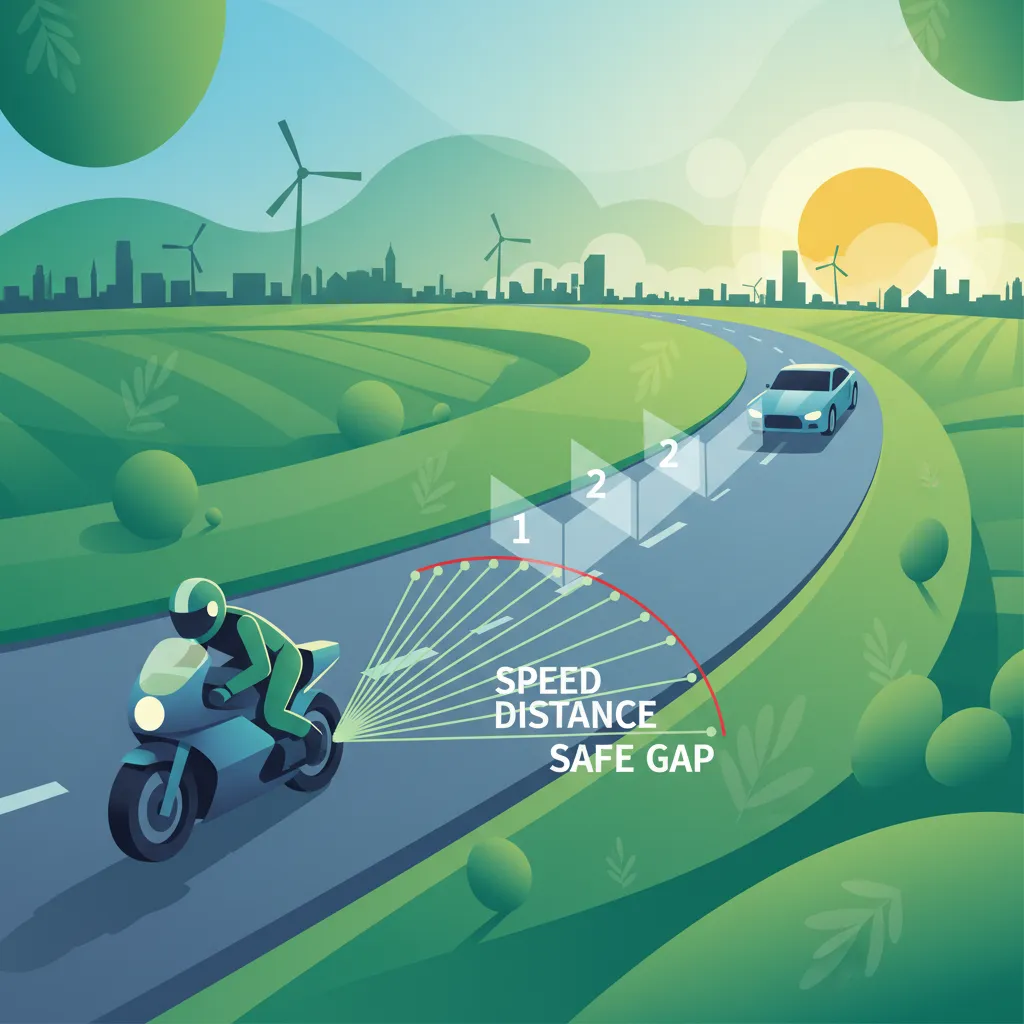
Browse all lessons that make up Speed, Distance and Stopping. Each lesson focuses on specific topics, learning objectives, and core concepts, helping you build essential knowledge and follow a clear, structured progression toward your study goals in the Netherlands.
This lesson provides a definitive guide to the legal speed limits on different types of Dutch roads. It covers the rules for built-up areas (typically 50 km/h), rural roads (80 km/h), expressways ('autowegen'), and motorways ('snelwegen'), including time-dependent variations. Understanding these official limits is the first step in managing speed legally and appropriately for the road environment, a core topic on the CBR theory test.
This lesson focuses on the crucial safety practice of maintaining an adequate following distance to the vehicle ahead. It explains the 'two-second rule' as a minimum baseline and emphasizes the need to increase this gap to three or four seconds in adverse conditions like rain or poor visibility. For a motorcyclist, this 'space cushion' is a critical buffer that provides the necessary time and space to react to sudden hazards or stop safely.
This lesson provides a theoretical understanding of the components that make up the total stopping distance. It explains how to calculate reaction distance (the distance traveled before applying the brakes) and braking distance (the distance traveled while braking). The content highlights how speed exponentially increases stopping distance and how other variables like rider alertness, road grip, and brake condition play a significant role in the final calculation.
This lesson focuses on hazard perception ('gevaarherkenning'), a critical section of the CBR exam. It explains how increasing speed reduces a rider's field of vision and shortens the time available to identify, process, and react to potential dangers. The content explores techniques for actively scanning the road ahead and anticipating the actions of other road users to make safe, proactive decisions rather than reactive ones.
This lesson compares the different skills and awareness levels required for riding in dense urban environments versus high-speed express environments. It discusses managing frequent hazards like intersections and vulnerable road users in the city, contrasted with the need for high-speed stability, smooth lane changes, and managing merging traffic on motorways. Understanding how to adapt riding style is key to navigating these distinct settings safely.
Explore high-intent keywords and long-tail search topics learners use when researching Speed, Distance and Stopping. These terms reflect how people search for reliable study materials, structured explanations, and unit-level theory preparation support in the Netherlands.
Find clear answers to the most common questions learners ask about Speed, Distance and Stopping. Understand how the unit is organized, what learning goals it supports, and how it contributes to your study progression with structured explanations and practical guidance tailored for learners in the Netherlands.
The two-second rule is a guideline for maintaining a safe following distance. Pick a fixed point on the road ahead (like a sign). When the vehicle in front passes it, start counting 'one thousand one, one thousand two'. If you reach the point before you finish counting, you are too close. For motorcycles, this might need adjustment based on road conditions and your speed; sometimes a longer gap is necessary.
Total stopping distance is composed of two parts: reaction distance and braking distance. Reaction distance is the distance your motorcycle travels from the moment you perceive a hazard to the moment you apply the brakes. Braking distance is the distance your motorcycle travels from the moment you apply the brakes until it comes to a complete stop. Speed has a significant impact on both, but especially on braking distance.
Speed dramatically increases stopping distance. As speed doubles, your reaction distance also doubles, but your braking distance increases by the square of the speed. This means if you double your speed, your braking distance becomes four times longer. This is a critical concept for understanding why maintaining appropriate speeds is paramount for safety.
Several factors influence stopping distance. These include the condition of your tires (tread depth and inflation), the road surface (wet, dry, gravel, or oily surfaces reduce grip), the condition of your brakes, the weight of the motorcycle and rider, and even the rider's reaction time. Weather conditions like rain, ice, or fog significantly increase stopping distances.
Generally, motorcycles can stop faster than cars under ideal conditions due to their agility and often more powerful braking systems relative to their weight. However, motorcycles are also more vulnerable. Factors like tire grip and rider stability are more critical, meaning stopping distances can increase dramatically on less-than-ideal surfaces or if braking is not executed correctly.
In the Netherlands, specific speed limits apply to different road types: 50 km/h in built-up areas, 100 km/h on provincial roads (buiten bebouwde kom), 120 km/h on motorways (autosnelwegen), and 130 km/h on specific motorways. Always adhere to these limits and adjust your speed according to traffic, road, and weather conditions, ensuring you can stop safely at all times.
All included lessons
Lessons in Speed, Distance and Stopping
See who benefits most from studying Speed, Distance and Stopping. This overview explains how the unit supports different learning needs, what level of knowledge is helpful before starting, and how it fits into the overall study path in the Netherlands.
This unit is essential for all learners preparing for the Dutch A1 motorcycle theory exam, especially those who need to grasp the critical physics and practical application of safe speeds and stopping distances. It's particularly beneficial for riders who want to build a strong foundation in hazard perception and risk management specific to motorcycle vulnerability.

See how Dutch A1 Motorcycle Theory is structured, with key topics, learning objectives, and a step-by-step path for theory preparation in the Netherlands.
Explore all units and lessons included in this driving theory course.