
Welcome to this lesson on Variable Message Signs (VMS) and digital displays, a crucial topic within Unit 2: Road Signs and Signals for Motorcyclists. Understanding these dynamic signs, often called 'matrixborden', is vital for adapting to changing traffic conditions and ensuring your safety on Dutch roads, especially on motorways and in tunnels. This knowledge is directly tested in the CBR motorcycle theory exam.

As a motorcyclist preparing for the Dutch CBR Category A theory exam, comprehending Variable Message Signs (VMS) and other digital displays is not just beneficial—it's critical for your safety and legal compliance. These advanced electronic signs, often called matrixborden or variabele informatieborden in Dutch, provide real-time traffic information that can dynamically alter road conditions, speed limits, and lane usage. Your ability to quickly interpret and respond to these messages will directly impact your decision-making on motorways and in tunnels, ensuring a safer and smoother ride.
Variable Message Signs (VMS) are sophisticated electronic display panels strategically positioned on Dutch roads, motorways, and tunnel entrances. Unlike static road signs, VMS are programmable, allowing traffic authorities to convey real-time, location-specific information instantly. This dynamic communication system is a cornerstone of modern traffic management, enabling rapid responses to changing road conditions such as congestion, accidents, and adverse weather.
These signs are integral to dynamic traffic guidance, aiming to improve traffic flow, enhance safety, and reduce environmental impact. For motorcyclists, understanding VMS is paramount, as the information displayed directly impacts legal requirements and safe riding practices. Non-compliance can lead to hazardous situations and legal penalties, underscoring the importance of instant interpretation and obedience.
VMS come in various forms, each designed for specific environments and information delivery needs. While all serve the common goal of dynamic traffic guidance, their technical specifications and typical applications can differ:
The primary purpose of VMS is to facilitate dynamic traffic guidance, adapting road rules and information to the current situation. This real-time data communication offers several key benefits:
For motorcyclists, this means a constantly evolving road environment where adherence to VMS instructions is not merely a suggestion but a legal and safety imperative. Your ability to anticipate, identify, and correctly interpret these signs is a fundamental skill for safe riding in the Netherlands.
One of the most significant functions of VMS is the display of dynamic speed limits. These are temporary speed restrictions that supersede the static, permanently posted speed limits for a specific section of road. It is crucial for motorcyclists to understand that these dynamic limits are not merely recommendations; they are legally binding and must be strictly obeyed.
Dynamic speed limits are determined by sophisticated traffic management centers (TMC) using real-time data from various sensors embedded in the road, cameras, and weather stations. Factors influencing these limits include:
The displayed dynamic speed limit applies immediately from the point of the sign and remains in effect until a new VMS indicates a different limit, or until the end of the restricted zone is clearly marked, or until the default static speed limit of the road segment is reached. VMS often display speed limits with different background colors to indicate urgency:
For motorcyclists, compliance with dynamic speed limits is enshrined in Dutch law. Article 7, paragraph 1a, of the Reglement verkeersregels en verkeerstekens (RVV) 1990 explicitly states that dynamic speed limits displayed on VMS are legally binding. This means that:
Failing to comply with a dynamic speed limit is a traffic offense, carrying potential fines and penalty points on your driving record. It also significantly increases your risk of an accident, especially on a motorcycle where reduced stability and braking distances are crucial considerations.
Beyond speed limits, Variable Message Signs are extensively used for dynamic lane control. These messages direct traffic regarding lane usage, indicate closures, and impose overtaking restrictions. As a motorcyclist, understanding and immediately obeying these directives is vital for preventing collisions and ensuring smooth traffic flow, especially in complex motorway environments or at roadworks.
VMS can display various symbols and text messages to control lane usage. These messages are legally binding under Article 7, paragraph 3, of the RVV 1990.
VMS can also communicate various prohibitions that demand immediate compliance:
Compliance with lane control and prohibition messages is crucial. Ignoring a closed lane can lead to head-on collisions with maintenance vehicles or workers, while violating an overtaking ban increases the risk of side-swipe accidents, especially for smaller vehicles like motorcycles.
Variable Message Signs are indispensable tools for alerting road users to unforeseen incidents and hazards ahead. These alerts demand immediate attention and appropriate action to prevent secondary accidents and ensure overall road safety. While there might not be a single RVV article specifically for "hazard alerts," responding appropriately falls under the general duty of care stipulated in Article 3 of the Wegenverkeerswet 1994.
VMS can display a variety of hazard alerts, often using a combination of text and universally recognized symbols:
Upon seeing any hazard alert on a VMS, a motorcyclist's duty of care mandates a responsible and immediate response. This includes:
Ignoring a hazard warning displayed on a VMS is not only reckless but can be deemed negligent in the event of an accident. The intent of these signs is to give you precious extra seconds to react, which can be the difference between a near miss and a serious collision.
Tunnels present unique challenges for road users, including reduced visibility, limited escape routes, and confined spaces. Variable Message Signs within tunnels, or at their entrances, are therefore designed and deployed with enhanced safety features and critical functionalities to manage these risks effectively.
Tunnel VMS often possess specific characteristics to ensure maximum visibility and functionality in a confined environment:
When entering a tunnel, be prepared for a sudden change in light and a potential reduction in speed limit. Look immediately for VMS at the entrance and within the tunnel itself.
In the dire event of a tunnel fire or major incident, tunnel VMS play a crucial role in directing emergency evacuations. These instructions are paramount and must be followed immediately without hesitation:
European Union Directive 2004/54/EC, implemented in Dutch law, sets stringent safety requirements for tunnels, including the precise function and placement of VMS for emergency management. As a motorcyclist, your survival in such a scenario could depend entirely on your prompt and correct response to these critical messages.
The effectiveness of Variable Message Signs relies heavily on their technical performance and reliability. In the Netherlands, VMS adhere to strict European and national technical standards to ensure they are visible, readable, and functional under a wide array of conditions.
Key technical criteria for VMS are outlined in standards such as EN 13561 and relevant EU Regulations. These standards dictate aspects like:
Modern VMS systems are designed with high reliability and redundancy to ensure continuous operation, especially during critical incidents:
These technical standards and reliability measures are in place to guarantee that the dynamic information you receive is consistently accurate and legible, allowing you to make informed decisions for your safety.
Compliance with Variable Message Signs in the Netherlands is not optional; it is a legal requirement enforced by specific articles within Dutch traffic legislation. Understanding the legal framework behind VMS ensures you ride safely and avoid penalties.
The Reglement verkeersregels en verkeerstekens (RVV) 1990 is the core regulation governing traffic rules and signs in the Netherlands. It explicitly grants legal authority to instructions displayed on VMS:
Beyond the RVV 1990, the broader Wegenverkeerswet 1994 (Road Traffic Act) includes a general "duty of care" (Article 3), which implies that drivers must always act responsibly to prevent danger or obstruction. This covers the requirement to respond appropriately to hazard alerts displayed on VMS, even if a specific speed limit isn't imposed.
Violating the instructions displayed on Variable Message Signs can lead to significant legal and financial consequences:
Therefore, for anyone undertaking the Dutch Motorcycle Theory – Category A Comprehensive Preparation, internalizing the legal weight of VMS messages is fundamental to becoming a responsible and safe rider.
Despite the clear intentions and legal backing of VMS, common misunderstandings can lead to unsafe practices or violations. Understanding these pitfalls and adopting safe riding strategies is crucial for all motorcyclists.
The interpretation of VMS is often dynamic and depends on the prevailing conditions:
Motorcyclists should be particularly wary of the following common errors when encountering VMS:
By being proactively aware of these potential issues and practicing defensive riding, motorcyclists can significantly enhance their safety and legal standing on Dutch roads. Your ability to consistently interpret and respond to VMS correctly is a hallmark of a skilled and responsible rider.
Lesson content overview
Explore all units and lessons included in this driving theory course.
Explore search topics learners often look for when studying Variable Message Signs and Digital Displays. These topics reflect common questions about road rules, driving situations, safety guidance, and lesson level theory preparation for learners in the Netherlands.
Browse additional driving theory lessons that cover connected traffic rules, road signs, and common driving situations related to this topic. Improve your understanding of how different rules interact across everyday traffic scenarios.
Learn about the specific functions of Variable Message Signs (VMS) in Dutch tunnels. Understand how to interpret tunnel VMS for speed limits, lane control, and crucial emergency evacuation instructions for motorcyclists.

This lesson details the specific regulations ('tunnelvoorschriften') and best practices for riding through tunnels in the Netherlands. It covers key rules such as removing sunglasses before entry, maintaining a safe following distance, and understanding tunnel-specific signage and traffic lights. The curriculum also explains the location and purpose of emergency exits and refuges, and the importance of tuning into the indicated radio frequency for emergency broadcasts.

This lesson provides clear, life-saving instructions for handling an emergency stop inside a tunnel. It outlines the correct procedure: pull into an emergency bay if possible, activate hazard lights, turn off the engine, and leave the key. The content emphasizes the importance of moving to a safe location, using the emergency telephones to report the incident, and following all instructions from tunnel operators, including evacuation procedures if necessary.

This lesson transitions hazard perception skills to the high-speed environment of motorways and tunnels. It covers specific risks such as vehicles merging at different speeds, sudden braking and congestion ahead, road debris, and the aerodynamic effects of crosswinds and large trucks. The curriculum also addresses the challenges of riding in tunnels, including changes in light and surface conditions, and the importance of identifying emergency exits and procedures in case of an incident.

This lesson equips you with the knowledge to safely navigate special traffic situations. It covers the rules for riding through tunnels, including mandatory lighting, and the absolute priority of trains at level crossings, indicated by warning lights and barriers. You will also learn to recognize and react to the temporary signage and altered lane configurations typically found in road work zones, ensuring you can adapt your riding to maintain safety in these potentially hazardous environments.

This lesson clarifies the specific Dutch regulations concerning stopping and parking for motorcycles, including designated parking bays and rules for parking on pavements. It also covers the mandatory procedures for safely navigating tunnels, such as required lighting, lane discipline, and actions to take during a breakdown or emergency. By understanding these rules, riders can avoid fines and navigate these specific traffic situations with confidence.

This lesson explains how to respond to variable speed limits shown on overhead electronic signs, which are used to manage traffic flow in real-time. You will learn why these limits are adjusted for factors like congestion, accidents, or bad weather, and the legal requirement to obey them. The content focuses on the importance of anticipatory riding, scanning far ahead for these signs to allow for smooth and safe speed adjustments.

This lesson covers safety procedures for specific infrastructure. You will learn the importance of using dipped headlights in tunnels and what to do in case of a breakdown or fire inside a tunnel. The curriculum explains how to respond to the warning lights and barriers at movable bridges and railway level crossings, emphasizing that you must always stop for flashing red lights. The meaning of the St. Andrew's Crosses, indicating the number of railway tracks, is also covered.

This lesson details the purpose and visual design of Dutch warning signs ('gevarendriehoeken') that alert riders to potential hazards ahead. It covers a wide range of scenarios, from road narrowing and dangerous curves to construction zones and the risk of falling rocks, emphasizing the need for early anticipation and speed adaptation. The content also explains how these warning signs integrate with other traffic information to help a rider form an accurate risk assessment and make safer decisions.

This lesson prepares riders for navigating the unique challenges of construction zones and temporary road layouts. It covers the identification of orange-colored temporary signs, understanding detour (omleiding) routes, and adhering to reduced speed limits. Special attention is given to the hazards common in work zones, such as loose gravel, uneven surfaces, and the presence of workers, emphasizing the need for heightened awareness and caution.

This lesson offers an in-depth study of Dutch regulatory signs, which impose mandatory actions or prohibitions on road users, with a specific focus on their impact on motorcyclists. It explains the visual language of prohibition symbols ('verbodsborden') and obligation symbols ('verplichtingsborden'), the contexts in which they appear, and the strict statutory consequences of non-compliance. Real-world examples are used to illustrate how these signs directly influence route planning, overtaking decisions, and speed management.
Master the legal requirements and safe interpretation of dynamic speed limits and lane control messages on Dutch Variable Message Signs (VMS). This lesson covers rider responsibilities and avoiding common misinterpretations.
This lesson explains how to respond to variable speed limits shown on overhead electronic signs, which are used to manage traffic flow in real-time. You will learn why these limits are adjusted for factors like congestion, accidents, or bad weather, and the legal requirement to obey them. The content focuses on the importance of anticipatory riding, scanning far ahead for these signs to allow for smooth and safe speed adjustments.
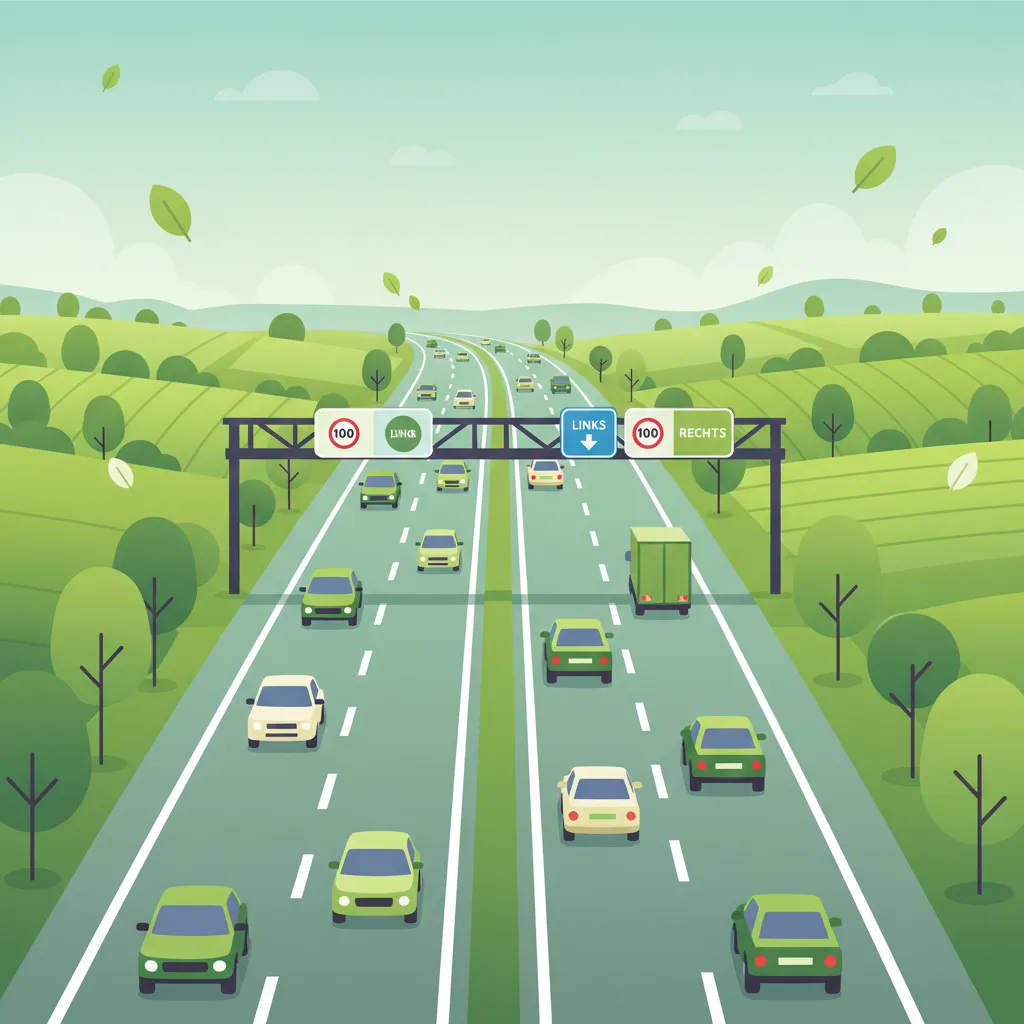
This lesson covers the specific articles of the Dutch Road Traffic Act that apply to motorways, with a primary focus on the strict rule of keeping to the rightmost available lane unless overtaking. It explains the legal and safety reasons for only passing on the left and discusses the correct positioning within a lane for maximum visibility and safety. The content also addresses the nuances of lane usage during heavy congestion, ensuring riders comply with the law and contribute to smooth traffic flow.
This lesson provides a detailed overview of fixed speed limits on the Dutch road network and the signs that indicate them. You will learn to identify signs for maximum speed (BORD 50) and understand the default limits that apply within built-up areas, on rural roads, and on motorways. The content emphasizes the importance of constant awareness and legal compliance to avoid penalties and ensure road safety for yourself and others.

This lesson reinforces the fundamental rule of Dutch highway driving: use the rightmost lane available and use the lanes to the left only for overtaking. You will learn the complete, safe overtaking procedure: check mirrors, signal, perform a shoulder check for the blind spot, smoothly move over, accelerate past the vehicle, and then return to the right lane when safe.

This lesson focuses on Dutch regulatory signs that enforce mandatory rules and restrictions, particularly those impacting A2 motorcyclists. You will learn to recognize and obey prohibition signs, such as those indicating a motorcycle ban (BORD 40), speed limits, and overtaking restrictions (BORD 21). The content explains the legal consequences of non-compliance and how to apply these rules in practical riding scenarios to ensure full adherence to Dutch traffic law.

This lesson focuses on the unique demands of riding at sustained high speeds on motorways ('snelwegen'). It covers essential topics such as strict lane discipline, safe overtaking procedures, and maintaining a greater following distance to compensate for higher reaction and braking times. The content also addresses the physical and mental challenges, including managing wind blast, increased noise levels, and maintaining heightened situational awareness over long distances to combat fatigue.

This lesson focuses on the legal requirements and safe practices for riding near pedestrian crossings ('zebrapaden') and designated school zones. It details the absolute obligation to yield to pedestrians on or about to use a crossing and the need for significantly reduced speeds and heightened vigilance in areas with children. The content underscores the importance of anticipation and being prepared for unpredictable movements from vulnerable road users to prevent serious incidents.

This lesson explains the concept of strategic lane positioning, moving beyond simply staying in the center of the lane. It details how to select a position—typically in the left or right wheel track of cars—to be more visible in other drivers' mirrors, avoid the slippery center strip, and maintain a space cushion. The content emphasizes constantly adjusting position based on traffic, road conditions, and potential hazards.

This lesson provides an overview of the various speed enforcement technologies and strategies used in the Netherlands. It explains the operation of fixed speed cameras ('flitspalen'), average speed check systems ('trajectcontrole'), and mobile enforcement units used by the police. Understanding these methods helps riders appreciate the high likelihood of being caught for speeding, reinforcing the importance of consistent compliance with all posted speed limits to avoid fines and other penalties.

This lesson explains the specific rules and best practices for lane filtering in traffic jams ('file rijden') in the Netherlands. You will learn the conditions under which it is permitted, such as the limited speed difference between you and the cars. The content emphasizes heightened awareness, watching for drivers changing lanes unexpectedly, and the importance of performing this manoeuvre at a low, controlled speed.
Find clear answers to common questions learners have about Variable Message Signs and Digital Displays. Learn how the lesson is structured, which driving theory objectives it supports, and how it fits into the overall learning path of units and curriculum progression in the Netherlands. These explanations help you understand key concepts, lesson flow, and exam focused study goals.
In the Netherlands, motorcyclists are legally required to obey all instructions displayed on Variable Message Signs (VMS), also known as matrixborden. These signs provide dynamic traffic information, such as speed limits, lane closures, or warnings, and are as binding as permanent road signs. Failing to comply can lead to fines and poses a safety risk.
VMS often display temporary or variable speed limits that can differ from the permanent national limits. For motorcycles, it is crucial to constantly monitor these signs, especially on motorways and in tunnels, and adjust your speed accordingly. These dynamic limits are usually set to manage traffic flow or in response to specific conditions like congestion or an accident.
If a VMS indicates a lane closure, you must prepare to change lanes safely, yielding to other traffic if necessary, and move to an open lane. If a diversion route is indicated, follow the signs for that route. Always check your mirrors and blind spots before changing lanes or exiting the current road. This is a common scenario tested in the theory exam.
Generally, VMS display information relevant to all vehicles, including motorcycles. However, sometimes specific lanes or advisory speeds might be indicated that are more critical for certain vehicle types due to their characteristics. Always interpret the signs in context of your motorcycle's capabilities and general traffic flow.
Standard road signs are permanent fixtures, while VMS are dynamic and can change their message or display in real-time. This allows traffic authorities to adapt to changing conditions, such as weather, traffic volume, or incidents. Their temporary nature means they require constant attention from riders, as the rules can change unexpectedly.