
Logo
Dutch Driving Theory Courses

Lesson 3 of the Road Signs and Signals for Motorcyclists unit

Dutch Motorcycle Theory A: Information Signs (richtings- en bestemmingstekens)

This lesson dives into information signs ('richtings- en bestemmingstekens'), a key part of the Dutch Category A motorcycle theory exam. Understanding these signs is crucial for safe navigation and route planning, especially on longer journeys. We'll break down the symbols, colours, and meanings that guide you to your destination and essential services.

information signsdirectional signsnavigationroute planningCBR A
Dutch Motorcycle Theory A: Information Signs (richtings- en bestemmingstekens)
Dutch Motorcycle Theory A

Understanding Dutch Information Signs (Richtings- en Bestemmingstekens) for Motorcyclists

Navigating the roads safely and efficiently as a motorcyclist in the Netherlands requires a comprehensive understanding of all traffic signage. While regulatory signs dictate what you must or must not do, and warning signs alert you to potential dangers, information signs (known in Dutch as richtings- en bestemmingstekens) play a crucial role in guiding your journey. These signs provide non-mandatory yet highly useful data about directions, distances, destinations, and available services, enabling you to make informed decisions on the road.

This lesson, part of your Dutch Motorcycle Theory – Category A Comprehensive Preparation, will delve into the specific types of informational signs found in the Netherlands. We will explore their design, meaning, and how they contribute to strategic route planning and overall road safety. By mastering the interpretation of these signs, you can enhance your situational awareness, reduce rider fatigue, and ensure a smooth, predictable trip, whether you're on a short city ride or a long-distance tour.

Core Principles of Dutch Informational Road Signs

Informational signs are distinct from other sign categories because they offer guidance rather than commands. Despite their advisory nature, their design and placement are highly standardized to ensure maximum effectiveness for all road users, including motorcyclists who often experience unique perceptual challenges. Understanding these core principles is fundamental to their correct interpretation.

Standardisation and Uniformity

All informational signs in the Netherlands adhere to a strict set of regulations concerning their shapes, colours, and symbols, as defined in the Reglement verkeersregels en verkeerstekens (RVV 1990). This standardisation guarantees instant recognisability across the entire national road network, regardless of whether you are in a bustling city or a remote rural area. This consistency is particularly beneficial for motorcyclists, who need to process information quickly due to higher speeds and reduced peripheral vision from helmets.

Non-Mandatory Nature: Advisory Guidance

A key characteristic of information signs is their advisory nature. Unlike regulatory signs, there is no legal requirement to obey their content directly. For example, while a sign might point to a "Tourist Route," you are not legally obliged to follow it. This provides flexibility in route choice while still promoting safer, more logical travel decisions. However, ignoring critical navigational information can indirectly lead to unsafe actions, such as sudden lane changes or missed exits, which may then contravene other traffic rules related to general duty of care.

Visibility and Legibility for Motorcyclists

The placement, height, illumination, and contrast of informational signs are carefully regulated to ensure maximum readability. For instance, signs on roads with a speed limit exceeding 70 km/h are typically designed to be legible from at least 150 meters away. This aids motorcyclists by providing sufficient perception and reaction time. Poor visibility, such as during heavy rain, dense fog, or at night, can significantly reduce the effective range of these signs, necessitating a reduced approach speed to maintain safety.

Hierarchical Information Processing

Informational signs are designed to convey the most critical data first, streamlining cognitive processing for riders under time pressure. The typical hierarchy flows from general direction, to distance, then specific destinations, and finally to available facilities. For example, a sign will first show the arrow for a major route, then the distance to the next major town, then perhaps a specific point of interest, and only then indicate a nearby service. Misreading this order can lead to incorrect route decisions and potential hazards.

Contextual Consistency

The content of informational signs must always be consistent with the actual surrounding road layout and conditions. A sign indicating a "Motorway Exit" will only appear where a physical exit truly exists. This consistency prevents confusion and misinformation, building trust in the signage system. Should you encounter inconsistent or conflicting signage, it might indicate a road authority error, but as a rider, you should always cross-reference with your knowledge of the road and, if possible, navigation tools.

Detailed Breakdown of Dutch Information Sign Types

The Dutch road network employs several distinct types of information signs, each serving a specific purpose in guiding road users. Recognising these categories and their unique characteristics is vital for effective navigation.

Directional Signs (Richtingsborden)

Directional signs are rectangular and predominantly feature a blue background with white arrows and text for national roads, or a green background with white arrows and text for motorways (A-roads). They are designed to guide riders towards a specific road or route.

These signs can be:

  • Single-arrow signs: Indicating a singular direction for a road.
  • Multiple-arrow signs: Presenting several possible directions, often with route numbers (e.g., "A1 - Utrecht, A2 - Amsterdam").
  • Route-number signs: Explicitly including alphanumeric route identifiers (e.g., "N331 Zwolle").
  • Temporary directional signs: Distinctly marked with an orange background, white text, and arrows, used for detours during roadworks or special events.

Tip

On high-speed roads, directional signs are typically placed well in advance of a junction, often 150 meters or more. This provides motorcyclists with sufficient time to assess the information, check mirrors, signal, and safely position themselves for an exit or turn.

Destination Signs (Bestemmingstekens)

Destination signs are blue rectangular signs that display the names of cities, towns, villages, or specific points of interest. They frequently include the distance to the named location in kilometres.

These signs can feature:

  • City/Town names: Such as "AMERSFOORT" or "ROTTERDAM."
  • Specific facilities: Like "VILLAGE CENTER" or "AIRPORT SCHIPHOL."
  • Tourist attractions: For example, "MUSEUM DISTRICT."

Destination signs help riders confirm they are on the correct route and allow for early planning of lane changes or exits. It's important to pay attention to the distance value, as it indicates the total distance to the destination, not just to the next junction.

Distance Signs (Afstandsborden)

Distance signs provide crucial information about the remaining kilometres to a referenced location. They are typically blue and positioned directly below or next to associated directional or destination signs. For very short distances (e.g., less than 500 meters), the distance may occasionally be expressed in metres.

These signs are essential for:

  • Gauging remaining travel distance: Helping riders anticipate when to slow down for exits or plan stops.
  • Fuel management: Assisting in estimating fuel consumption over the remaining distance.
  • Overtaking decisions: Informing whether there's sufficient clear road ahead before a major junction.

Motorcyclists should look for a decreasing sequence of distance values as they travel, confirming they are on the correct route towards their destination.

Service and Facility Signs (Voorzieningenborden)

Service and facility signs are blue background signs featuring white pictograms that indicate the presence of essential services or amenities. These signs are invaluable for planning breaks and ensuring the comfort and safety of a journey.

Common symbols include:

  • Fuel: A fuel pump for petrol, diesel, or LPG.
  • Food & Drink: Fork and knife for restaurants, coffee cup for cafés.
  • Accommodation: Bed symbol for hotels, tent for camping sites.
  • Restrooms: Toilet symbol, sometimes with baby changing facilities.
  • Emergency Services: Red cross for first aid, police car, or phone symbol for emergency calls.
  • Parking: A 'P' symbol.

Note

While service signs indicate availability, they generally do not guarantee 24-hour operation. Riders should consider verifying opening hours, especially during night rides or in less populated areas.

Tourist and Cultural Information Signs (Toeristische Informatieborden)

These distinctive blue signs feature white icons representing cultural, natural, or scenic attractions. They often include a distance indication, aiding riders who wish to explore points of interest or scenic routes.

Examples include:

  • Cultural attractions: Castles, museums, historic towns.
  • Natural attractions: National parks, beaches, forests.
  • Scenic routes: Designated landschapsroutes designed for enjoyable drives.

These signs are purely informative and do not imply any special road conditions or priority. Riders should still adhere to all standard traffic rules when deciding to deviate for sightseeing.

Variable Message Signs (VMS) – Digitale Informatieborden

Variable Message Signs are electronic display panels found primarily on motorways and major arterial roads. They provide real-time, dynamic information, supplementing static signs with up-to-date data.

VMS can display:

  • Traffic congestion: Warnings about traffic jams ahead.
  • Weather alerts: Such as fog or slippery road conditions.
  • Temporary lane closures or detours: Due to incidents or maintenance.
  • Journey times to upcoming destinations.

For motorcyclists, VMS require quick interpretation as they may necessitate immediate adjustments to route choice or speed. In case of conflicting information, the data presented on a Variable Message Sign generally takes precedence over static signs because it reflects the most current road conditions.

While informational signs are advisory, their deployment and characteristics are strictly governed by Dutch traffic law, primarily the RVV 1990. These regulations ensure consistency, visibility, and accuracy across the road network, directly impacting a motorcyclist's ability to navigate safely.

Placement and Visibility Rules

The placement of informational signs is critical for providing adequate perception and reaction time, especially on high-speed roads.

  • Minimum Distance for Directional Signs (R1): Directional signs must be placed at a minimum distance of 150 metres before a junction on roads with a speed limit exceeding 70 km/h. This ensures that riders have ample time to assess the sign, check their surroundings, and execute a safe lane change or turn.
  • Illumination Requirements: Destination and service signs on roads with a speed limit greater than 50 km/h must be illuminated at night. This ensures that crucial navigational and service information remains visible, supporting safe night riding.

Accuracy and Maintenance Standards

The accuracy and upkeep of informational signs are also regulated to prevent misinformation and maintain trust in the signage system.

  • Distance Value Accuracy (R2): Distance values displayed on informational signs must be expressed in kilometres (or metres for very short distances) and be accurate to within ±5% of the actual road distance. This precision is vital for riders managing fuel, planning stops, and judging journey times.
  • Service Sign Proximity (R3): Service signs (e.g., for fuel, food) must be placed no farther than 500 metres from the service entrance. This ensures that riders can locate the service without unnecessary diversions or unsafe manoeuvres.
  • Removal of Temporary Signs (R4): Temporary informational signs, such as orange detour signs, must be removed within 30 days after the temporary condition (e.g., roadworks) ceases, unless an extension is granted. This rule prevents outdated information from causing confusion or leading riders onto incorrect or non-existent routes.

Precedence with Variable Message Signs (VMS)

  • VMS Precedence (R5): Variable Message Signs must not display information that conflicts with static signs. If a conflict occurs, the most recent information, typically displayed by the VMS, takes precedence. This is because VMS often reflect real-time conditions (e.g., traffic jams, unexpected closures) that static signs cannot convey. Motorcyclists should always prioritise the dynamic information provided by VMS for the safest and most efficient navigation.

Common Challenges and Misinterpretations of Information Signs

Even with clear regulations, certain situations can lead to misinterpretations or difficulties for motorcyclists regarding informational signs. Awareness of these common challenges can help riders anticipate and avoid potential hazards.

  • Late Placement of Directional Signs: If a directional sign is placed too close to a high-speed exit (e.g., less than 100 metres), motorcyclists may not have enough time to safely change lanes. This can lead to abrupt braking or swerving, increasing the risk of collision with other traffic.
  • Incorrect Distance Values: A sign displaying "5 km" to a destination when the actual distance is 7 km can cause problems, particularly for riders managing low fuel levels. Such inaccuracies can lead to running out of fuel and requiring an unsafe stop.
  • Obscured Service Signs: Overgrown foliage, vandalism, or large vehicles can obscure service signs, causing a rider to miss an upcoming fuel stop or rest area. This can force a rider to make an emergency pull-over or continue riding while fatigued, both of which are hazardous.
  • Conflicting Information: When a Variable Message Sign indicates "Road closed ahead" but a static sign still points to the same route as open, confusion arises. Following the outdated static sign can lead to illegal entry into a closed road and potentially dangerous situations.
  • Outdated Temporary Detour Signs: Leaving orange temporary detour signs in place long after roadworks are completed can mislead riders onto unnecessary detours or even dead ends, causing frustration and wasted time.
  • Incorrect Colour Usage: Using an orange (temporary) sign for a permanent route can confuse riders into thinking the route is provisional or only for specific conditions, causing them to miss their intended path.
  • Missing Distance Indicators: On long stretches of highway, a directional sign without an accompanying distance indicator can make it difficult for motorcyclists to accurately judge their exit timing, leading to uncertainty and potential last-minute manoeuvres.
  • Overcrowded Sign Clusters: Multiple informational signs placed too close together (e.g., within 150 metres of each other) can overload a rider's visual processing, making it difficult to absorb all the necessary information quickly and accurately.
  • Service Sign Placement Exceeding 500m Limit: If a service sign is placed too far from the actual service entrance, a rider might have to travel a considerable distance off the main road to reach it, increasing the risk of getting lost or making unsafe turns.
  • Night-time Visibility Failure: A non-illuminated tourist sign on a dark motorway, where illumination is required for safety, can prevent a rider from noticing a scenic detour turn, potentially leading to abrupt and dangerous lane changes if they decide to turn late.

Adapting to Conditions: Weather, Light, and Road Type

Effective interpretation of informational signs often requires motorcyclists to adjust their approach based on prevailing conditions. Factors such as weather, lighting, road type, and even the state of the vehicle can significantly impact sign visibility and the time available for a safe reaction.

Weather Conditions and Visibility

  • Rain and Fog: Reduced visibility in heavy rain or dense fog severely shortens the effective detection distance of signs. Motorcyclists should treat the stipulated visibility distance (e.g., 150m at 90 km/h) as a maximum and significantly reduce speed to allow more time for sign identification and reaction.
  • Snow and Ice: Snow accumulation can obscure signs, and low contrast in snowy conditions may make blue and green signs harder to distinguish. In these conditions, auxiliary reflective elements on signs become crucial, and riders must be extra vigilant.

Lighting Conditions

  • Daylight: During daylight hours, the high contrast between the blue/green backgrounds and white symbols/text ensures legibility up to their designed maximum distances.
  • Night-time: While illuminated signs (mandatory on routes with speed limits over 50 km/h) extend legibility to around 120 metres, non-illuminated signs lose much of their effectiveness. Motorcyclists must compensate by reducing speed and relying more on their headlights to illuminate signs.

Road Type and Sign Characteristics

  • Motorways (A-roads): These feature green directional signs, typically larger in size and placed higher (2.5-3 metres above ground) to ensure visibility at high speeds. Exit numbers are prominent, aiding navigation.
  • Urban Streets: Informational signs in urban areas are generally blue, placed at lower heights (around 2 metres), and designed for shorter detection distances due to lower speed limits and increased visual clutter.
  • Rural Roads: On rural routes, motorcyclists may need to rely more heavily on distance signs due to longer stretches between junctions and less frequent signage. Expect variations in sign placement and size depending on the road classification.

Vehicle State and Rider Preparedness

  • Heavy Load or Trailer: When riding with a heavy load or towing a trailer, braking distances increase. This means motorcyclists should start interpreting informational signs even earlier than usual to allow for the extended stopping time required for safe manoeuvres.
  • Poor Motorcycle Maintenance: Dim headlights, dirty windscreens, or a scratched helmet visor can significantly reduce a rider's ability to see and read signs clearly. Regular vehicle inspection and maintenance, including headlight functionality, are crucial.
  • Interaction with Vulnerable Road Users: When an informational sign indicates an upcoming pedestrian zone or a shared space, motorcyclists must anticipate reduced speeds, potential changes in right-of-way rules, and a heightened need for caution to protect pedestrians and cyclists.

Impact of Information Signs on Riding Safety and Strategy

Information signs are fundamental to a motorcyclist's safety and strategic riding decisions. Their design and placement are rooted in an understanding of human perception, cognitive load, and risk psychology, aiming to minimise errors and prevent accidents.

Enhancing Perception and Reaction Time

The human visual system is optimised to process high-contrast colours and clear shapes quickly. The blue/green backgrounds with white text on Dutch informational signs are chosen for this very reason. Sign dimensions are calibrated to be legible at specific distances (e.g., 150 metres at 100 km/h), providing approximately 4 seconds for a rider to perceive the sign, understand its meaning, and initiate a response. This perception-reaction window is critical for safe decision-making.

Managing Cognitive Load

Information signs are deliberately designed with a clear hierarchy (direction before distance, destination before services) to minimise cognitive load. Motorcyclists first scan for the most critical information—their desired direction—then process secondary details like distance and specific destinations. Overloading riders with too many signs or conflicting information can elevate the risk of errors, as their brains struggle to process everything in the limited time available.

Influencing Rider Reaction Time

An average rider's reaction time is approximately 1.0 second. At a speed of 120 km/h (approximately 33 metres per second), a motorcyclist travels about 33 metres before even beginning to react. This highlights why early detection and interpretation of signs are so crucial. Delaying the reading of a sign can drastically reduce the available space and time for a safe manoeuvre, especially on high-speed roads.

Mitigating Risk Psychology

Riders, like all drivers, can sometimes underestimate distances or anticipate services that aren't there. The explicit provision of distance information on signs reduces this "optimism bias," encouraging more conservative speed selection and better planning. Data from studies, such as those by the Dutch Institute for Road Safety (SWOV), have shown tangible safety benefits, like a reported 12% reduction in missed exits on motorways when clear distance signs are present.

Cause-and-Effect in Riding Scenarios

  • Accurate Reading of Directional Signs: When a directional sign is correctly read and acted upon, it leads to smooth lane changes, timely exits, and maintained traffic flow. Misinterpreting or missing such a sign, however, can result in sudden, unsafe lane changes, abrupt braking, and potential collisions. This not only increases crash risk but can also lead to traffic infringements for unsafe manoeuvres.
  • Correct Interpretation of Distance Signs: Proper understanding of distance signs allows for adequate speed reduction before exits and effective fuel planning. Ignoring these distances can cause abrupt braking at the last moment or lead to fuel shortages, potentially stranding the vehicle in an unsafe location.
  • Visibility of Service Signs: Clear and visible service signs enable planned stops without abrupt manoeuvres. If service signs are missed, a rider might be forced into an emergency stop on a high-speed road or continue riding while fatigued, increasing safety risks.
  • Compliance with Temporary Detour Signs: Following temporary orange detour signs ensures riders use designated alternate routes, avoiding active construction zones. Ignoring them can lead to entering hazardous areas, endangering both the rider and road workers, and potentially resulting in legal violations.
  • Alignment between VMS and Static Signs: Trustworthy navigation decisions are made when VMS and static signs provide consistent information. When they conflict, it creates confusion and can lead to incorrect turns, wasted time, and unsafe, abrupt steering corrections.

Key Terminology for Dutch Information Signs

Mastering the specific vocabulary associated with informational signs in the Netherlands is essential for comprehensive understanding.

Richtingsbord
A directional sign indicating the bearing of a road or route, typically blue for national roads or green for motorways.
Bestemmingsteken
A destination sign presenting the name of a place or point of interest, often accompanied by distance in kilometres.
Afstandsbord
A distance sign showing the remaining kilometres (or metres) to a destination indicated on an accompanying sign.
Voorzieningenbord
A service or facility sign indicating the presence of amenities such as fuel, food, restrooms, or accommodation, represented by white symbols on a blue background.
Toeristisch informatiebord
A sign indicating cultural, natural, or scenic attractions, usually featuring a pictogram and distance.
Variabel berichtbord (VMS)
An electronic display panel providing real-time traffic or service information, capable of overriding static signs temporarily.
Detour sign
A temporary orange sign indicating an alternative route due to construction or a blockage.
Illuminated sign
A traffic sign equipped with built-in lighting or made from reflective material to ensure visibility at night.
Perception-Reaction Distance
The total distance a rider travels from the moment a sign is first perceived until a safe response or action is fully executed.
Signage Hierarchy
The principle guiding the arrangement of information on signs, typically prioritising direction, then distance, then destination, then services.
Legal Tolerance
The permitted deviation (e.g., ±5%) between the distance displayed on a sign and the actual road distance, as specified by law.
RVV 1990
The Dutch traffic rules and traffic signs regulation, which defines the standards for all road signs in the Netherlands.

Practical Scenarios: Applying Information Sign Knowledge

Let's examine how the correct interpretation and application of informational sign knowledge play out in real-world riding scenarios.

Scenario A: Approaching a Motorway Exit for a Major City

  • Setting: You are riding your motorcycle on a three-lane motorway in bright daylight at 120 km/h. You see an overhead green directional sign with "Utrecht A2" and an arrow pointing to the right, along with a distance sign confirming "3 km" to the exit.
  • Relevant Rule/Decision Point: Understanding the directional and distance signs to execute a safe exit.
  • Correct Behaviour: Upon seeing the sign 3 km before the exit, you begin your lane change to the rightmost lane. You maintain a steady speed, use your mirrors and signal effectively, ensuring a smooth transition. This allows ample time for other traffic to react to your manoeuvre.
  • Incorrect Behaviour: You delay your lane change until you are only 500 metres from the exit. This forces you to brake abruptly, signal frantically, and make a sudden, potentially dangerous swerve across lanes to make the exit, creating a conflict with faster-moving vehicles.
  • Explanation: Early lane positioning, guided by the distance sign, respects your perception-reaction time and prevents sudden, unsafe manoeuvres, maintaining the flow of traffic.

Scenario B: Locating a Fuel Station on a Rural Road at Night

  • Setting: You are on a rural two-lane road at 80 km/h, riding at night. You see an illuminated blue service sign displaying a white fuel pump icon and the text "6 km". Your fuel gauge is getting low.
  • Relevant Rule/Decision Point: Identifying the service sign and planning for a fuel stop.
  • Correct Behaviour: You slightly reduce your speed, acknowledging the upcoming fuel station. You begin to plan for a safe lane shift (if necessary) and prepare to enter the service area, looking for additional signage confirming the entrance.
  • Incorrect Behaviour: You ignore the sign, hoping to find another station closer. Your fuel runs out, forcing you to attempt an emergency pull-over on the dark, narrow shoulder of the high-speed road, putting yourself and others at severe risk.
  • Explanation: Planning ahead based on the service sign avoids an unsafe emergency stop on a high-speed road and ensures you reach services safely.

Scenario C: Navigating a Detour During Roadworks

  • Setting: You are riding on an urban arterial road in heavy rain, with a speed limit of 60 km/h. You spot an orange temporary detour sign, placed 200 metres before a visible construction zone, instructing you to turn left.
  • Relevant Rule/Decision Point: Recognizing and complying with a temporary detour sign.
  • Correct Behaviour: You immediately reduce your speed, signal your intent to turn left, and smoothly follow the indicated detour route, paying close attention to any additional temporary signs.
  • Incorrect Behaviour: You ignore the orange detour sign, assuming the construction might be passable, and attempt to continue straight into the active construction area. This not only puts you in danger but also poses a risk to road workers and may result in legal penalties for entering a restricted zone.
  • Explanation: Detour signs are mandatory directives for temporary conditions. Ignoring them breaches safety regulations and can lead to dangerous situations or legal infractions.

Scenario D: Responding to a Tourist Information Sign on a Scenic Route

  • Setting: You are enjoying a ride on a country road on a clear day at 70 km/h. You see a blue tourist informational sign with a castle icon, indicating "National Park – 5 km" to the right.
  • Relevant Rule/Decision Point: Deciding whether to deviate for a tourist attraction safely.
  • Correct Behaviour: You note the sign and the distance. If you decide to visit, you confirm the turn-off point, check your mirrors for traffic, signal well in advance, and make a controlled turn into the park road, maintaining a safe speed.
  • Incorrect Behaviour: You suddenly decide to turn without checking your mirrors or signalling, making an abrupt swerve into the park road, potentially causing a dangerous conflict with following traffic or an unindicated hazard.
  • Explanation: Tourist signs are purely informative. Awareness of an upcoming turn allows for a controlled, safe manoeuvre, prioritising safety over an impulsive decision.

Scenario E: Resolving Conflicting Information from VMS and Static Signs

  • Setting: You are on a highway at night, travelling at 130 km/h. An overhead Variable Message Sign (VMS) clearly displays "EXIT 12 – CLOSED." However, just below it, a static green directional sign still indicates "Exit 12 – 2 km."
  • Relevant Rule/Decision Point: Understanding which sign takes precedence in a conflict.
  • Correct Behaviour: You immediately follow the information on the VMS, accepting that Exit 12 is closed. You continue safely to the next available exit, decelerating smoothly as needed, and do not attempt to use the closed exit.
  • Incorrect Behaviour: You follow the static sign, assuming it's the correct long-term information. As you attempt to exit, you encounter a closed lane or barrier, forcing an abrupt stop or dangerous last-minute lane change back into high-speed traffic.
  • Explanation: Variable Message Signs reflect the most current road conditions and thus take precedence over static signs. Following outdated static information can lead to unsafe obstructions and potential collisions.

Learn more with these articles

Check out these practice sets


Search topics related to Information Signs (richtings- en bestemmingstekens)

Explore search topics learners often look for when studying Information Signs (richtings- en bestemmingstekens). These topics reflect common questions about road rules, driving situations, safety guidance, and lesson level theory preparation for learners in the Netherlands.

dutch motorcycle theory information signswhat do richtingsborden mean motorcycleCBR A category signs examhow to read destination signs motorcycle netherlandsunderstanding traffic signs for navigation nlmotorcycle route signs meaningdutch road signs guiding services

Related driving theory lessons for Information Signs (richtings- en bestemmingstekens)

Browse additional driving theory lessons that cover connected traffic rules, road signs, and common driving situations related to this topic. Improve your understanding of how different rules interact across everyday traffic scenarios.

Advanced Navigation and Route Planning with Dutch Information Signs

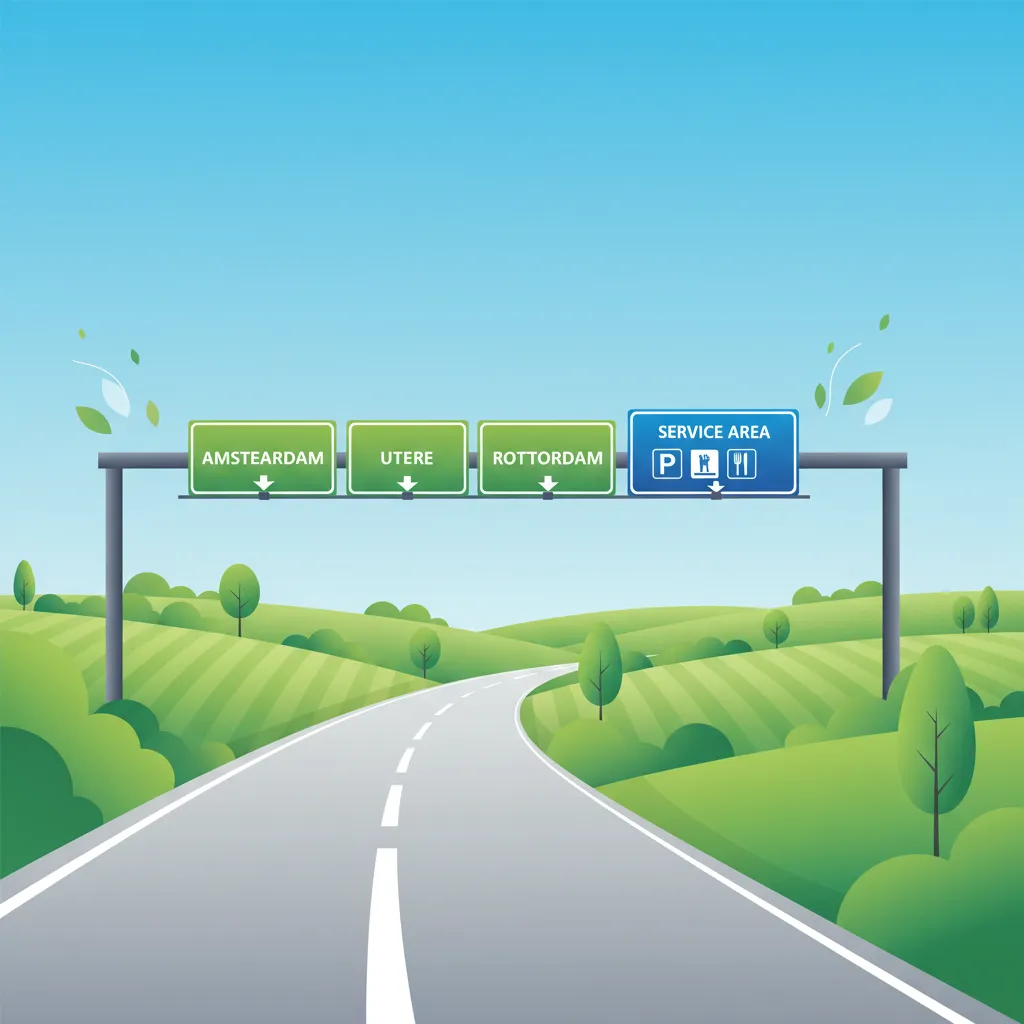
Learn to interpret complex directional and destination signs for effective route planning on Dutch roads. This lesson explores how advanced information signage supports strategic navigation, especially on motorways and during long journeys, crucial for motorcycle theory.
information signsnavigationroute planningadvanced theoryDutch traffic signs
Information Signs and Directional Indicators lesson image

Information Signs and Directional Indicators

This lesson explains how to interpret informational signs that provide guidance and navigational aid. You will learn to read directional signs indicating cities and locations, understand route numbering on major roads, and recognize signs for services like fuel stations or parking areas. It also covers the signs that mark the beginning and end of a built-up area ('bebouwde kom'), which have important implications for speed limits and traffic rules.

Dutch Driving Theory AMTraffic Signs & Signals
View lesson
Warning Sign Recognition lesson image

Warning Sign Recognition

This lesson introduces warning signs, which are designed to alert drivers to potential dangers or changes in road layout ahead. You will learn to interpret the triangular-shaped signs that indicate hazards such as sharp curves, slippery road surfaces (J27), or upcoming road works (J8). The curriculum explains how these signs help in anticipating risks and adjusting driving behavior accordingly, such as reducing speed or increasing alertness. A thorough understanding of warning signs is vital for proactive and defensive driving in various environments.
Dutch Driving Theory BRoad Sign Identification
View lesson
Intersection and Lane Sign Interpretation lesson image

Intersection and Lane Sign Interpretation

This lesson focuses on the array of signs used to manage traffic at intersections and along multi-lane roads. You will learn to interpret overhead gantry signs, lane designation signs, and markings that guide drivers into the correct lane for their intended direction. The curriculum covers signs indicating priority at upcoming junctions, such as the B3 and B4 signs, which clarify right-of-way rules in complex scenarios. Proper interpretation of these signs is essential for smooth lane changes, efficient navigation, and preventing conflicts at junctions.
Dutch Driving Theory BRoad Sign Identification
View lesson
Directional and Informational Signs for Motorcyclists lesson image

Directional and Informational Signs for Motorcyclists

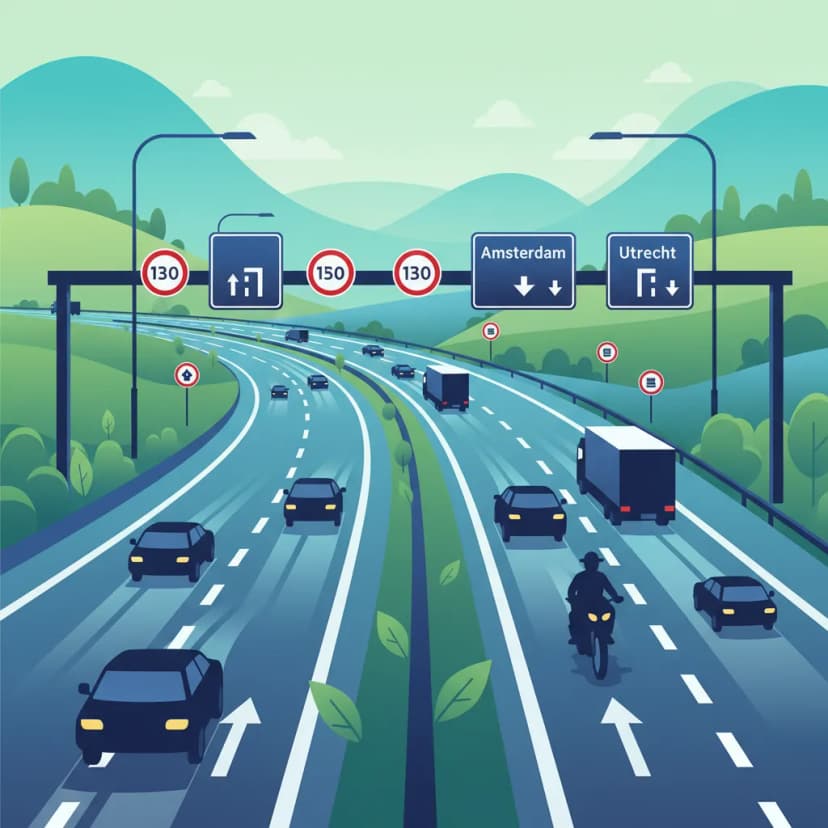
This lesson explains how to interpret directional and informational signs to navigate the Dutch road network effectively. You will learn to read route signs on highways, understand lane guidance arrows for complex intersections, and identify panels indicating services like fuel stations or rest areas. The content focuses on how motorcyclists can use this information for safe and efficient route planning, including adapting to real-time information from electronic signs.
Dutch Motorcycle Theory (A2)Road Signs and Motorcycle-Specific Indicators
View lesson
Autosnelweg (Motorway) Rules lesson image

Autosnelweg (Motorway) Rules

This lesson details the specific regulations for driving on Dutch motorways, identifiable by the G1 sign. You will learn the correct procedure for joining the flow of traffic using the acceleration lane and for leaving via the deceleration lane. The curriculum reinforces the 'keep right unless overtaking' rule for lane discipline. It also explains that stopping is strictly forbidden, and the hard shoulder (vluchtstrook) may only be used for genuine emergencies.
Dutch Driving Theory BInfrastructure and Special Roads
View lesson
Regulatory Sign Recognition lesson image

Regulatory Sign Recognition

This lesson focuses on regulatory signs, which impose legal obligations on drivers and are essential for maintaining traffic order. You will learn to identify and act upon fundamental signs such as the octagonal B6 Stop sign, the diamond-shaped B1 Priority Road sign, and various compulsory direction arrows. The content explains the legal implications of these signs, detailing when a driver must stop completely, when they have priority, or the required path they must follow. Understanding these commands is crucial for safe and lawful driving at intersections and on designated routes.
Dutch Driving Theory BRoad Sign Identification
View lesson
Information & Directional Signs (B-codes) lesson image

Information & Directional Signs (B-codes)

This lesson focuses on B-code signs, which provide essential information for navigation and route planning. It explains how to read directional signs for cities and motorways, understand route numbering, and identify signs for services like fuel stations or rest areas. For motorcyclists, clear and quick interpretation of these signs is vital for smooth navigation, especially when making decisions about lane changes for upcoming exits or junctions.
Dutch A1 Motorcycle TheoryRoad Signs and Markings (Motorcycle Perspective)
View lesson
Road Works and Temporary Traffic Management lesson image

Road Works and Temporary Traffic Management

This lesson prepares you for encountering road works, a common feature on any road network. You will learn that signs and markings related to road works are often yellow and that they temporarily override permanent white markings and signs. The curriculum stresses the importance of adhering to temporary speed limits, being alert for workers and machinery, and navigating narrowed lanes. It also covers how to follow diversion routes ('omleiding') and obey instructions given by traffic controllers.
Dutch Driving Theory BInfrastructure and Special Roads
View lesson
Highway Speed Limits (Autosnelweg & Autoweg) lesson image

Highway Speed Limits (Autosnelweg & Autoweg)

This lesson focuses on the specific speed regulations for major highways in the Netherlands. You will learn to identify an 'autosnelweg' (motorway, G1 sign), where the speed limit is 100 km/h between 6:00 and 19:00 and often 130 km/h at other times, unless indicated otherwise. The lesson also covers the 'autoweg' (expressway, G3 sign), which typically has a speed limit of 100 km/h. Furthermore, you will study dynamic speed limits indicated on electronic signs, which can change due to traffic or weather conditions.

Dutch Driving Theory BSpeed Management and Limits
View lesson
Reversing and Turning Around lesson image

Reversing and Turning Around

This lesson covers the procedures and safety considerations for driving in reverse and turning around. You will learn that reversing should only be done over short distances and when it does not endanger or obstruct other road users. The curriculum details techniques for turning in the road and identifies situations and locations where U-turns are prohibited. The importance of all-around observation, checking blind spots, and yielding to all other traffic is a central theme.

Dutch Driving Theory BSpecial Maneuvers
View lesson

Contextual Understanding of Dutch Information Road Signs

Explore real-world scenarios and common misinterpretations of information signs in the Netherlands. This lesson clarifies how factors like weather, lighting, and road type affect sign visibility and rider decision-making for the Dutch theory exam.

information signsdriving contextcommon mistakesroad safetyCBR A
Information Signs and Directional Indicators lesson image

Information Signs and Directional Indicators

This lesson explains how to interpret informational signs that provide guidance and navigational aid. You will learn to read directional signs indicating cities and locations, understand route numbering on major roads, and recognize signs for services like fuel stations or parking areas. It also covers the signs that mark the beginning and end of a built-up area ('bebouwde kom'), which have important implications for speed limits and traffic rules.

Dutch Driving Theory AMTraffic Signs & Signals
View lesson
Warning Sign Recognition lesson image

Warning Sign Recognition

This lesson introduces warning signs, which are designed to alert drivers to potential dangers or changes in road layout ahead. You will learn to interpret the triangular-shaped signs that indicate hazards such as sharp curves, slippery road surfaces (J27), or upcoming road works (J8). The curriculum explains how these signs help in anticipating risks and adjusting driving behavior accordingly, such as reducing speed or increasing alertness. A thorough understanding of warning signs is vital for proactive and defensive driving in various environments.

Dutch Driving Theory BRoad Sign Identification
View lesson
Regulatory Sign Recognition lesson image

Regulatory Sign Recognition

This lesson focuses on regulatory signs, which impose legal obligations on drivers and are essential for maintaining traffic order. You will learn to identify and act upon fundamental signs such as the octagonal B6 Stop sign, the diamond-shaped B1 Priority Road sign, and various compulsory direction arrows. The content explains the legal implications of these signs, detailing when a driver must stop completely, when they have priority, or the required path they must follow. Understanding these commands is crucial for safe and lawful driving at intersections and on designated routes.

Dutch Driving Theory BRoad Sign Identification
View lesson
Intersection and Lane Sign Interpretation lesson image

Intersection and Lane Sign Interpretation

This lesson focuses on the array of signs used to manage traffic at intersections and along multi-lane roads. You will learn to interpret overhead gantry signs, lane designation signs, and markings that guide drivers into the correct lane for their intended direction. The curriculum covers signs indicating priority at upcoming junctions, such as the B3 and B4 signs, which clarify right-of-way rules in complex scenarios. Proper interpretation of these signs is essential for smooth lane changes, efficient navigation, and preventing conflicts at junctions.

Dutch Driving Theory BRoad Sign Identification
View lesson
Road Works and Temporary Traffic Management lesson image

Road Works and Temporary Traffic Management

This lesson prepares you for encountering road works, a common feature on any road network. You will learn that signs and markings related to road works are often yellow and that they temporarily override permanent white markings and signs. The curriculum stresses the importance of adhering to temporary speed limits, being alert for workers and machinery, and navigating narrowed lanes. It also covers how to follow diversion routes ('omleiding') and obey instructions given by traffic controllers.

Dutch Driving Theory BInfrastructure and Special Roads
View lesson
Autosnelweg (Motorway) Rules lesson image

Autosnelweg (Motorway) Rules

This lesson details the specific regulations for driving on Dutch motorways, identifiable by the G1 sign. You will learn the correct procedure for joining the flow of traffic using the acceleration lane and for leaving via the deceleration lane. The curriculum reinforces the 'keep right unless overtaking' rule for lane discipline. It also explains that stopping is strictly forbidden, and the hard shoulder (vluchtstrook) may only be used for genuine emergencies.

Dutch Driving Theory BInfrastructure and Special Roads
View lesson
Regulatory Signs (verbodsborden, verbods- en verplichtingsborden) lesson image

Regulatory Signs (verbodsborden, verbods- en verplichtingsborden)

This lesson offers an in-depth study of Dutch regulatory signs, which impose mandatory actions or prohibitions on road users, with a specific focus on their impact on motorcyclists. It explains the visual language of prohibition symbols ('verbodsborden') and obligation symbols ('verplichtingsborden'), the contexts in which they appear, and the strict statutory consequences of non-compliance. Real-world examples are used to illustrate how these signs directly influence route planning, overtaking decisions, and speed management.

Dutch Motorcycle Theory ARoad Signs and Signals for Motorcyclists
View lesson
Prohibition Sign Identification lesson image

Prohibition Sign Identification

This lesson covers prohibition signs, which are used to forbid specific maneuvers or restrict access for certain vehicles. You will study the characteristics of these signs, typically circular with a red border, such as the C2 'No Entry for any vehicle' or the F1 'No Parking' sign. The content details the legal consequences of ignoring these prohibitions and explains how they contribute to traffic flow and safety in congested or sensitive areas. Recognizing these signs is fundamental to avoiding fines and dangerous situations on the road.

Dutch Driving Theory BRoad Sign Identification
View lesson
Lights, Signals, and Reflectors lesson image

Lights, Signals, and Reflectors

This lesson covers the full range of lights and signals required on a vehicle for visibility and communication. You will learn about the mandatory requirements for headlights, taillights, brake lights, indicators, and reflectors. The curriculum emphasizes the driver's legal responsibility to ensure all lights are clean and functional before every journey. The correct use and function of the horn as an audible warning device in case of imminent danger are also explained.
Dutch Driving Theory BVehicle Requirements, Inspection, and Maintenance
View lesson
Basic Road Positioning and Driving on the Right lesson image

Basic Road Positioning and Driving on the Right

This lesson covers the core principle of road positioning in the Netherlands: drive as far to the right as is safely possible. You will learn why this rule is critical for maintaining traffic flow and preventing conflicts with oncoming and overtaking vehicles. The curriculum explains how to apply this rule on different road types, from single-lane rural roads to multi-lane motorways. It also discusses maintaining a safe lateral distance from the edge of the road, parked cars, and vulnerable road users like cyclists.

Dutch Driving Theory BVehicle Positioning and Lane Use
View lesson

Frequently asked questions about Information Signs (richtings- en bestemmingstekens)

Find clear answers to common questions learners have about Information Signs (richtings- en bestemmingstekens). Learn how the lesson is structured, which driving theory objectives it supports, and how it fits into the overall learning path of units and curriculum progression in the Netherlands. These explanations help you understand key concepts, lesson flow, and exam focused study goals.

What is the difference between a directional sign and a destination sign?

Directional signs ('richtingsborden') primarily indicate which lane or direction to take for a specific route, town, or motorway. Destination signs often include the name of the destination and the distance to it, helping you plan your journey.

Are there specific information signs for motorcyclists in the Netherlands?

While most information signs are universal, the Category A exam focuses on understanding how these general signs apply to motorcycle navigation. For instance, knowing how to interpret signs for motorcycle parking or specific routes is key.

How do information signs differ from regulatory or warning signs?

Regulatory signs (like speed limits or 'no entry') mandate specific actions. Warning signs (like sharp bends) alert you to potential hazards. Information signs, however, primarily provide guidance and directions to help you navigate.

What do the different colours of information signs mean?

In the Netherlands, information signs often use specific colours to denote road types: blue signs typically indicate motorways or permanent directions, while green signs often relate to main roads or temporary diversions. Yellow signs can indicate temporary conditions or deviations.

How important are these signs for the CBR Category A exam?

Information signs are a crucial part of the CBR Category A theory exam. You'll be tested on your ability to interpret them for navigation, route selection, and understanding the road ahead, ensuring you can ride safely and legally.

Continue your Dutch driving theory learning journey

Dutch road signsDutch article topicsSearch Dutch road signsDutch driving theory homeDutch road sign categoriesSearch Dutch theory articlesDutch driving theory coursesDutch Driving Theory B courseDutch driving theory articlesDutch driving theory practiceDutch practice set categoriesDutch Driving Theory AM courseDutch Motorcycle Theory A courseDutch A1 Motorcycle Theory courseDutch Motorcycle Theory (A2) courseSearch Dutch driving theory practiceTowing, Trailers, and Loads unit in Dutch Driving Theory BRoadway Access & Navigation unit in Dutch Driving Theory AMVehicle Positioning and Lane Use unit in Dutch Driving Theory BHuman Factors & Risk Management unit in Dutch Driving Theory AMInfrastructure and Special Roads unit in Dutch Driving Theory BLegal Foundations & Vehicle Types unit in Dutch Driving Theory AMLegal Responsibilities & Incident Procedures unit in Dutch Driving Theory AMLight Signals and Horn Usage lesson in Road Signs and Signals for MotorcyclistsHighway (Autosnelweg) Rules for Motorcycles unit in Dutch Motorcycle Theory (A2)Advanced Riding Techniques and High-Speed Control unit in Dutch Motorcycle Theory ARoad Markings and Surface Indicators lesson in Road Signs and Signals for MotorcyclistsAccident Management, Legal Responsibilities & Substance Use unit in Dutch A1 Motorcycle TheoryVariable Message Signs and Digital Displays lesson in Road Signs and Signals for MotorcyclistsInterpretation of International Signage in the NL lesson in Road Signs and Signals for MotorcyclistsInformation Signs (richtings- en bestemmingstekens) lesson in Road Signs and Signals for MotorcyclistsWarning Signs (gevarendriehoeken, waarschuwingstekens) lesson in Road Signs and Signals for MotorcyclistsRegulatory Signs (verbodsborden, verbods- en verplichtingsborden) lesson in Road Signs and Signals for Motorcyclists