
This lesson focuses on directional and informational signs, a crucial part of navigating the Dutch road network safely and efficiently on your A2 motorcycle. Understanding these signs helps you follow routes, choose the correct lanes, and locate necessary services. It builds upon your knowledge of basic road signs from Unit 1 and prepares you for more complex navigation scenarios, especially on highways and within busy urban areas.
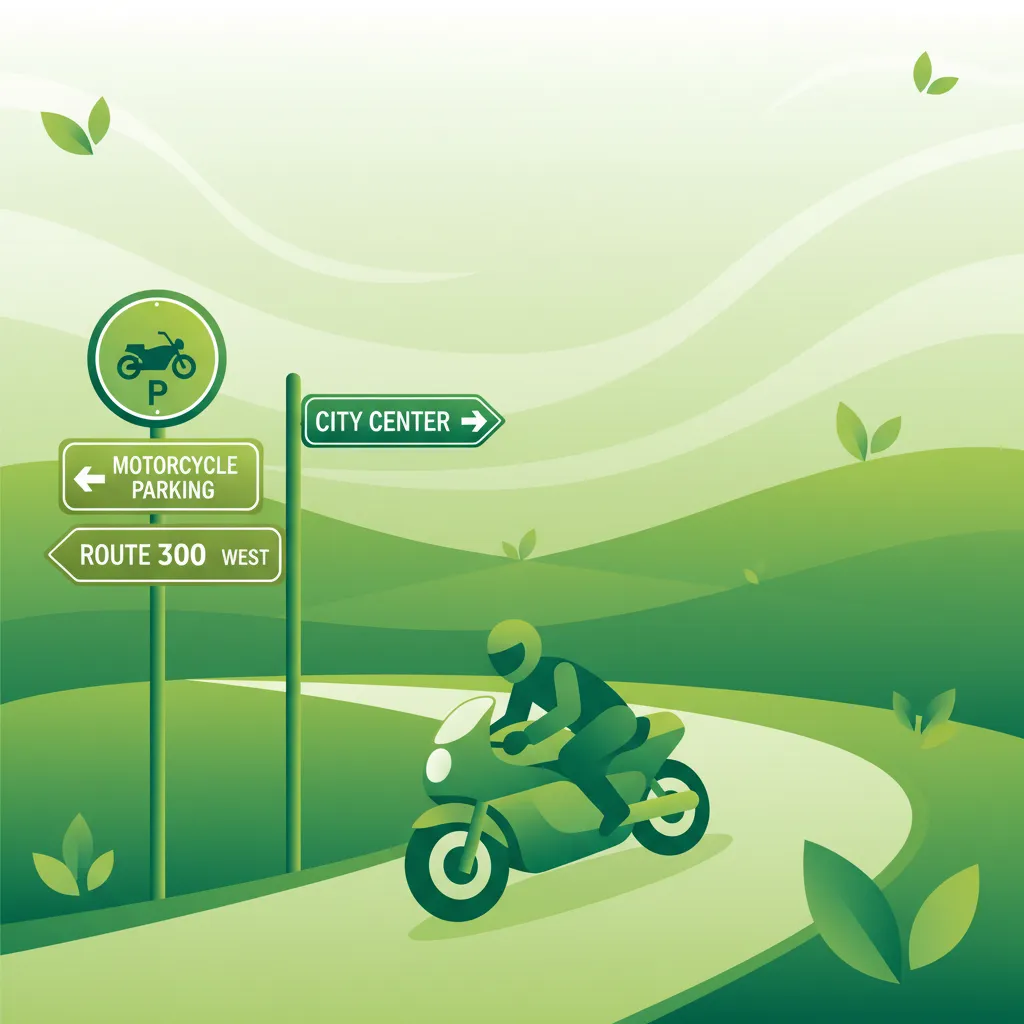
Understanding road signs is crucial for safe and efficient navigation, especially for motorcyclists who require precise information to plan their maneuvers. This chapter of the Complete CBR Theory Course for the Dutch Motorcycle License (Category A2) focuses on directional and informational signs in the Netherlands, explaining how they guide riders, indicate services, and provide real-time updates. Mastering these signs allows you to make timely decisions, maintain stability, and ride confidently on Dutch roads, from bustling city centers to high-speed autosnelwegen (motorways).
Directional and informational signs form an essential layer of traffic control, providing the necessary guidance for all road users, including motorcyclists. Their primary purpose is to help you navigate, understand your route, identify available services, and react to changing road conditions. For motorcyclists, who need to maintain focus and stability, these signs are particularly vital for planning ahead and avoiding sudden, potentially hazardous maneuvers.
These signs are designed around three core principles:
This chapter builds upon your foundational knowledge of regulatory signs (Unit 1.1) and right-of-way rules (Unit 2), demonstrating how these different categories of signs work together to create a cohesive traffic management system. Understanding how directional signs interact with mandatory speed limits or lane restrictions is key to safe riding.
Effective navigation relies on a clear understanding of the principles governing road signage. For motorcyclists, these principles have specific implications due to the unique characteristics of riding a two-wheeled vehicle.
All Dutch road signs adhere to uniform standards for shape, colour, and iconography, as prescribed by the RVV 1990. This standardisation is crucial because it allows riders to instantly recognise a sign's category and general meaning, even before fully reading any text. For motorcyclists, whose helmet visors can sometimes limit peripheral vision or create glare, clear and consistent visual cues are paramount. You can rely on these established designs to quickly process information, ensuring you maintain a stable trajectory without excessive head movements.
Directional and informational signs are strategically placed to give road users ample time to react safely. For instance, on autosnelwegen (motorways), exit signs are typically placed at least 150 meters before the actual decision point. This "advance notice distance" is vital for motorcyclists, providing sufficient time to:
The Dutch signage system follows a clear hierarchy to prevent information overload. Primary navigation information, such as arrows indicating the main route, is foregrounded. Secondary details, like specific destinations or distances, are often on separate panels, and ancillary services (e.g., fuel, rest areas) are typically displayed on yet another type of sign. This layered approach helps motorcyclists focus on critical route information first, then delve into secondary options if needed, reducing cognitive load, especially at high speeds or in complex junctions.
Modern road networks increasingly use Variable Message Signs (VMS), which are electronic panels displaying real-time information. These signs adapt to current conditions, showing data on traffic congestion, accidents, road works, or weather alerts. For motorcyclists, VMS are essential for dynamic route planning, allowing you to avoid unexpected hazards that could compromise stability or safety. It is crucial to interpret these changing messages quickly and comply with any temporary instructions, such as reduced speed limits, while maintaining control of your motorcycle.
In certain urban areas or specific road designs, you might encounter dedicated lane-guidance arrows or markings, sometimes even "motorcycle lane" indicators. These are designed to recognise the distinct characteristics of motorcycles—their narrower width, unique acceleration, and maneuverability. Such guidance aims to optimize lane usage for motorcyclists, improve safety by separating them from larger vehicles, and reduce conflicts, particularly at busy intersections or on shared routes.
The Dutch road network employs various types of signs to guide and inform. Understanding each category and its specific implications for motorcyclists is fundamental.
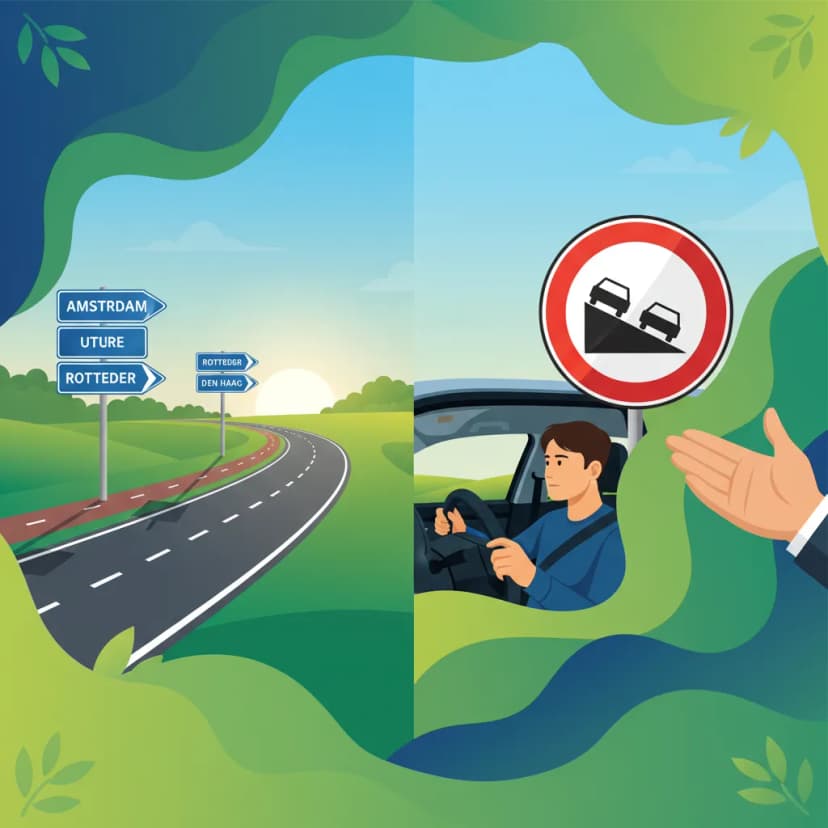
Directional arrow signs are fundamental navigation tools, typically rectangular or triangular, featuring arrows that indicate the direction of travel, route continuation, or upcoming exits. They guide you along your chosen route and help you prepare for turns or lane changes.
For motorcyclists, these signs are crucial for selecting the correct lane early, allowing for smooth, gradual lane changes that maintain bike stability. When directional arrow signs are combined with mandatory lane signs (which often include arrows), they become legally binding according to RVV 1990, article 34. Failing to follow them can lead to dangerous situations and penalties. A common misunderstanding is assuming a "straight" arrow allows overtaking in any lane, or ignoring smaller lane-guidance arrows that designate a separate, often safer, lane.
Destination panels are typically rectangular, blue, or green signs, placed below or adjacent to directional arrow signs. They list destinations, distances in kilometers, and sometimes even estimated travel times.
These panels enable motorcyclists to plan their route and positioning well in advance, especially important where multiple exits are close together. You can anticipate where to slow down, make mirror checks, and initiate lane changes. Remember that the distances shown are road-travel distances, not "as-the-crow-flies." It is also essential not to miss panels placed on the far side of a median, which might provide critical information for your chosen route.
Informational service signs indicate the presence of facilities that are beneficial to road users. These signs are typically blue for general services or brown for tourist attractions.
For motorcyclists, these signs provide safe and legal stopping points for breaks, refuelling, or making route adjustments. On motorways, it is critical to remember that stopping is only permitted within the designated service areas indicated by these signs, not on the hard shoulder, as per RVV 1990, article 39. Always confirm that the indicated service applies to motorcycles, as some signs might be "only for heavy vehicles."
Variable Message Signs (VMS) are modern electronic LED or LCD panels that display real-time, dynamic information. They are highly responsive to changing road conditions.
VMS allow motorcyclists to adjust their route, speed, and lane positioning dynamically, which is crucial for mitigating unexpected hazards. When a VMS displays a speed limit, it is legally binding for all road users, as stated in RVV 1990, article 33. Misinterpreting VMS as merely advisory or failing to comply with temporary speed limits can lead to fines and dangerous situations, especially given the reduced traction motorcycles experience in poor weather.
In some urban areas or on specific multi-lane roads, you might encounter dedicated lane guidance aimed specifically at motorcycles.
These dedicated lanes are designed to improve safety by separating motorcycles from larger vehicles, reducing exposure to blind spots and providing a more predictable traffic flow. According to RVV 1990, article 36, using a motorcycle-only lane is mandatory when present and suitable for your speed. However, always ensure the lane is active and not temporarily closed for maintenance or designated for other vehicles during specific hours. Riding in a closed or restricted lane can lead to fines and obstruct other traffic.
Adhering to the rules governing directional and informational signs is not just a matter of good navigation but also a legal obligation under the Reglement Verkeersregels en Verkeerstekens (RVV 1990).
Misinterpreting or ignoring directional and informational signs can lead to dangerous situations and legal consequences.
The effectiveness of directional and informational signs, and your ability to react to them, can vary significantly depending on external factors. Motorcyclists must be particularly aware of these conditional logic scenarios.
When a directional sign indicates an upcoming pedestrian crossing or cyclist path, motorcyclists must be especially vigilant and prepare to yield. Such signs may be combined with flashing beacons to enhance alertness, requiring immediate attention and speed adjustment.
Be aware that VMS can have a slight latency; some electronic signs update every 30 seconds. While generally reliable, a rider should anticipate that conditions might have changed slightly since the last update, especially in rapidly evolving traffic situations.
The specific design and placement of directional and informational signs are deeply rooted in principles of road safety and human psychology, particularly relevant for motorcyclists.
The human visual system requires approximately 0.2 seconds to recognize a sign. At a speed of 90 km/h, a motorcycle travels roughly 5 meters in that short interval. This highlights why the advance notice distance of signs (e.g., 150 meters for motorway exits) is so critical. It provides 1 to 2 seconds for a rider to fully process the information, decide on a course of action, and initiate a safe maneuver. This window is crucial for maintaining stability on a motorcycle, where sudden inputs can lead to loss of control.
Motorcyclists often experience a higher cognitive load due to the dynamic nature of riding and the need for constant attention to road conditions and surroundings. Processing multiple signs simultaneously can be overwhelming. The hierarchy of information (primary arrow, then destination panel, then service options) is designed to mitigate this, ensuring critical route information is processed first. This helps riders make informed decisions efficiently, reducing mental fatigue and allowing them to focus on the physical act of riding.
A motorcyclist's posture and helmet design can limit peripheral vision. This necessitates more conscious head checks and scanning of the road ahead. Proper headlight alignment and a clean helmet visor are essential for maximizing sign readability, especially at night or in low light. Any factor that compromises visibility—be it dirty gear or an improperly adjusted headlight—can directly impact the rider's ability to see and react to crucial directional cues.
Navigating the Dutch road network requires a thorough understanding of its diverse signage. For motorcyclists, correctly interpreting directional and informational signs is a cornerstone of safe and efficient riding.
Mastering these signs allows you to ride proactively, reducing surprises and enhancing your overall safety on Dutch roads.
Lesson content overview
Explore all units and lessons included in this driving theory course.
Explore search topics learners often look for when studying Directional and Informational Signs for Motorcyclists. These topics reflect common questions about road rules, driving situations, safety guidance, and lesson level theory preparation for learners in the Netherlands.
Browse additional driving theory lessons that cover connected traffic rules, road signs, and common driving situations related to this topic. Improve your understanding of how different rules interact across everyday traffic scenarios.
Explore how directional and informational signs are used in complex Dutch traffic situations. Understand variable message signs (VMS), motorcycle-specific lane guidance, and their integration with other traffic rules for safe navigation on motorways and urban roads.
This lesson examines the function and interpretation of variable message signs (VMS) and other digital displays that provide real-time traffic information on Dutch roads. It explains how these systems communicate dynamic speed limits, congestion alerts, lane closures, and diversion routes, and how motorcyclists must legally comply with these instructions. Understanding these 'matrixborden' is critical for adapting to changing road conditions and ensuring safety on motorways and in tunnels.

This lesson focuses on informational signs that guide motorcyclists in navigation, route planning, and locating essential services while on the road. It examines the standardized symbols and color-coding for directions ('richtingsborden'), destinations, distances, and amenities, explaining how these signs support efficient and safe travel. Learners will understand how to use this information for strategic route selection, especially on long journeys or in unfamiliar areas, ensuring a smooth and predictable trip.

This lesson explains how to respond to variable speed limits shown on overhead electronic signs, which are used to manage traffic flow in real-time. You will learn why these limits are adjusted for factors like congestion, accidents, or bad weather, and the legal requirement to obey them. The content focuses on the importance of anticipatory riding, scanning far ahead for these signs to allow for smooth and safe speed adjustments.

This lesson introduces warning signs, which are designed to alert drivers to potential dangers or changes in road layout ahead. You will learn to interpret the triangular-shaped signs that indicate hazards such as sharp curves, slippery road surfaces (J27), or upcoming road works (J8). The curriculum explains how these signs help in anticipating risks and adjusting driving behavior accordingly, such as reducing speed or increasing alertness. A thorough understanding of warning signs is vital for proactive and defensive driving in various environments.

This lesson offers an in-depth study of Dutch regulatory signs, which impose mandatory actions or prohibitions on road users, with a specific focus on their impact on motorcyclists. It explains the visual language of prohibition symbols ('verbodsborden') and obligation symbols ('verplichtingsborden'), the contexts in which they appear, and the strict statutory consequences of non-compliance. Real-world examples are used to illustrate how these signs directly influence route planning, overtaking decisions, and speed management.
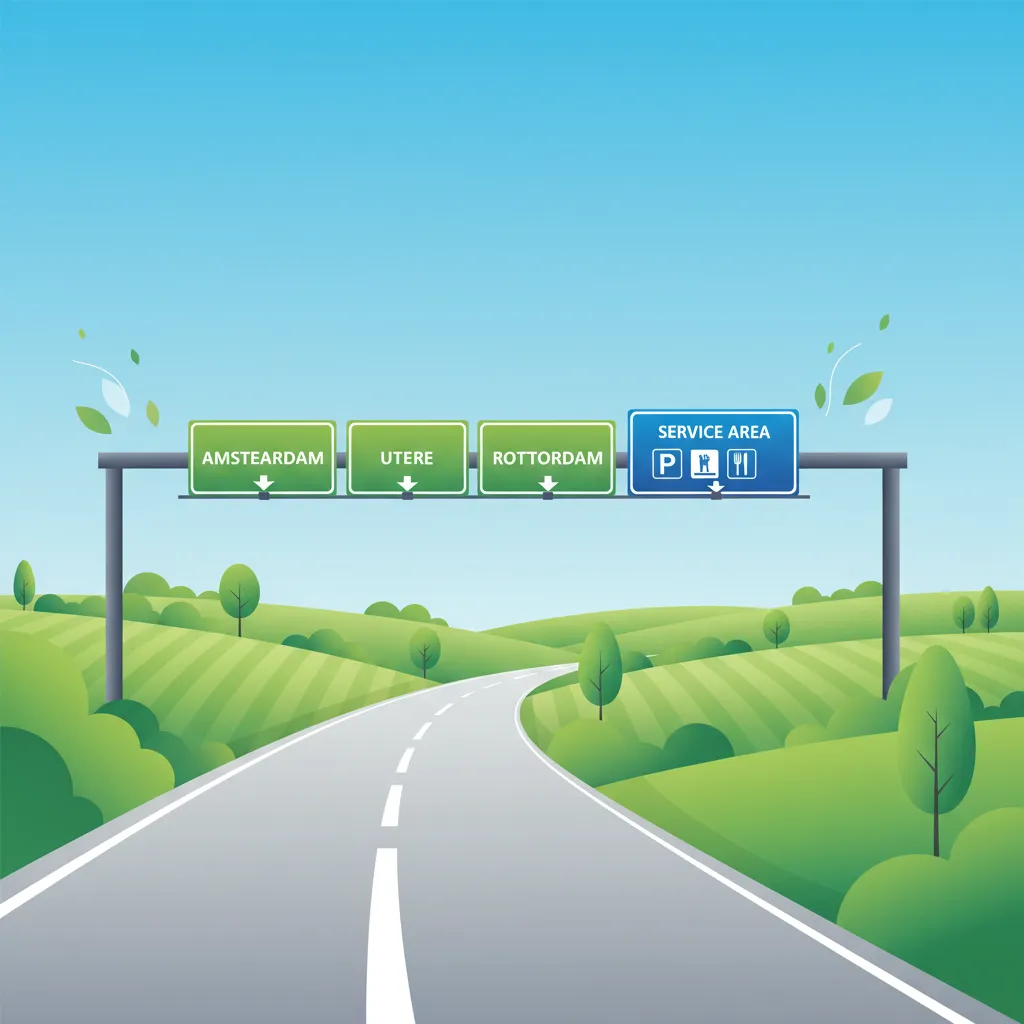
This lesson explains how to interpret informational signs that provide guidance and navigational aid. You will learn to read directional signs indicating cities and locations, understand route numbering on major roads, and recognize signs for services like fuel stations or parking areas. It also covers the signs that mark the beginning and end of a built-up area ('bebouwde kom'), which have important implications for speed limits and traffic rules.

This lesson focuses on Dutch regulatory signs that enforce mandatory rules and restrictions, particularly those impacting A2 motorcyclists. You will learn to recognize and obey prohibition signs, such as those indicating a motorcycle ban (BORD 40), speed limits, and overtaking restrictions (BORD 21). The content explains the legal consequences of non-compliance and how to apply these rules in practical riding scenarios to ensure full adherence to Dutch traffic law.

This lesson explores the legal meaning of various road surface markings, including solid and broken lane delimiters, directional arrows, and special-purpose lane indicators. It describes how markings dictate permitted maneuvers, such as overtaking and lane changes, and alert riders to upcoming hazards or changes in road layout. The content also examines the relationship between markings and road design in the Netherlands, emphasizing how a motorcyclist must interpret these visual cues for safe positioning.
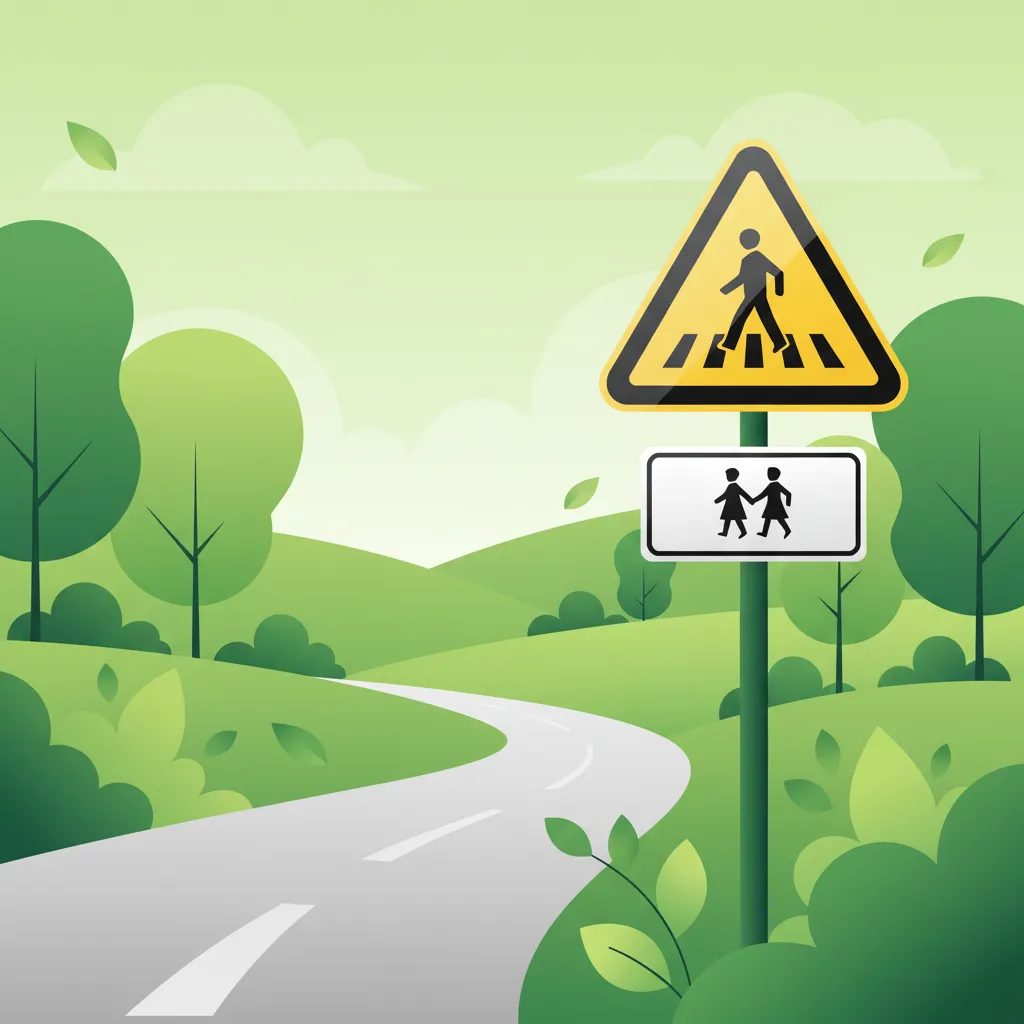
This lesson details the purpose and visual design of Dutch warning signs ('gevarendriehoeken') that alert riders to potential hazards ahead. It covers a wide range of scenarios, from road narrowing and dangerous curves to construction zones and the risk of falling rocks, emphasizing the need for early anticipation and speed adaptation. The content also explains how these warning signs integrate with other traffic information to help a rider form an accurate risk assessment and make safer decisions.

This lesson provides essential guidance on recognizing and interpreting traffic signs that may differ from Dutch standards but are commonly encountered when riding across borders within the European Union. It highlights key differences based on the Vienna Convention on Road Signs and Signals, helping riders understand variations in regulatory, warning, and informational signs. This knowledge is crucial for maintaining legal compliance and safety when navigating foreign road systems, ensuring a confident international riding experience.
Learn about typical errors motorcyclists make when interpreting directional and informational signs in the Netherlands. This lesson focuses on understanding potential hazards from misinterpreting signs and how to avoid them for safer riding.
This lesson focuses on informational signs that guide motorcyclists in navigation, route planning, and locating essential services while on the road. It examines the standardized symbols and color-coding for directions ('richtingsborden'), destinations, distances, and amenities, explaining how these signs support efficient and safe travel. Learners will understand how to use this information for strategic route selection, especially on long journeys or in unfamiliar areas, ensuring a smooth and predictable trip.
This lesson examines the function and interpretation of variable message signs (VMS) and other digital displays that provide real-time traffic information on Dutch roads. It explains how these systems communicate dynamic speed limits, congestion alerts, lane closures, and diversion routes, and how motorcyclists must legally comply with these instructions. Understanding these 'matrixborden' is critical for adapting to changing road conditions and ensuring safety on motorways and in tunnels.
This lesson offers an in-depth study of Dutch regulatory signs, which impose mandatory actions or prohibitions on road users, with a specific focus on their impact on motorcyclists. It explains the visual language of prohibition symbols ('verbodsborden') and obligation symbols ('verplichtingsborden'), the contexts in which they appear, and the strict statutory consequences of non-compliance. Real-world examples are used to illustrate how these signs directly influence route planning, overtaking decisions, and speed management.
This lesson explains how to interpret informational signs that provide guidance and navigational aid. You will learn to read directional signs indicating cities and locations, understand route numbering on major roads, and recognize signs for services like fuel stations or parking areas. It also covers the signs that mark the beginning and end of a built-up area ('bebouwde kom'), which have important implications for speed limits and traffic rules.

This lesson covers A-code signs, which are designed to warn drivers of potential hazards on the road ahead. For motorcyclists, warnings about sharp bends, slippery surfaces, crosswinds, or falling rocks are especially critical for maintaining control and stability. The content explains how to interpret these triangular signs to anticipate changing conditions, adjust speed, and adopt a defensive riding posture well in advance of the hazard.
This lesson focuses on Dutch regulatory signs that enforce mandatory rules and restrictions, particularly those impacting A2 motorcyclists. You will learn to recognize and obey prohibition signs, such as those indicating a motorcycle ban (BORD 40), speed limits, and overtaking restrictions (BORD 21). The content explains the legal consequences of non-compliance and how to apply these rules in practical riding scenarios to ensure full adherence to Dutch traffic law.
This lesson provides essential guidance on recognizing and interpreting traffic signs that may differ from Dutch standards but are commonly encountered when riding across borders within the European Union. It highlights key differences based on the Vienna Convention on Road Signs and Signals, helping riders understand variations in regulatory, warning, and informational signs. This knowledge is crucial for maintaining legal compliance and safety when navigating foreign road systems, ensuring a confident international riding experience.
This lesson focuses on B-code signs, which provide essential information for navigation and route planning. It explains how to read directional signs for cities and motorways, understand route numbering, and identify signs for services like fuel stations or rest areas. For motorcyclists, clear and quick interpretation of these signs is vital for smooth navigation, especially when making decisions about lane changes for upcoming exits or junctions.
This lesson details the purpose and visual design of Dutch warning signs ('gevarendriehoeken') that alert riders to potential hazards ahead. It covers a wide range of scenarios, from road narrowing and dangerous curves to construction zones and the risk of falling rocks, emphasizing the need for early anticipation and speed adaptation. The content also explains how these warning signs integrate with other traffic information to help a rider form an accurate risk assessment and make safer decisions.
This lesson explores the legal meaning of various road surface markings, including solid and broken lane delimiters, directional arrows, and special-purpose lane indicators. It describes how markings dictate permitted maneuvers, such as overtaking and lane changes, and alert riders to upcoming hazards or changes in road layout. The content also examines the relationship between markings and road design in the Netherlands, emphasizing how a motorcyclist must interpret these visual cues for safe positioning.
Find clear answers to common questions learners have about Directional and Informational Signs for Motorcyclists. Learn how the lesson is structured, which driving theory objectives it supports, and how it fits into the overall learning path of units and curriculum progression in the Netherlands. These explanations help you understand key concepts, lesson flow, and exam focused study goals.
While the basic shapes and colours of directional and informational signs are the same across the board, this lesson highlights how A2 motorcyclists can best utilise them for navigation. We focus on interpreting route numbers, lane guidance, and service signs specifically from a rider's perspective, ensuring safe and efficient travel on Dutch roads.
Electronic variable message signs provide crucial real-time information about traffic conditions, diversions, or temporary restrictions. For motorcyclists, understanding these signs is vital for adapting speed, choosing alternative routes, or being aware of hazards ahead, especially on highways where conditions can change rapidly.
Directional signs primarily guide you towards destinations, routes, or specific lanes, often displaying route numbers, place names, and arrows. Informational signs provide useful details about services (like petrol stations or hospitals), distances, or general road conditions. Both are essential for navigating effectively and safely.
The CBR theory exam frequently includes questions that test your understanding of directional and informational signs. You'll encounter scenarios where you need to identify the correct route to a destination, interpret lane instructions at an intersection, or determine the location of necessary services, all based on these signs.
If you miss a directional sign on the highway, do not brake suddenly or make abrupt lane changes. Continue to the next exit or designated safe area (like a service station), and use your navigation tools or a map to reorient yourself. It’s safer to take a slightly longer route than to risk an accident by trying to correct immediately.