
This lesson focuses on the critical skill of motorcycle skid control and recovery, essential for Category A riders. You'll learn the theory behind managing both front and rear wheel skids, understanding their causes and the precise, often counter-intuitive, actions needed to regain control. Mastering these techniques will not only prepare you for challenging CBR theory exam questions but also equip you for safer real-world riding in unexpected emergency situations.

Riding a motorcycle safely demands not only skill but also a profound understanding of vehicle dynamics, especially when faced with unexpected loss of traction. This lesson explores the critical topic of skid control and recovery techniques, vital knowledge for any rider aiming to master the Dutch Motorcycle Theory curriculum. Effectively managing a skid, whether it originates from the front or rear wheel, can prevent serious accidents and ensure you maintain control as legally required by Dutch traffic law.
A motorcycle skid occurs when the tires lose their grip on the road surface, causing an uncontrolled slide. This loss of traction can be sudden and disorienting, but with the right theoretical knowledge and practical approach, a rider can significantly increase their chances of recovery. The ability to manage skids is a cornerstone of safe riding, particularly on high-performance motorcycles where the limits of traction can be approached more quickly.
At the heart of any skid is the concept of traction threshold. This is the maximum longitudinal (forward/backward) or lateral (sideways) force a tire can transmit to the road before it begins to slip. This threshold is determined by two primary factors: the friction coefficient (μ) between the tire and the road surface, and the normal load (the weight pressing down on that tire).
The friction coefficient (μ) is not constant; it changes dramatically with various conditions:
When the forces applied to a tire (through braking, acceleration, or cornering) exceed this traction threshold, the tire begins to slide, and a skid initiates.
Weight transfer is the redistribution of the motorcycle’s mass between its wheels during various maneuvers. This phenomenon profoundly influences which wheel is more prone to skidding:
Understanding weight transfer is crucial for modulating rider inputs and staying within the traction limits of each tire.
Skids are generally categorized by the wheel that loses traction. Each type presents unique challenges and requires specific recovery techniques.
A rear-wheel skid, often referred to as oversteer, occurs when the rear tire loses grip and rotates faster than the road surface allows. This causes the rear of the motorcycle to slide outward from the intended path, leading the motorcycle to yaw or pivot around the front wheel. The rider might feel the rear tire "pushing" sideways or the motorcycle trying to turn more sharply than intended.
According to Dutch traffic law, specifically RVV 1990, article 3, riders must keep their speed appropriate to prevailing road conditions. Failing to do so by accelerating or braking too harshly on a low-grip surface can directly lead to a rear-wheel skid and be deemed negligence.
A front-wheel skid is generally far more dangerous and difficult to recover from than a rear-wheel skid. It occurs when the front tire loses grip, resulting in a sudden and critical loss of steering ability. The motorcycle will typically continue in a straighter line than desired, even if the handlebars are turned. This is often called understeer or "wash-out."
The consequences of a front-wheel skid are severe. Since the front wheel is responsible for steering, its loss of traction means a loss of directional control, often leading to an immediate fall. This underscores the importance of maintaining an appropriate following distance (as discussed in Lesson 5: Safe Following Distance and Hazard Perception) and not exceeding safe cornering speeds.
Target fixation is a critical visual perception error where a rider, in a high-stress situation, inadvertently focuses their gaze on an obstacle or the direction of a skid, leading them to steer precisely towards that point. Instead of looking at the escape path or the intended direction of travel, the rider's eyes lock onto the danger.
This phenomenon is particularly dangerous during a skid because human beings tend to steer where they look (gaze-steering coupling). If you are skidding and fixate on the ditch you are trying to avoid, you are more likely to steer directly into it. This is not a conscious decision but an automatic response under pressure.
To counteract target fixation, the fundamental principle is to "look where you want to go." By consciously shifting your visual focus to your desired path, you can help direct your steering inputs to guide the motorcycle away from danger and back onto a safe trajectory. This principle is not only key for skid recovery but also for general hazard avoidance.
Anti-Lock Braking Systems (ABS) are designed to prevent wheel lock-up during braking by rapidly modulating brake pressure. When a wheel begins to decelerate too quickly (indicating it's about to lock), ABS momentarily releases and then reapplies brake pressure, allowing the wheel to continue rotating and maintain some steering ability.
While ABS significantly enhances braking safety and can prevent many brake-induced skids, especially rear-wheel lock-ups, it is crucial to understand its limitations:
Successful skid recovery involves a combination of quick thinking, smooth inputs, and a crucial mental shift to look in the desired direction of travel. The general principle is to restore traction by reducing the forces that caused the skid, then gently guiding the motorcycle back to its intended path.
Regardless of the type of skid, several core principles apply to effective recovery:
When the rear wheel skids (oversteer):
The key with a rear-wheel skid is to essentially "catch" the rear with the front wheel by steering into the slide.
A front-wheel skid is more critical and demands an even quicker, more precise response:
Dutch traffic law places clear responsibilities on drivers to maintain control of their vehicles and adapt to road conditions. These regulations form the legal framework for why skid prevention and recovery are not just safety measures but legal necessities.
RVV 1990, Article 1: "The driver must keep the vehicle under control at all times." This foundational article mandates that any driver, including motorcyclists, must always be able to steer, brake, and accelerate their vehicle predictably and safely. Failure to recover from a skid, leading to an accident or endangering other road users, can be interpreted as a violation of this article, potentially resulting in legal consequences such as fines or liability for negligence.
RVV 1990, Article 3: "The driver must adjust speed to conditions and must not exceed safe speed for weather, road surface, and vehicle load." This article directly links a driver's speed to the prevailing circumstances. When road conditions reduce tire grip (e.g., rain, ice, gravel, oil spills), motorcyclists are legally obligated to reduce their speed and adjust their riding technique accordingly. Skids often occur because a rider's speed or inputs (braking, acceleration, cornering) exceed the available traction for the current conditions, directly violating Article 3.
Regulation on ABS (EU Regulation No 79/2002 amended by 2004/55/EC): For motorcycles over 125 cc, ABS is mandatory. This regulation ensures that these safety systems are functional and do not impede the rider's ability to control the vehicle. However, as noted, ABS does not absolve the rider from their duties under RVV 1990, articles 1 and 3. Riders are still expected to adapt their speed and riding style to avoid reaching the limits of traction, even with ABS engaged.
Road Traffic Signs (RVV 1990, Article 54): "Wet Road" sign (often combined with advisory speed limits). When signs indicating a wet road or other hazardous conditions are present, they serve as an explicit warning that friction is reduced. Riders must acknowledge these warnings and adjust their speed and inputs proactively to prevent skids. Ignoring such signs and subsequently losing control can lead to a more severe interpretation of negligence under the law.
While recovery techniques are essential, the safest approach is always prevention. Many skids can be avoided by adopting a proactive and defensive riding style, constantly assessing risks and adapting inputs.
The coefficient of friction (μ) is highly variable. Safe riders constantly evaluate road conditions and modify their riding accordingly.
The condition of your motorcycle directly impacts its ability to maintain traction.
Even experienced riders can make mistakes under pressure. Being aware of common pitfalls can help in preventing or recovering from skids.
Understanding the specific vocabulary associated with motorcycle skids is crucial for effective learning and communication regarding safe riding techniques.
Mastering skid control and recovery is an advanced yet fundamental skill for any rider, especially within the context of the Dutch Motorcycle Theory curriculum. It blends an understanding of physics, human psychology, and precise riding techniques, all underpinned by legal obligations to maintain control.
The core takeaways are:
By integrating these principles, motorcyclists can significantly enhance their safety, confidently navigate challenging road conditions, and prepare for more advanced riding techniques and emergency situations.
Lesson content overview
Explore all units and lessons included in this driving theory course.
Explore search topics learners often look for when studying Skid Control and Recovery Techniques. These topics reflect common questions about road rules, driving situations, safety guidance, and lesson level theory preparation for learners in the Netherlands.
Browse additional driving theory lessons that cover connected traffic rules, road signs, and common driving situations related to this topic. Improve your understanding of how different rules interact across everyday traffic scenarios.
Understand the theory behind motorcycle skids, including causes of front and rear wheel slides. Learn essential recovery techniques and how to avoid target fixation to maintain control according to Dutch traffic laws.
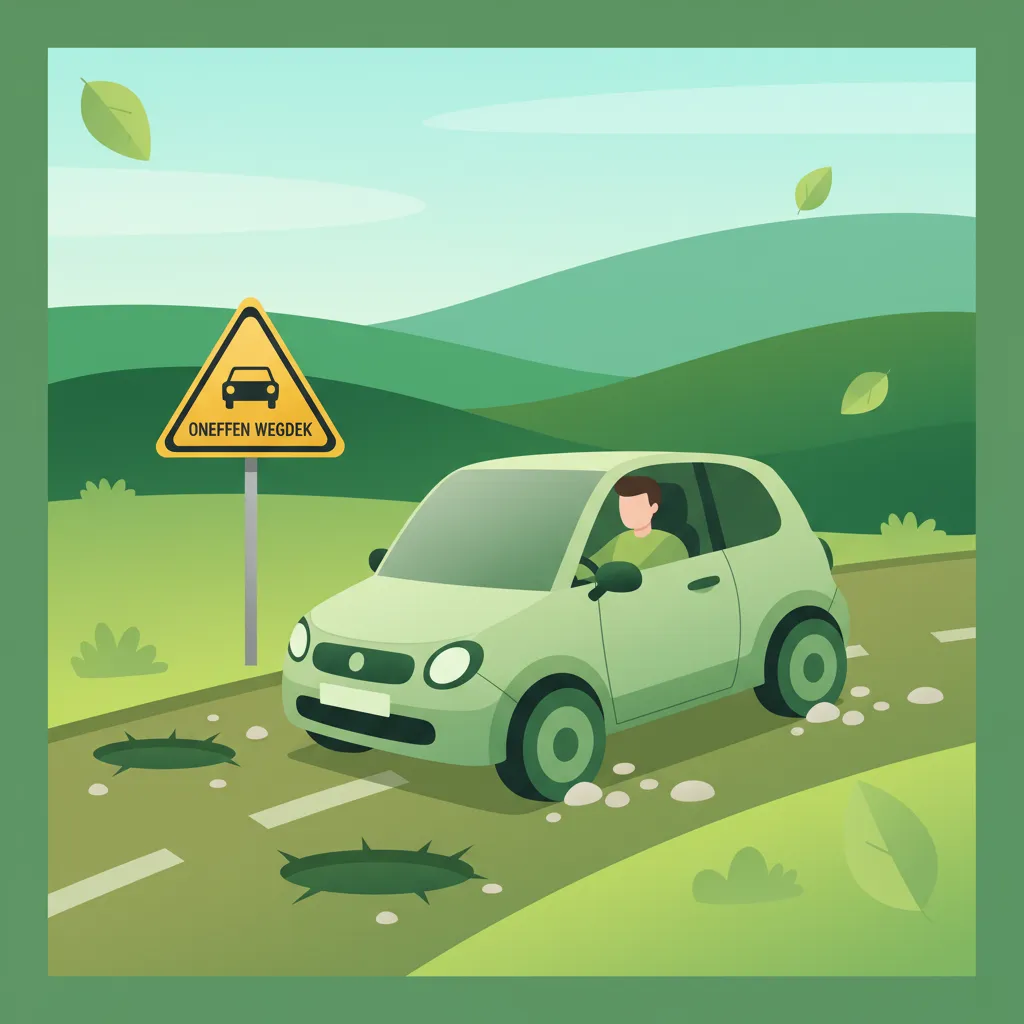
This lesson prepares you to deal with sudden changes in road surface that can cause a loss of traction. You will learn to scan for these hazards and, if they cannot be avoided, how to ride over them safely. The key technique is to keep the motorcycle upright and maintain smooth, steady control inputs—no abrupt braking, accelerating, or steering—to minimize the risk of a skid.

This lesson provides a comprehensive guide to safe and effective deceleration on a motorcycle. You will learn the principles of controlled braking, including the progressive application of both the front and rear brakes to maximize stopping power while maintaining stability. The content also explains the role of engine braking in managing speed and how the Anti-lock Braking System (ABS) helps prevent wheel lock-up during hard braking.

Riding on two wheels requires special care on surfaces with reduced grip. This lesson teaches you how to handle challenging conditions like rain, ice, wet leaves, or tram tracks. Key principles include reducing speed significantly, making all control inputs (braking, accelerating, steering) much more smoothly and gradually, and increasing your following distance to allow for much longer stopping distances. Recognizing potentially slippery areas is a critical part of proactive hazard perception.

This lesson explains the science behind reduced grip on wet surfaces and the dangerous phenomenon of hydroplaning, where a tire rides on a layer of water instead of the road. It details the critical roles of tire tread depth, tire pressure, and riding speed in maintaining contact with the asphalt. Riders will learn techniques for riding in the rain, including using exceptionally smooth control inputs and proactively reducing speed when approaching standing water.

This lesson addresses the specific challenge of cornering when road grip is compromised. It teaches riders how to identify potential low-traction surfaces like wet manhole covers, painted lines, gravel, or oil patches. The content focuses on techniques to mitigate risk, such as reducing speed, minimizing lean angle, and applying all control inputs—braking, steering, and throttle—with exceptional smoothness to avoid overwhelming the available grip.

This lesson teaches the technique of progressive braking, which involves applying the brakes smoothly and gradually rather than abruptly. This method allows the motorcycle's weight to transfer forward in a controlled manner, compressing the front suspension and increasing the size of the front tire's contact patch. This, in turn, maximizes available grip and allows for harder, safer braking without unsettling the chassis or locking a wheel.

This lesson moves beyond basic braking to teach advanced techniques for optimal stopping performance. You will learn that the front brake provides the majority of your stopping power due to forward weight transfer, but that skillful application of the rear brake is crucial for stability. The content covers the concept of progressive braking—squeezing the levers smoothly—to manage traction and prevent wheel lock, especially on motorcycles without ABS.

This lesson explains the physics of why wet roads offer significantly less traction than dry ones, highlighting particular hazards like the first rain after a dry spell. It defines aquaplaning (when a tire rides on a layer of water instead of the road) and explains how speed and tire condition contribute to this dangerous phenomenon. The content provides clear strategies for riding in the rain, including reducing speed and applying all controls with extra smoothness.

This lesson teaches the crucial skill of assessing road surfaces and adjusting speed accordingly to maintain maximum traction. It covers a variety of hazardous conditions, including wet asphalt, loose gravel, oil patches, metal manhole covers, and painted road markings, all of which can significantly reduce grip. Riders will learn to constantly scan the road ahead, identify potential traction-reducing surfaces, and proactively manage their speed to prevent slides and loss of control.

This lesson explains how to apply the principle of counter-steering decisively in an emergency situation to perform a rapid swerve. It covers the importance of looking where you want to go, avoiding 'target fixation' on the obstacle, and executing a firm push on the appropriate handlebar to initiate a quick lean and change of direction. This skill is a critical component of collision avoidance for any motorcyclist.
Explore how road surface conditions, weather, and vehicle maintenance affect motorcycle grip. Learn proactive strategies to prevent skids and understand how factors like tire pressure and load influence traction for the Dutch theory exam.
This lesson prepares you to deal with sudden changes in road surface that can cause a loss of traction. You will learn to scan for these hazards and, if they cannot be avoided, how to ride over them safely. The key technique is to keep the motorcycle upright and maintain smooth, steady control inputs—no abrupt braking, accelerating, or steering—to minimize the risk of a skid.
This lesson explains the science behind reduced grip on wet surfaces and the dangerous phenomenon of hydroplaning, where a tire rides on a layer of water instead of the road. It details the critical roles of tire tread depth, tire pressure, and riding speed in maintaining contact with the asphalt. Riders will learn techniques for riding in the rain, including using exceptionally smooth control inputs and proactively reducing speed when approaching standing water.
Riding on two wheels requires special care on surfaces with reduced grip. This lesson teaches you how to handle challenging conditions like rain, ice, wet leaves, or tram tracks. Key principles include reducing speed significantly, making all control inputs (braking, accelerating, steering) much more smoothly and gradually, and increasing your following distance to allow for much longer stopping distances. Recognizing potentially slippery areas is a critical part of proactive hazard perception.
This lesson explains the physics of why wet roads offer significantly less traction than dry ones, highlighting particular hazards like the first rain after a dry spell. It defines aquaplaning (when a tire rides on a layer of water instead of the road) and explains how speed and tire condition contribute to this dangerous phenomenon. The content provides clear strategies for riding in the rain, including reducing speed and applying all controls with extra smoothness.
This lesson addresses the specific challenge of cornering when road grip is compromised. It teaches riders how to identify potential low-traction surfaces like wet manhole covers, painted lines, gravel, or oil patches. The content focuses on techniques to mitigate risk, such as reducing speed, minimizing lean angle, and applying all control inputs—braking, steering, and throttle—with exceptional smoothness to avoid overwhelming the available grip.
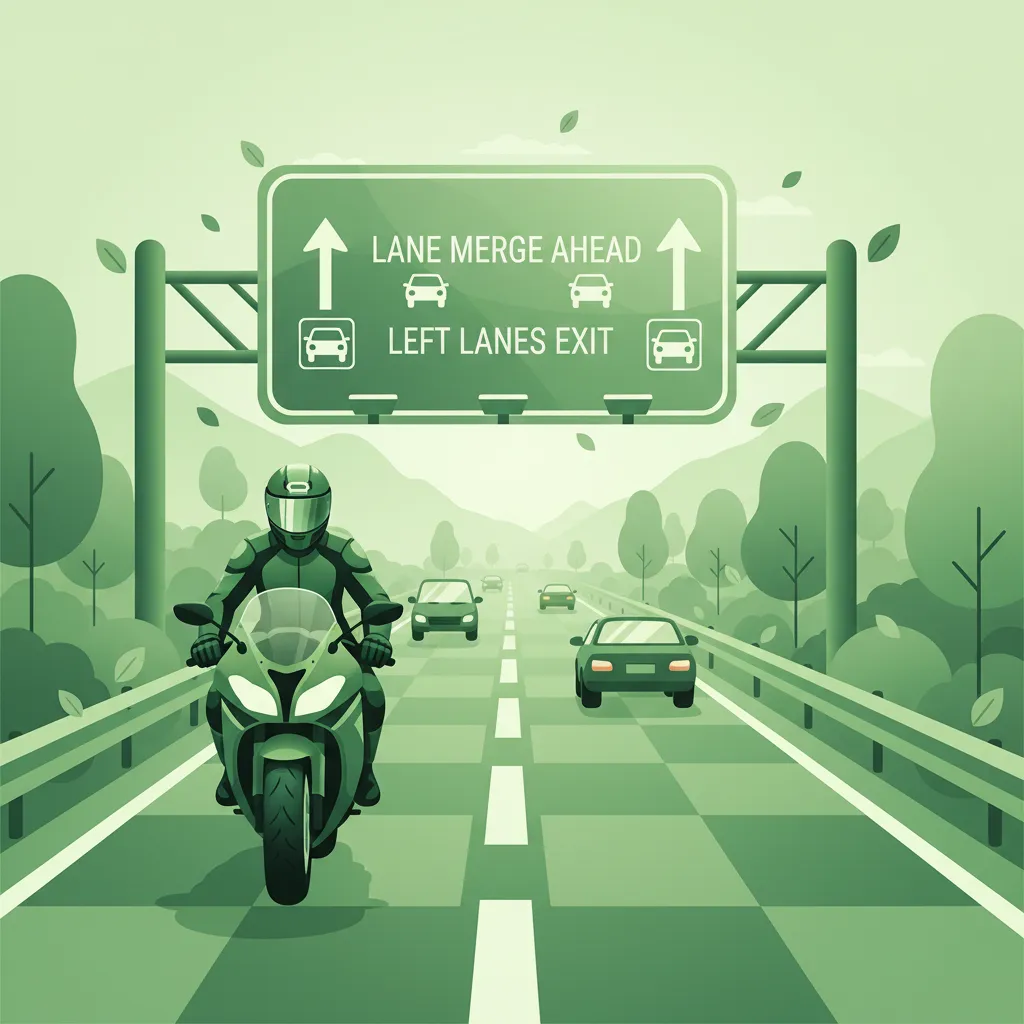
This lesson prepares you for the unique dangers of high-speed highway riding. You will learn to scan for and navigate road hazards like debris, potholes, and slippery steel expansion joints on bridges. The content also addresses the powerful air turbulence created by large trucks that can upset a motorcycle's stability and the mental challenge of maintaining focus on long, monotonous stretches of road.
This lesson teaches the crucial skill of assessing road surfaces and adjusting speed accordingly to maintain maximum traction. It covers a variety of hazardous conditions, including wet asphalt, loose gravel, oil patches, metal manhole covers, and painted road markings, all of which can significantly reduce grip. Riders will learn to constantly scan the road ahead, identify potential traction-reducing surfaces, and proactively manage their speed to prevent slides and loss of control.

This lesson introduces the Dutch concept of 'voorspellend rijgedrag,' or anticipatory riding, a proactive approach to safety. It teaches motorcyclists how to look beyond the immediate vehicle in front and scan for clues that predict the actions of other road users, such as turn signals, wheel direction, and driver head movement. By anticipating potential conflicts before they happen, riders can position themselves to avoid danger and ensure a smoother, safer journey through complex traffic.
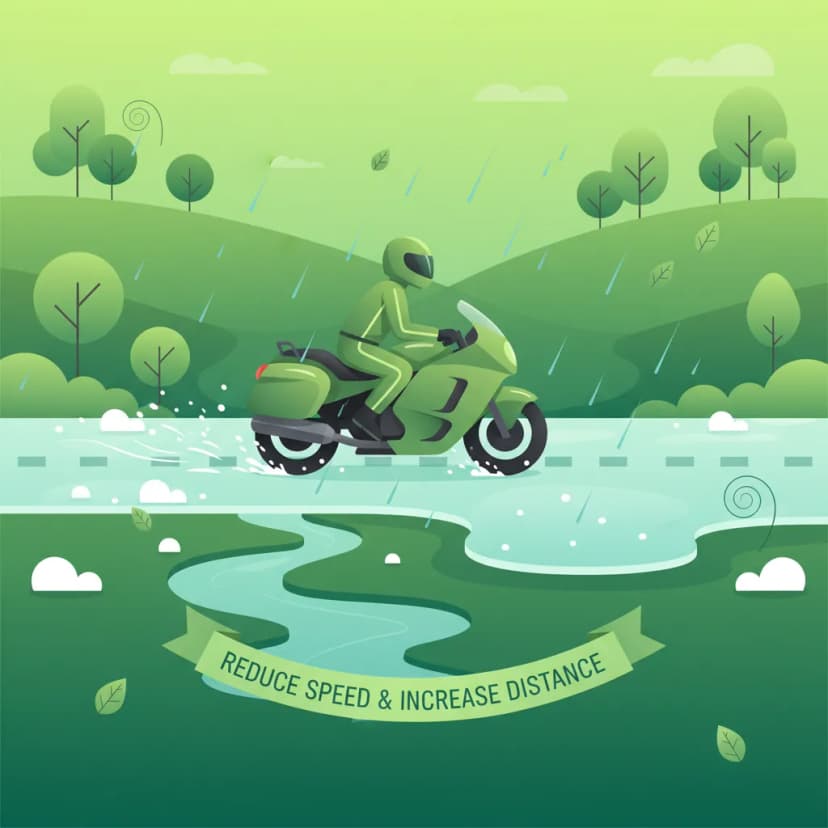
This lesson provides survival strategies for riding in the most challenging weather conditions, including heavy rain, snow, and potential ice. It emphasizes the importance of mental preparation, drastically reduced speeds, and hyper-smooth inputs for throttle, brakes, and steering. The content also covers identifying high-risk areas for 'black ice,' such as bridges and shaded spots, and the critical role of appropriate waterproof and insulated gear in preventing hypothermia and maintaining concentration.

Rain significantly reduces tire grip and rider visibility. This lesson covers the essential adjustments needed for wet-weather riding, including reducing speed, increasing following distance, and applying all controls more smoothly. It explains the danger of hydroplaning (aquaplaning) when tires lose contact with the road over standing water and how to avoid it. You will also learn about the importance of good tire tread depth for channeling water away and maintaining traction.
Find clear answers to common questions learners have about Skid Control and Recovery Techniques. Learn how the lesson is structured, which driving theory objectives it supports, and how it fits into the overall learning path of units and curriculum progression in the Netherlands. These explanations help you understand key concepts, lesson flow, and exam focused study goals.
A rear wheel skid (lock-up) is often more manageable; releasing the rear brake gently and looking where you want to go can help regain control. A front wheel skid, however, is far more critical and requires immediate, gentle release of the front brake combined with careful counter-steering, as recovery is very difficult if the wheel is at an extreme angle.
This is called 'target fixation'. Your body naturally steers towards where your eyes are focused. During a skid, if you stare at the obstacle or the ground, you're likely to steer into it or fall. By actively looking towards your escape route or the desired path, you mentally and physically aid the recovery process.
ABS (Anti-lock Braking System) is designed to prevent wheel lock-up during braking, which is a common cause of skids. While it significantly reduces the risk of skidding under hard braking, it cannot prevent skids caused by excessive throttle, sudden steering inputs, or low-grip surfaces (like ice or loose gravel) where traction is simply unavailable.
It depends on which wheel is skidding. If the rear wheel skids under braking, you should generally ease off the rear brake. If the front wheel skids under braking, immediately and gently release the front brake pressure. Re-applying the other brake or a combination should only be done if control is regained and it's safe to do so.