
This lesson provides a comprehensive overview of how to correctly use light and audible signals as a Category A motorcyclist in the Netherlands. Understanding these rules is vital for safe communication on the road and forms a key part of the Dutch CBR theory exam. It builds upon your knowledge of road signs, ensuring you can signal your intentions clearly and legally to other road users.
This comprehensive lesson, part of the Dutch Motorcycle Theory – Category A Comprehensive Preparation course, delves into the essential rules and practical applications of light and audible signals for motorcyclists in the Netherlands. Mastering the correct use of headlights, turn signals, hazard lights, brake lights, and the horn is not just a legal requirement but a fundamental skill for safe and predictable riding. These signals are your primary tools for communicating intentions and enhancing visibility, thereby significantly reducing the risk of collisions on Dutch roads.
Effective communication on the road is paramount for safety, especially for motorcyclists who are more vulnerable road users. Light and sound signals serve as active safety systems, designed to convey your intentions, warn of potential dangers, and improve your conspicuity in varying conditions. Understanding the underlying logic of these signals—physical propagation, legal mandates, and safety psychology—is crucial for their correct and timely application.
Proactive Signalling Saves Lives: Always think ahead and signal your intentions early. This gives other road users ample time to perceive your actions and react safely.
Four core principles govern the use of all signals in Dutch traffic, ensuring uniformity and enhancing safety:
Headlights are critical for both illuminating the road ahead and ensuring your motorcycle is visible to others, particularly in low-light or adverse weather conditions. Dutch traffic law distinguishes between several types of headlights, each with specific usage rules.
The dipped beam, also known as low beam, is your standard headlight setting for most riding conditions outside of bright daylight. It provides a shorter-range, downward-angled light beam specifically designed to illuminate the road without dazzling oncoming traffic or drivers you are following.
When to Use Dipped Beam: Dipped beam is mandatory from sunset until sunrise, and at any time when visibility is reduced due to rain, fog, heavy snowfall, or other atmospheric conditions.
The main beam, or high beam, offers a long-range, upward-angled light beam for maximum road illumination. While powerful, its use is strictly regulated to prevent glare.
Main Beam Restriction: You may only use your main beam on unlit roads where there is no oncoming traffic within 150 metres (or 200 metres in foggy conditions). You must switch to dipped beam well in advance of meeting or following another vehicle.
Using main beam in urban areas or when approaching other vehicles can cause temporary blindness (glare), significantly increasing the risk of head-on or rear-end collisions.
Daytime Running Lights (DRL) are low-intensity lights designed to increase the conspicuity of your motorcycle during daylight hours. They are typically automatic, activating when the engine starts.
DRLs are mandatory for new motorcycles sold in the EU and significantly enhance your visibility to other road users in clear daylight. However, it is crucial to remember that DRLs are not a substitute for dipped beam at night or in conditions of reduced visibility. They do not illuminate the road sufficiently for safe night riding.
Auxiliary lights, often referred to as position lights or parking lights, are small, low-intensity lights that indicate the presence of your motorcycle when it is stationary. They are useful when parking your motorcycle on the roadside in low-light conditions or reduced visibility, ensuring it remains visible to passing traffic without consuming excessive battery power or causing glare. These lights should never be used as the primary source of illumination while moving.
Many modern motorcycles are equipped with automatic headlight systems that use sensors to switch between off, dipped, and sometimes main beams based on ambient light conditions. While convenient, these systems are not infallible. As the driver, you retain ultimate responsibility for ensuring the correct lighting is active. Always be prepared to manually override the system if it fails to activate the appropriate lights (e.g., in sudden fog or heavy rain).
Turn signals, or indicators, are fundamental for communicating your intention to change direction or lane. Precise and timely use of indicators is critical for preventing accidents.
Dutch traffic law, especially as interpreted for CBR exams, requires specific timing for indicator activation. You must activate your turn signal at least 3 seconds before initiating a lane change, making a turn, or entering a roundabout. The signal must remain on throughout the maneuver until the vehicle has fully completed the action.
The "3-Second Rule": This unwritten but widely enforced rule provides a crucial safety buffer, giving other road users enough time to register your signal and react. Practice this timing diligently.
You must use your indicators in the following situations:
Equally important to activating signals early is cancelling them immediately after completing your maneuver. Leaving an indicator on, especially after exiting a roundabout or completing a turn, is misleading and can cause confusion for other road users, potentially leading to dangerous situations. Your motorcycle may have self-cancelling indicators, but always double-check.
Using indicators for purposes other than signalling a direction change (e.g., as a "thank you" or "sorry" gesture) is strictly prohibited. Such misuse creates ambiguity and undermines the standard communication system, increasing risk for all road users.
Hazard lights, which simultaneously flash all turn signals, are specifically designed to warn other road users of a temporary danger caused by a stationary vehicle.
Hazard Lights Usage: Hazard lights may be used only when your motorcycle is stopped on a road and poses a danger to traffic, such as in the event of a breakdown, accident, or obstruction.
It is illegal to use hazard lights while driving, as this misleads other drivers into believing your vehicle is stationary. For example, you should never use hazard lights while proceeding through an intersection or driving slowly in adverse weather, as this disrupts the clear communication of your actual intent.
Brake lights are red lights located at the rear of your motorcycle that illuminate automatically when you apply either the front brake lever or the rear brake pedal. Their primary function is to provide an immediate visual cue of your deceleration to following traffic.
It is a legal requirement that your brake lights must be operational and illuminate immediately upon brake application. A delayed or non-functional brake light significantly increases the risk of a rear-end collision, as following drivers receive no warning that you are slowing down. Regular checks of your brake lights are therefore essential for safety and legal compliance.
Rear-facing lights, generally, must be operational at all times to ensure the visibility of your vehicle from the rear. This is checked during mandatory vehicle inspections.
Reverse lights are white lights that illuminate when a vehicle is moving backward. For most standard motorcycles, which lack a reverse gear, these lights are generally not applicable or required. However, if a motorcycle is equipped with a reverse gear (e.g., certain heavy touring bikes or motorcycles with side-car assemblies), its reverse lights must comply with relevant EU directives.
The horn is an audible signaling device intended solely to warn other road users of imminent danger. Its use is strictly regulated to prevent noise pollution and ensure its effectiveness as a critical warning tool.
Horn for Danger Only: The horn may be used only to warn of immediate danger. It is explicitly prohibited for expressing impatience, frustration, greeting, or signalling "thank you" or "sorry."
The sound pressure level of a motorcycle horn in the Netherlands must not exceed 110 dB(A) at a distance of 1 metre, in accordance with EU regulations. While there are no explicit time restrictions on horn usage in residential areas at night, any use outside of the "danger" criterion can be classified as nuisance and may result in penalties.
Prolonged honking in traffic jams or using the horn to "hurry up" a slow driver are common examples of misuse that can lead to fines for causing annoyance or unnecessary disturbance. Keep horn blasts brief and focused on preventing immediate hazards.
Adhering to Dutch traffic regulations regarding light and horn usage is non-negotiable for motorcyclists. Here's a summary of key rules:
Misuse or neglect of light signals and horn usage carries significant risks and legal penalties.
Legal Penalties: Violations of lighting and signaling rules can result in fines ranging from approximately €80 to €140, and may include demerit points on your license, potentially leading to suspension upon accumulation.
Here are some common violations:
The correct application of signals often depends on environmental factors and specific riding situations.
Motorcyclists have a higher duty of care towards pedestrians and cyclists. Use your horn only when there is an immediate danger. Avoid bright flashing lights (other than hazard lights when stationary) in urban zones or near VRUs, as this can startle or confuse them.
Every choice you make regarding signals has direct consequences for road safety.
Effective signaling is not an isolated skill but is deeply interconnected with other aspects of Dutch traffic law and safe riding practices.
This lesson provides the essential foundation for more advanced topics, particularly in Night Riding (Lesson 7), where lighting choices become critical for safety, and in Emergency Braking (Lesson 9), where the timing of brake lights under stress is paramount.
Let's explore some practical scenarios to solidify your understanding of light signals and horn usage.
Situation: You are riding your motorcycle on a country road after sunset. There are no streetlights, and visibility is generally good, but the road is dark. Correct Action: You initially use your main beam to maximize your view of the road ahead. As you spot an oncoming car in the distance, you dim your lights to dipped beam when the car is approximately 200 metres away, ensuring it is well before the 150-meter threshold. Reasoning: This allows you to see far ahead while responsibly preventing glare for the oncoming driver, maintaining safety for both parties.
Situation: You are in a city center during the day, approaching a traffic light at an intersection where you intend to turn right. Correct Action: You activate your right turn indicator approximately 4-5 seconds before reaching the intersection, giving ample warning to traffic behind and beside you. You maintain the indicator through the entire turn and immediately cancel it once your motorcycle is fully aligned in the new street. Reasoning: Early and sustained signaling provides clear, unambiguous communication, allowing other drivers and pedestrians to anticipate your maneuver. Prompt cancellation prevents misleading signals.
Situation: You are riding on a motorway, and heavy fog suddenly reduces visibility to less than 50 meters. Your motorcycle then suffers a mechanical breakdown, forcing you to stop on the hard shoulder. Correct Action: Immediately pull over safely to the hard shoulder. Activate your hazard lights, and ensure your Daytime Running Lights (DRL) and auxiliary lights are on to maximize your motorcycle's visibility in the thick fog. If necessary, also make a hand signal for "stop." Reasoning: The combination of hazard lights and other active lighting ensures your stationary vehicle is as conspicuous as possible under dangerous, low-visibility conditions, warning approaching traffic of the obstruction.
Situation: You are riding through a residential street in the evening. Ahead, a pedestrian unexpectedly steps onto a crosswalk without looking, directly into your path. Correct Action: You immediately give a brief (less than 1 second), sharp blast of your horn to alert the pedestrian to your presence, while simultaneously preparing to brake and slow down. Reasoning: The horn is used appropriately here to warn of an imminent danger, preventing a potential collision without causing unnecessary disturbance or expressing frustration.
Mastering light signals and horn usage is fundamental to safe and legal motorcycling in the Netherlands.
This lesson provides a critical foundation for communicating effectively and safely on the road, contributing to your overall skill as a responsible motorcyclist in the Netherlands.
Lesson content overview
Explore all units and lessons included in this driving theory course.
Explore search topics learners often look for when studying Light Signals and Horn Usage. These topics reflect common questions about road rules, driving situations, safety guidance, and lesson level theory preparation for learners in the Netherlands.
Browse additional driving theory lessons that cover connected traffic rules, road signs, and common driving situations related to this topic. Improve your understanding of how different rules interact across everyday traffic scenarios.
Explore advanced applications of motorcycle lighting and horn signals across diverse Dutch driving scenarios. Understand how weather, road type, and traffic density dictate correct signal usage beyond basic rules. This lesson covers nuanced communication for enhanced safety and legal compliance.
This lesson covers the full range of lights and signals required on a vehicle for visibility and communication. You will learn about the mandatory requirements for headlights, taillights, brake lights, indicators, and reflectors. The curriculum emphasizes the driver's legal responsibility to ensure all lights are clean and functional before every journey. The correct use and function of the horn as an audible warning device in case of imminent danger are also explained.
Effective communication with other road users is vital for safety. This lesson details the legal requirements and proper use of your vehicle's signaling equipment, including headlights, brake lights, and turn signals (indicators). It also explains the specific situations in which using the horn is permitted to avert danger. Finally, it covers the mandatory placement and type of reflectors that ensure your vehicle remains visible to others, especially in low-light conditions.
This lesson focuses on the use of specialized lights for specific situations. You will learn the strict conditions under which fog lights may be used: the rear fog light is only permitted when visibility from fog or snow is less than 50 meters, and not in rain. The lesson also explains the correct use of hazard warning lights, which are intended to warn other drivers of a stationary obstruction (like a breakdown or the tail end of a sudden traffic jam) or while being towed.
This lesson covers the mandatory lighting and signaling equipment for A2 motorcycles under Dutch law, ensuring you remain visible and communicate your intentions correctly. You will learn the rules for using headlights, taillights, turn signals, and brake lights in various conditions, including daytime and adverse weather. The content also addresses the importance of maintaining this equipment and using hand signals as a valid secondary method of communication in traffic.
This lesson details the functions of the various lights on a car and the legal requirements for their use. You will learn the difference between dipped beams (dimlicht), which are the standard headlights for night driving and poor visibility, and main beams (grootlicht), which can only be used when they won't dazzle other road users. The content also covers the use of sidelights (stadslicht) for parking and the automatic function of Daytime Running Lights (DRLs). Correct usage is vital for visibility and avoiding blinding other drivers.
This lesson goes beyond the legal requirements of lighting to teach you how to use it strategically to stand out in traffic. You will learn the importance of always riding with your low-beam headlight on, and the appropriate, considerate use of the high beam to make yourself more noticeable from a distance. The content also covers using turn signals well in advance and tapping the brakes to flash the brake light before slowing.
This lesson focuses on the dual challenge of visibility: seeing the road ahead and ensuring other drivers see you. It covers the legal requirements and tactical use of headlights ('koplampen'), including when to use high and low beams, and the importance of daytime running lights. Additionally, it explores strategies for enhancing personal conspicuity through high-visibility and reflective clothing, and using lane positioning to stand out in traffic and avoid blind spots.

Your vehicle's lights and horn are your primary tools for seeing, being seen, and communicating warnings. This lesson guides you through a simple but vital check of all electrical components before you ride. You will learn how to verify the function of your headlight (high and low beam), taillight, brake light (using both front and rear brake levers), and turn signals. It also covers checking the horn's operation and ensuring all mandatory reflectors are clean and intact.
This lesson covers the universal Dutch road rules with a specific focus on their application to light motorcycles. It details the various speed limits for different road types, from urban areas to motorways, and explains the correct procedures for overtaking and lane positioning. The legal aspects of lane filtering in congestion are also examined, alongside mandatory equipment use like daytime running lights, to ensure riders can integrate safely and legally into traffic flow.
This lesson explains the purpose of audible indicator reminders, often called 'squealers' or 'piepers', which help prevent riders from unintentionally leaving their turn signals on. It also provides a detailed breakdown of the legal nuances and restrictions related to lane splitting and filtering. The content clarifies the distinction between these maneuvers and outlines the specific road situations and traffic conditions where such actions are explicitly prohibited or heavily regulated.
Understand typical mistakes motorcyclists make with light signals and horn usage according to Dutch traffic law. Learn to avoid incorrect application of indicators, headlights, hazard lights, and horn to prevent dangerous situations and fines. Essential for CBR theory preparation.
Effective communication with other road users is vital for safety. This lesson details the legal requirements and proper use of your vehicle's signaling equipment, including headlights, brake lights, and turn signals (indicators). It also explains the specific situations in which using the horn is permitted to avert danger. Finally, it covers the mandatory placement and type of reflectors that ensure your vehicle remains visible to others, especially in low-light conditions.
This lesson covers the mandatory lighting and signaling equipment for A2 motorcycles under Dutch law, ensuring you remain visible and communicate your intentions correctly. You will learn the rules for using headlights, taillights, turn signals, and brake lights in various conditions, including daytime and adverse weather. The content also addresses the importance of maintaining this equipment and using hand signals as a valid secondary method of communication in traffic.
Your vehicle's lights and horn are your primary tools for seeing, being seen, and communicating warnings. This lesson guides you through a simple but vital check of all electrical components before you ride. You will learn how to verify the function of your headlight (high and low beam), taillight, brake light (using both front and rear brake levers), and turn signals. It also covers checking the horn's operation and ensuring all mandatory reflectors are clean and intact.
This lesson covers the full range of lights and signals required on a vehicle for visibility and communication. You will learn about the mandatory requirements for headlights, taillights, brake lights, indicators, and reflectors. The curriculum emphasizes the driver's legal responsibility to ensure all lights are clean and functional before every journey. The correct use and function of the horn as an audible warning device in case of imminent danger are also explained.
This lesson goes beyond the legal requirements of lighting to teach you how to use it strategically to stand out in traffic. You will learn the importance of always riding with your low-beam headlight on, and the appropriate, considerate use of the high beam to make yourself more noticeable from a distance. The content also covers using turn signals well in advance and tapping the brakes to flash the brake light before slowing.
This lesson explains the purpose of audible indicator reminders, often called 'squealers' or 'piepers', which help prevent riders from unintentionally leaving their turn signals on. It also provides a detailed breakdown of the legal nuances and restrictions related to lane splitting and filtering. The content clarifies the distinction between these maneuvers and outlines the specific road situations and traffic conditions where such actions are explicitly prohibited or heavily regulated.
This lesson details the systematic procedure for checking the functionality of all lights and indicators before a ride. This simple but critical safety check includes verifying the operation of the high and low beam headlight, the taillight, the brake light (using both front and rear brake activators), and all four turn signals. Ensuring all lights are working is a legal requirement and fundamental for visibility and communicating intentions to other road users.
This lesson focuses on the use of specialized lights for specific situations. You will learn the strict conditions under which fog lights may be used: the rear fog light is only permitted when visibility from fog or snow is less than 50 meters, and not in rain. The lesson also explains the correct use of hazard warning lights, which are intended to warn other drivers of a stationary obstruction (like a breakdown or the tail end of a sudden traffic jam) or while being towed.
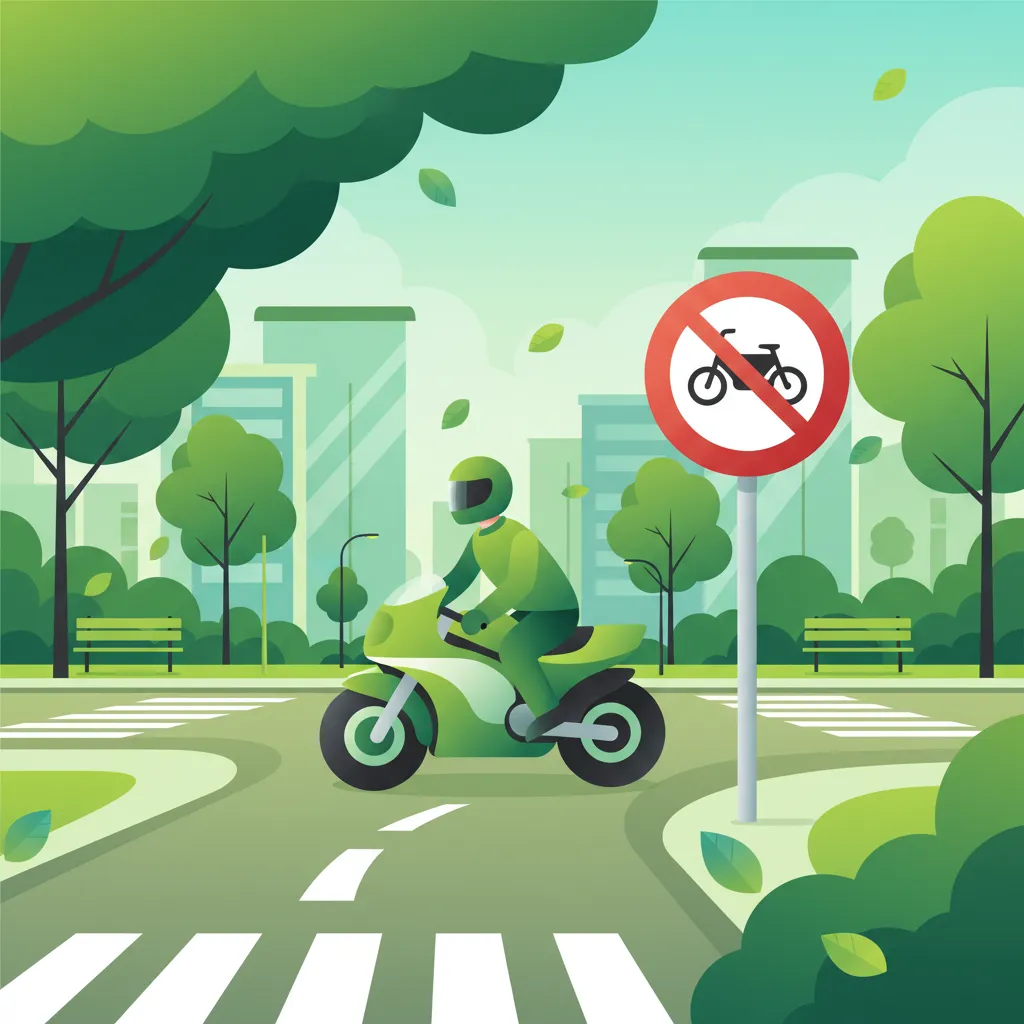
This lesson focuses on Dutch regulatory signs that enforce mandatory rules and restrictions, particularly those impacting A2 motorcyclists. You will learn to recognize and obey prohibition signs, such as those indicating a motorcycle ban (BORD 40), speed limits, and overtaking restrictions (BORD 21). The content explains the legal consequences of non-compliance and how to apply these rules in practical riding scenarios to ensure full adherence to Dutch traffic law.
This lesson offers an in-depth study of Dutch regulatory signs, which impose mandatory actions or prohibitions on road users, with a specific focus on their impact on motorcyclists. It explains the visual language of prohibition symbols ('verbodsborden') and obligation symbols ('verplichtingsborden'), the contexts in which they appear, and the strict statutory consequences of non-compliance. Real-world examples are used to illustrate how these signs directly influence route planning, overtaking decisions, and speed management.
Find clear answers to common questions learners have about Light Signals and Horn Usage. Learn how the lesson is structured, which driving theory objectives it supports, and how it fits into the overall learning path of units and curriculum progression in the Netherlands. These explanations help you understand key concepts, lesson flow, and exam focused study goals.
The horn should only be used to avert an imminent dangerous situation. It is not permitted for greeting, showing annoyance, or signaling to someone unnecessarily. Misuse of the horn can result in a fine according to Dutch traffic law.
Yes, in the Netherlands, motorcycles are generally required to use their dipped beam headlights (dimlicht) or daytime running lights (DRL) during the day, even in good visibility. This is to enhance your visibility to other road users, significantly improving safety for Category A motorcyclists.
Hazard lights should primarily be used to warn other road users of a temporary obstruction or danger, such as a breakdown, an accident, or when you are momentarily blocking traffic. They should not be used while driving normally in adverse weather or in a convoy, as this can confuse other drivers about your intentions.
No, in the Netherlands, turn signals are strictly for indicating your intention to turn or change lanes. Using them to thank drivers or signal slowing down is incorrect and can lead to confusion, potentially causing dangerous situations. Always use signals only for their intended purpose.
Incorrect use of lights (e.g., driving without required lights) or the horn (e.g., unnecessary honking) can lead to fines from the Dutch police. These penalties are designed to ensure road safety and clear communication among all road users, including Category A motorcyclists.