
Overtaking other vehicles is a critical skill for AM-category riders, but also a high-risk maneuver. This lesson, part of the 'Vehicle Control & Maneuvers' unit, will guide you through the essential steps to overtake safely and legally, ensuring you understand when it's permitted and how to execute it correctly to pass your theory exam and ride confidently.

Overtaking, or "inhalen" in Dutch, is a fundamental driving maneuver for moped and scooter riders in the Netherlands. While essential for maintaining traffic flow and navigating around slower vehicles, it is also statistically one of the highest-risk maneuvers you will perform. This comprehensive lesson, tailored for the Dutch Driving License Theory Course for Category AM, delves into the critical knowledge, legal framework, and decision-making processes required to execute overtaking safely and responsibly.
Overtaking is a purposeful change in your lateral position on the roadway to move ahead of another road user traveling in the same direction. For Category AM vehicles like mopeds (bromfietsen) and scooters (snorfietsen), understanding the nuances of overtaking is crucial for several reasons. It not only allows you to progress efficiently but, more importantly, it helps prevent collisions and protects all road users, especially vulnerable ones like pedestrians and cyclists.
In the context of Dutch traffic law, "overtaking" (inhalen) primarily refers to moving past a vehicle traveling in the same direction. This usually involves moving to the left lane or section of the road, accelerating, and then returning to your original position. "Passing" (passeren) can be a broader term, sometimes encompassing situations where you move past oncoming traffic on a two-lane road, or even past stationary obstacles. For moped riders, the focus is typically on safely moving past slower traffic in the same direction.
The maneuver is governed by a combination of safety logic, physical laws, and strict legal intent as outlined in the Dutch traffic code (RVV 1990). Reducing the time spent directly behind slower traffic can decrease the risk of rear-end collisions, but the act of overtaking itself introduces new hazards such as reduced sight distances and potential lateral conflicts with other vehicles or oncoming traffic.
Mopeds, with their smaller size and unique road access rules, face particular challenges when overtaking. While they generally have good acceleration for urban speeds, their maximum speed limit of 45 km/h means they must carefully assess when and where overtaking is safe and legal. Incorrect execution of an overtaking maneuver can lead to severe consequences, including head-on collisions, side-swipes, and serious injury to vulnerable road users. Adhering to the correct procedure not only keeps you safe but also fulfills your mandatory legal obligations as a road user in the Netherlands.
Successful and safe overtaking is built upon a foundation of several interconnected principles. Mastering these is key to confident and compliant riding.
The first step in any overtaking maneuver is to confirm you are in a legal overtaking zone. This is any stretch of road where overtaking is not explicitly prohibited by traffic signs or road markings. A solid white line on your left side typically indicates that overtaking is forbidden, as it signifies no lateral movement across the line. Conversely, a broken white line generally permits overtaking, provided all other safety conditions are met. These zones guarantee adequate sight distance and road width for safe lateral movement. Always verify the road markings and scan for prohibitive signs before initiating any maneuver.
In the Netherlands, as in many right-hand traffic countries, the fundamental rule is that overtaking must be performed on the left side of the vehicle being passed. This aligns with standard Dutch traffic flow and significantly reduces the risk of head-on conflicts.
Overtaking must be performed on the left side of the vehicle being passed, except in narrowly defined exceptions, such as when the overtaken vehicle signals a left turn and conditions allow safe passage on its right.
There is a crucial exception to this rule: you may overtake on the right side if the vehicle you intend to pass is clearly signaling a left turn and there is sufficient space to pass safely without endangering anyone. This right-hand overtaking exception is strictly limited and should only be used when conditions are absolutely clear and safe.
A critical element of safe overtaking is maintaining adequate longitudinal gaps both before initiating the maneuver and after returning to your lane. This is known as "safe following distance."
The minimum longitudinal spacing between your moped and the vehicle ahead (or behind) needed to complete any maneuver safely. A common rule-of-thumb for mopeds is at least 2 seconds at the current speed.
This 2-second rule means you should be able to count "one thousand one, one thousand two" from the moment the vehicle in front passes a fixed point until your moped passes the same point. At 45 km/h, this translates to roughly 30 meters. This distance provides sufficient braking and reaction time for all involved parties, and it must be continuously assessed based on speed, weather, vehicle load, and road conditions. In adverse conditions like rain, this gap should be increased to at least 3 seconds.
Before any lateral movement, it is mandatory to communicate your intentions to surrounding road users. For mopeds, this means activating your left turn indicator (or using a clear hand signal if indicators are unavailable or malfunctioning).
The use of the left turn indicator (or a hand signal) to clearly announce your intention to change lanes or perform an overtaking maneuver to other road users.
The indicator must be activated at least 3 seconds before you begin to move out of your lane and should remain on until your moped is safely back in its original lane. This allows other drivers to anticipate your actions and adjust their speed or position accordingly, reducing the risk of confusion and collisions.
Visibility is paramount. Before any lateral movement, you must perform thorough checks of your surroundings using both your rear-view mirrors and a quick head turn, often called a "shoulder check."
The area directly beside and slightly behind your vehicle that cannot be seen in your rear-view mirrors. For mopeds, this typically extends about 1 meter laterally and 2-3 meters behind.
Blind spots can hide other vehicles, especially smaller ones like bicycles, other mopeds, or motorcycles. A failure to check your blind spot can lead to serious side-impact collisions, particularly with fast-approaching traffic or cyclists riding close to the curb. This thorough visual confirmation is a crucial part of your general duty of care (RVV 1990 Art. 4.1) to avoid collisions.
Once you have assessed the situation, signaled, and checked your surroundings, the actual overtaking maneuver requires smooth and decisive action. Accelerate to a speed that allows for swift passage while always staying within the legal speed limits (maximum 45 km/h for Category AM vehicles).
Over-acceleration can increase braking distance and make the vehicle harder to control, while under-acceleration can prolong the time spent in the overtaking lane, increasing exposure to hazards. Aim for a smooth, controlled increase in speed.
After passing the slower vehicle, return to your original lane only after achieving a safe distance from the overtaken vehicle. A good rule of thumb is to ensure you can see the entire front of the overtaken vehicle in your right-hand mirror before gently steering back. This prevents "cutting in" and maintains a safe traffic flow.
Beyond the core principles, several specific concepts and subtopics are vital for safe and legal overtaking.
Dutch traffic signs explicitly forbid overtaking in certain areas. Recognizing and obeying these signs is mandatory.
These signs (R100, R101, R102) indicate zones where overtaking is inherently dangerous, such as before blind corners, near intersections, or in areas with high pedestrian traffic. You must obey these signs regardless of your personal assessment of the safety.
The 2-second rule for safe following distance is fundamental. When initiating an overtake, you need enough space ahead of the vehicle you intend to pass and, crucially, enough clear road ahead to complete the maneuver and return to your lane before encountering oncoming traffic or other hazards. After returning to your lane, you must also maintain at least a 2-second gap to the vehicle you just passed to avoid cutting them off. This dynamic gap ensures sufficient braking distance and reaction time for all parties involved. Remember, this distance must increase in adverse conditions.
On larger roads, especially near junctions or merges, you may encounter designated acceleration or deceleration lanes. While mopeds are restricted from many high-speed roads, they may encounter these lanes in certain situations, for example, on provincial roads or around complex intersections where permitted.
A designated lane section that allows vehicles to increase speed to match the flow of traffic before merging or overtaking.
A road segment designed for vehicles to reduce speed safely when exiting a main road or preparing for a turn.
If present and permitted for mopeds, use acceleration lanes to build up speed to safely integrate into traffic flow or to facilitate an overtaking maneuver. Ignoring these lanes and attempting to overtake from a standstill or at an inappropriate speed reduces your ability to merge and maneuver safely.
While "overtaking" generally implies moving past traffic in the same direction, "passing" (passeren) can sometimes refer to moving past oncoming traffic on a two-lane road. For Category AM riders, passing oncoming traffic is only permitted on roads with clear road markings that allow it (e.g., a broken double line with the broken line on your side) and when there is absolutely adequate visibility and space to do so without any danger. This is never allowed on motorways or roads where mopeds are prohibited.
The Dutch Traffic Regulations (Reglement Verkeersregels en Verkeerstekens 1990, or RVV 1990) provide the legal framework for all road users, including moped riders. Specific articles govern overtaking:
Dutch law strictly prohibits overtaking in several high-risk zones to prevent accidents:
Always be aware of these prohibited zones. Ignoring them is not only illegal but extremely dangerous, significantly increasing the risk of severe collisions.
When overtaking vulnerable road users, such as cyclists or pedestrians, special care and increased lateral clearance are required.
Many accidents involving overtaking could be prevented by understanding and avoiding common mistakes.
| Violation | Why It’s Wrong | Correct Behaviour | Typical Consequence |
|---|---|---|---|
| Overtaking over a solid white line | Indicates no lateral movement; often in areas with limited visibility or specific hazards. | Remain in your lane; wait for a broken line or a clearly marked safe zone. | Fine, potential head-on collision or side-impact. |
| Overtaking within 30 m of a pedestrian crossing | Obscures pedestrians for both the overtaking driver and other road users; reduces reaction time. | Stop at least 30 m before the crossing; wait until it's clear before proceeding. | High risk of pedestrian injury, significant legal liability, fine. |
| Right-hand overtaking without proper left-turn signal | Violates the fundamental left-hand overtaking rule (RVV Art. 4.6). | Always overtake on the left, unless the vehicle ahead clearly signals a left turn and conditions are safe for right-hand passing. | Fine, possible rear-end or side-impact collision. |
| Insufficient rear gap when re-entering lane | Cuts off the overtaken vehicle, leaving inadequate braking distance for them. | Ensure you can see the entire front of the overtaken vehicle in your right mirror before returning to your lane. Maintain at least a 2-second gap. | Rear-end collision, possible injury, increased insurance costs. |
| Failing to perform a blind-spot (shoulder) check | Crucial for detecting hidden cyclists, mopeds, or motorcycles. | Always perform a quick shoulder check to confirm the blind spot is clear before moving laterally. | Side-collision with severe injuries. |
| Overtaking in rain without extending safe distances | Wet roads significantly increase braking distances and reduce tire grip. | Increase front and rear gaps (e.g., to 3 seconds); reduce your overall speed and acceleration. | Skidding, loss of control, collision. |
| Attempting overtaking on a motorway or prohibited road | Mopeds are legally prohibited from these roads, making any maneuver illegal and extremely dangerous due to high-speed traffic. | Seek an alternative route or remain in designated lanes for mopeds only. | Significant fine, vehicle impoundment, high accident risk. |
Safe overtaking is not a one-size-fits-all procedure. Environmental and situational factors demand adjustments to your technique.
Safe overtaking isn't just about rules; it's also about understanding the physics and human factors involved.
Here are a few scenarios to illustrate safe overtaking practices.
Correct Behaviour: The rider first checks their rear mirror (clear), performs a left shoulder check (no other vehicle), then activates their left indicator 3 seconds before initiating movement. They ensure at least a 2-second gap ahead (approx. 15m at 30km/h) and a similar gap behind before gently accelerating to 35 km/h. The moped overtakes the scooter on the left, then returns to the lane after achieving a 2-second rear gap from the overtaken scooter in their mirror.
Explanation: This approach respects the left-hand overtaking rule, maintains safe distances, and uses clear signaling, minimizing risk in a populated urban setting.
Correct Behaviour: The rider slows to 40 km/h, recognizing the reduced grip due to rain. They check their mirror (clear) and perform a shoulder check (no vehicle approaching from behind). They activate the left indicator, wait until the distance to the cyclist is greater than 30 meters, and ensure at least a 3-second rear gap to allow for longer braking distances in wet conditions. The moped then overtakes on the left, maintaining a lateral clearance of at least 1.5 meters from the cyclist. The rider returns to the lane only after the blind curve and after establishing a safe gap from the cyclist.
Explanation: Increased gaps are crucial in wet weather. Respecting the 1.5m lateral clearance protects the vulnerable cyclist, and waiting for a clear sightline past the blind curve avoids a high-risk situation.
Correct Behaviour: The rider observes the pedestrian crossing and the bus, immediately recognizing the 30-meter no-overtaking buffer zone. They stop their moped at least 30 meters before the crossing. They wait for the bus to clear the crossing and for any pedestrians to safely cross. Only then, with the crossing clear, do they proceed and, if safe, overtake the waiting scooter after the crossing, using proper signaling and maintaining safe gaps.
Explanation: Strict adherence to the 30-meter buffer zone before pedestrian crossings is legally mandatory and critical for pedestrian safety. Overtaking here would obscure pedestrians and create a high-risk scenario.
To ensure every overtaking maneuver is as safe and legal as possible, run through this mental checklist:
To further enhance your understanding and prepare for your Dutch Category AM theory exam, explore these related topics and practice questions:
Lesson content overview
Explore all units and lessons included in this driving theory course.
Explore search topics learners often look for when studying Overtaking and Passing Safely. These topics reflect common questions about road rules, driving situations, safety guidance, and lesson level theory preparation for learners in the Netherlands.
Browse additional driving theory lessons that cover connected traffic rules, road signs, and common driving situations related to this topic. Improve your understanding of how different rules interact across everyday traffic scenarios.
Explore real-world driving scenarios and specific exceptions to overtaking rules in the Netherlands. Understand prohibited zones and vulnerable road user interactions to ensure safe maneuvers and compliance with Dutch traffic law for your AM license.
This lesson provides a detailed guide on the rules and safety precautions for overtaking. You will learn that overtaking must almost always be done on the left and requires careful judgment of speed and distance. The content covers situations where overtaking is forbidden, such as before pedestrian crossings, at intersections, or where there are solid white lines. Key steps like checking mirrors, signaling intention, checking blind spots, and returning to the lane safely are explained thoroughly.
This lesson reinforces the fundamental rule of Dutch highway driving: use the rightmost lane available and use the lanes to the left only for overtaking. You will learn the complete, safe overtaking procedure: check mirrors, signal, perform a shoulder check for the blind spot, smoothly move over, accelerate past the vehicle, and then return to the right lane when safe.
This lesson provides a step-by-step guide to executing a safe and legal overtaking maneuver. It covers the entire process: assessing the situation for a sufficient gap in oncoming traffic, performing necessary mirror and shoulder checks, signaling intent, and accelerating decisively. The lesson also highlights situations where overtaking is prohibited by law, such as before pedestrian crossings or where there are solid white lines.
This lesson details the systematic process for safely overtaking on a multi-lane motorway, leveraging the acceleration capabilities of a Category A motorcycle. It covers the 'mirror, signal, maneuver' sequence, with a strong emphasis on the critical shoulder check to clear the blind spot before moving out. The content also discusses how to judge closing speeds, ensure adequate space before returning to the lane, and how to handle situations involving multiple lanes and slower-moving heavy vehicles.
This lesson covers the procedures and safety considerations for driving in reverse and turning around. You will learn that reversing should only be done over short distances and when it does not endanger or obstruct other road users. The curriculum details techniques for turning in the road and identifies situations and locations where U-turns are prohibited. The importance of all-around observation, checking blind spots, and yielding to all other traffic is a central theme.
Safely merging and changing lanes requires a systematic approach known as 'mirror-signal-blind spot'. This lesson explains the correct procedure for entering a carriageway from an acceleration lane, ensuring you match the speed of the traffic flow and find a safe gap. It also covers the technique for changing lanes, emphasizing the critical importance of checking your blind spot with a shoulder check (dode hoek) before making any lateral movement to prevent collisions.
Roundabouts are a common feature of Dutch roads, and they have specific priority rules. This lesson teaches the standard rule of yielding to traffic already circulating on the roundabout before you enter. It also covers correct lane positioning, the importance of signaling your intention to exit, and the specific rules that often apply to cyclists who may have priority when crossing the exits. These skills ensure smooth and safe passage through both large and mini-roundabouts.
This lesson details the specific regulations for driving on Dutch motorways, identifiable by the G1 sign. You will learn the correct procedure for joining the flow of traffic using the acceleration lane and for leaving via the deceleration lane. The curriculum reinforces the 'keep right unless overtaking' rule for lane discipline. It also explains that stopping is strictly forbidden, and the hard shoulder (vluchtstrook) may only be used for genuine emergencies.
This lesson is critical for driving in the Netherlands, a country with more bicycles than people. You will learn about the different types of cycle paths and how priority rules apply, especially at junctions. The content stresses the importance of checking the blind spot for cyclists before turning right ('dode hoek'). It also covers the rules for different types of mopeds (snorfiets and bromfiets) and the importance of giving all two-wheeled road users ample space when overtaking.
This lesson provides a structured methodology for assessing the safety and legality of an overtaking maneuver, particularly on two-lane roads. It teaches riders how to accurately judge the speed and distance of oncoming traffic, calculate the time and space needed to complete the pass safely, and check for hidden hazards. This systematic risk assessment process helps eliminate guesswork and ensures that every decision to overtake is a well-informed and safe one.
Learn how to safely adapt overtaking and passing maneuvers to various weather and road conditions, including rain, fog, and darkness. This lesson covers crucial aspects of visibility, braking distances, and speed adaptation for safe riding in the Netherlands.
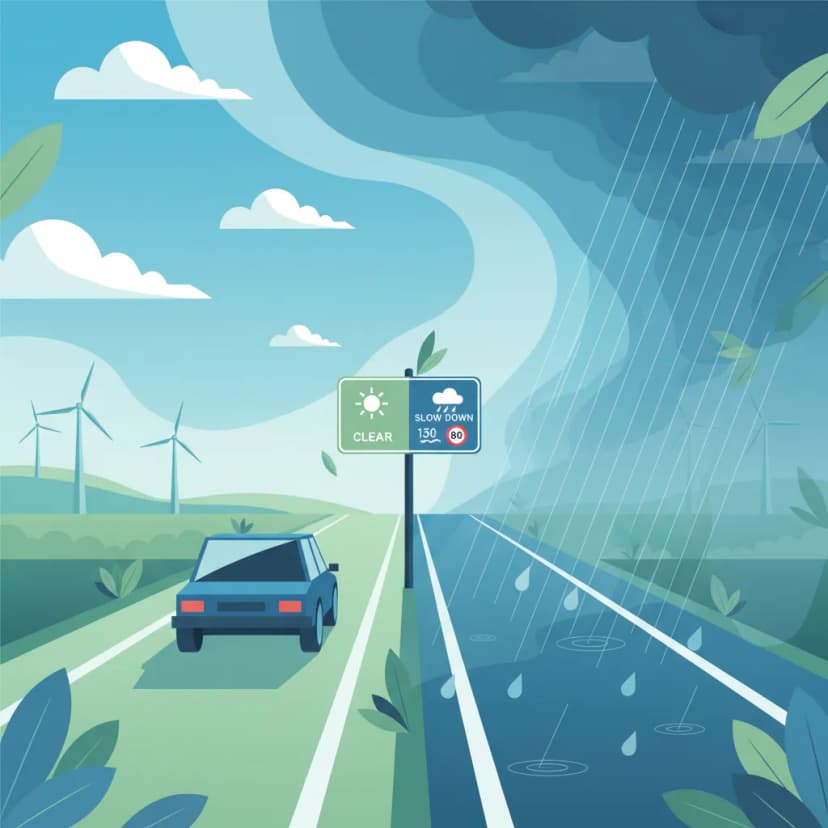
The posted speed limit is a maximum, not a target. This lesson teaches the crucial skill of adapting your speed to prevailing conditions. You will learn how to assess factors like traffic density, poor weather (rain, fog), limited visibility (at night), and slippery road surfaces. Adjusting your speed downwards in these situations provides you with more time to react to hazards and significantly reduces the risk of losing control or being involved in a collision.

Riding on two wheels requires special care on surfaces with reduced grip. This lesson teaches you how to handle challenging conditions like rain, ice, wet leaves, or tram tracks. Key principles include reducing speed significantly, making all control inputs (braking, accelerating, steering) much more smoothly and gradually, and increasing your following distance to allow for much longer stopping distances. Recognizing potentially slippery areas is a critical part of proactive hazard perception.
This lesson is critical for driving in the Netherlands, a country with more bicycles than people. You will learn about the different types of cycle paths and how priority rules apply, especially at junctions. The content stresses the importance of checking the blind spot for cyclists before turning right ('dode hoek'). It also covers the rules for different types of mopeds (snorfiets and bromfiets) and the importance of giving all two-wheeled road users ample space when overtaking.
This lesson explains why the standard two-second rule is insufficient in adverse conditions and requires extension. It details how factors like rain, fog, and darkness reduce both visibility and tire grip, thereby significantly increasing total stopping distance. The content provides practical guidelines, such as extending the following gap to four seconds or more in the wet, to ensure the rider always has enough time and space to stop safely, regardless of the conditions.
This lesson emphasizes the critical importance of adapting your speed to prevailing conditions, which may require driving slower than the legal limit. You will learn how factors like rain, fog, snow, and darkness significantly increase braking distances and reduce visibility. The curriculum explains the dangers of aquaplaning on wet roads and black ice in winter. The core principle taught is that a safe driver always adjusts their speed to ensure they can stop within the distance they can see to be clear.
This lesson reinforces the critical relationship between adverse conditions, reduced traction, and massively increased stopping distances. It provides a clear framework for how much riders need to increase their following distance and reduce their overall speed to maintain a safe margin for error. The curriculum teaches riders to constantly reassess their speed based on visual feedback from the road surface and the level of visibility, ensuring they can always stop within the distance they can clearly see.

This lesson addresses the dual challenge of poor visibility: being able to see the road ahead and ensuring other road users can see you. It covers techniques for riding in fog and heavy rain, such as using appropriate lights and reducing speed to match sight distance. The lesson also discusses practical issues like helmet visor fogging and the importance of wearing high-visibility or reflective clothing to enhance conspicuity in low-light conditions.

Rain significantly reduces tire grip and rider visibility. This lesson covers the essential adjustments needed for wet-weather riding, including reducing speed, increasing following distance, and applying all controls more smoothly. It explains the danger of hydroplaning (aquaplaning) when tires lose contact with the road over standing water and how to avoid it. You will also learn about the importance of good tire tread depth for channeling water away and maintaining traction.

Riding at night presents two main challenges: seeing the road and being seen by others. This lesson covers the legal requirements for your vehicle's lighting system and how to use it effectively, including when to use high beams. It also emphasizes strategies to increase your own conspicuity, such as wearing bright or reflective clothing. You will learn how darkness affects your perception of speed and distance and how to adapt your riding to compensate for these limitations.
Each season brings unique challenges for riders. This lesson discusses common seasonal hazards, such as wet autumn leaves that are as slippery as ice, the risk of black ice in winter, and increased agricultural traffic in the summer. It also highlights the importance of seasonal vehicle maintenance. For example, after winter, it is crucial to wash away corrosive road salt, and before winter, to check antifreeze and battery health, ensuring your vehicle is prepared for the conditions ahead.
Find clear answers to common questions learners have about Overtaking and Passing Safely. Learn how the lesson is structured, which driving theory objectives it supports, and how it fits into the overall learning path of units and curriculum progression in the Netherlands. These explanations help you understand key concepts, lesson flow, and exam focused study goals.
It is always illegal to overtake at intersections, on pedestrian crossings, before a blind corner or bend, on bridges with a one-way traffic flow, and at railway crossings. You also must not overtake if it endangers other road users or if signs prohibit it.
First, assess if overtaking is safe and legal, checking for oncoming traffic and signs. Then, check your mirrors and blind spot. Signal your intention clearly, accelerate smoothly past the vehicle, and move back into your lane once you have sufficient space, checking your mirrors again.
You need enough space to pass the vehicle entirely and to return to your lane safely without forcing other traffic to brake or swerve. Consider the speed of the vehicle you are overtaking, your own speed, and the distance to oncoming traffic. Always err on the side of caution.
You may overtake a tram on the right if the tram is not stopping and there is sufficient space on the right. If the tram is stopped at a designated tram stop and there is no pavement, you must wait for passengers to board or alight safely. If there is a pavement, you may pass the tram when passengers are no longer boarding or alighting.
Overtaking at night or in poor weather conditions significantly increases risk due to reduced visibility. You may not see oncoming traffic clearly, or other drivers may not see you signaling. Always be extra cautious, ensure your own lighting is adequate, and consider if overtaking is truly necessary.