
Welcome to the art of motorcycle cornering! This lesson focuses on the 'ideal line' – the optimal path your A2 motorcycle takes through a curve. Understanding how to approach curves safely by mastering entry, apex, and exit points is crucial for your Dutch theory exam and for building confidence on the road.

Navigating curves safely and efficiently is a fundamental skill for every motorcyclist. This lesson, part of your Complete CBR Theory Course for the Dutch Motorcycle License (Category A2), introduces you to the crucial concept of the 'ideal line' – the optimal path your motorcycle should follow through any bend. Understanding and applying the ideal line enhances your control, boosts your safety, and allows you to enjoy the ride with greater confidence.
The ideal line is not a rigid legal requirement, but a proven best-practice principle derived from the physics of motorcycle dynamics and extensive road safety research. It provides a strategic approach to cornering that prioritizes visibility, stability, and efficient use of tire traction.
The ideal line refers to the optimal geometric path a motorcyclist should trace through a curve. This path is characterized by a "wide-deep-wide" trajectory, meaning you enter the curve from the outer edge of your lane, move towards the innermost point (the apex) of the curve, and then exit by returning to the outer edge of your lane. This approach allows you to effectively straighten the curve's radius, reducing the lean angle required and maximizing your view.
Adopting the ideal line significantly influences several critical aspects of your riding:
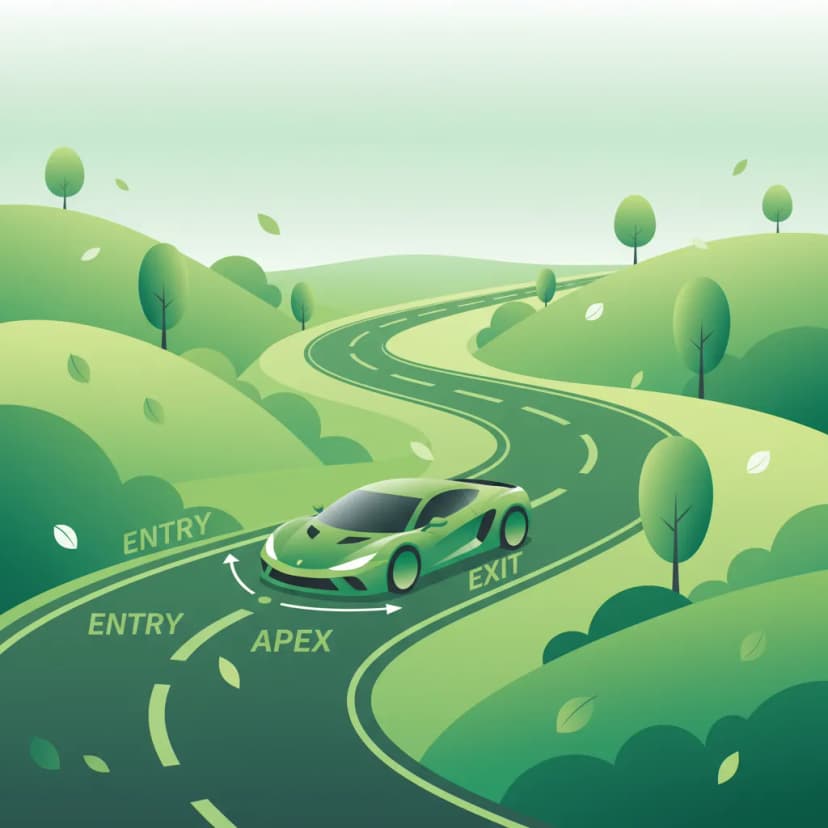
Every curve can be broken down into three fundamental stages: the entry, the apex, and the exit. Mastering each of these points is essential for successfully executing the ideal line.
The entry point is the specific location on the road where you begin to turn your motorcycle into the curve. For the ideal line, this point is strategically positioned near the outer edge of your lane or the road shoulder (where safe and permitted). This wide entry is crucial because it allows you to effectively broaden the curve's radius.
Choosing the correct entry point determines the initial steering angle required to initiate the turn and significantly influences the "sight triangle" – your visual corridor through the curve. A well-chosen wide entry sets you up for a smooth transition into the apex and a stable exit. Conversely, entering too early or too tightly can lead to an abrupt steering input, requiring a greater lean angle, and potentially compromising stability and vision.
The apex is the innermost point of the curve where your motorcycle's path is closest to the inside edge of the road (e.g., the center line or curb). It represents the deepest point of your trajectory within the turn. While there's no single "correct" apex point for all situations, its timing is critical.
The apex serves as a vital reference for the magnitude of your steering input and the precise moment to smoothly transition from braking to applying throttle. It is crucial to aim for the apex with a smooth, progressive steering input rather than a sharp, sudden movement.
The exit point is where you complete the turn and gradually straighten your motorcycle, returning to an upright position. Ideally, this involves moving towards the outer edge of your lane again, mirroring the wide entry. This wide exit allows for maximum visibility of the road ahead and provides the best possible alignment for upcoming traffic flow.
The exit point dictates the final reduction of your lean angle and determines the amount of usable tire traction available for acceleration. A smooth and controlled exit ensures stability as you roll on the throttle. Rushing the acceleration before the motorcycle has significantly straightened can overload the rear tire and lead to a loss of grip, which is a common error.
The fundamental principle of the ideal line is its geometric path, often described as "wide-deep-wide." This trajectory is specifically engineered to enhance safety and control on a motorcycle.
The wide-deep-wide geometry describes a trajectory where you:
This path provides the greatest lateral clearance within your lane and optimizes your sight line through the bend. For example, in a 70 km/h urban curve with a 30-meter radius, a rider might enter 1.2 meters from the outer lane marking, reach 0.3 meters from the inner curb at the apex, and exit at 1.2 meters again.
One of the primary benefits of the wide-deep-wide path is lean angle optimisation. By effectively widening the radius of the curve you are taking, you reduce the overall lean angle required for a given speed. Lower lean angles are highly advantageous because they:
For instance, at 50 km/h in a 25-meter radius curve, the theoretical lean required is approximately 30°. Using the ideal line helps ensure this lean is achievable within safe limits.
The sight triangle, or line-of-sight triangle, is a vital conceptual tool for cornering. It is an imaginary visual corridor formed by your eye point, the apex of the curve, and the exit point. Maintaining a clear and continuous sight triangle ensures that you are always looking as far ahead as possible through the curve.
Proper technique involves looking far ahead through the exit point, rather than just at the apex. Your gaze should lead your motorcycle, allowing your brain to process information and prepare for the next action.
Beyond choosing the right line, your interaction with the motorcycle's controls – particularly speed and throttle – is paramount for safe cornering.
Entry speed management involves adjusting your motorcycle's speed before you lean into a curve. The goal is to complete most, if not all, of your necessary braking while the motorcycle is still upright and traveling in a straight line. This approach prevents excessive braking while leaned over, which can destabilize the motorcycle by transferring too much weight to the front wheel, reducing rear tire grip, and potentially causing a slide.
Avoid late braking while already leaned into a curve, especially on public roads. This significantly increases the risk of losing traction and control. Always aim to adjust your speed fully before entering the turn.
For example, approaching a 60 km/h curve, a rider might reduce speed to 35 km/h while still straight, then enter the curve and smoothly apply throttle.
Throttle transition is the controlled application of throttle after you pass the apex of the curve, synchronizing it with the gradual reduction of your lean angle as you straighten the motorcycle. This smooth roll-on of the throttle is critical for several reasons:
After crossing the apex at, for example, 30 km/h, the rider should smoothly increase the throttle to 45 km/h while gradually straightening the bike. This progressive rear-wheel torque control is vital for safe and stable cornering.
While the ideal line is a principle of optimal riding, specific Dutch traffic regulations (RVV 1990) govern how you must behave on the road, including when navigating curves. Adhering to these rules is non-negotiable for safety and legal compliance.
Motorcyclists must stay within their designated lane and are prohibited from crossing the continuous centre line into oncoming traffic, except when safely avoiding an obstacle.
This article directly impacts how you implement the ideal line. You must always ensure that your wide entry, deep apex, and wide exit remain entirely within your lane. Crossing the centre line to "cut" a corner tighter, even if you perceive it as safer or faster, is a violation and extremely dangerous due to the risk of head-on collisions. For example, riding the inside edge of your lane while cornering is acceptable, but riding over the centre line to tighten a curve is not.
The rider must maintain a safe distance from the curb and any roadside obstacles (e.g., parked cars, trees, hedges).
This rule reinforces the "wide" aspects of the ideal line. While aiming for a deep apex, you must never compromise your safety margin by riding too close to the curb or other fixed objects. Maintaining a buffer, for instance, positioning your motorcycle 0.8 meters from the curb on a wide lane turn, reduces the risk of collision and allows for minor corrections if needed. Riding within 0.1 meters of the curb, for example, would be an incorrect and dangerous practice.
Drivers must always operate their vehicles in a manner that does not endanger other road users or pose a risk to themselves.
This overarching principle of Dutch traffic law applies to all aspects of your riding, including cornering. It dictates that your chosen line, speed, and lean angle must always be safe and responsible. Choosing a line that gives sufficient sight distance and allows for a controllable lean angle is compliant. Conversely, cutting a corner sharply to gain speed, which significantly reduces sight distance and increases risk, would be a violation of your duty of care. This article indirectly covers exceeding safe lean limits or causing rear-wheel slips.
The ideal line is a flexible principle, not a rigid rule. Its application must be dynamically adjusted based on various environmental and situational factors.
Understanding common errors is as important as learning correct techniques. Here are some pitfalls to avoid:
Lesson content overview
Explore all units and lessons included in this driving theory course.
Explore search topics learners often look for when studying The Ideal Line: Entry, Apex, and Exit. These topics reflect common questions about road rules, driving situations, safety guidance, and lesson level theory preparation for learners in the Netherlands.
Browse additional driving theory lessons that cover connected traffic rules, road signs, and common driving situations related to this topic. Improve your understanding of how different rules interact across everyday traffic scenarios.
Explore advanced motorcycle cornering techniques beyond the ideal line. Learn to manage dynamic control, adapt to varying road conditions, and understand how vehicle load impacts curve negotiation for safer, more confident riding in the Netherlands.

This lesson prepares you for real-world cornering challenges where conditions are not always perfect. You will learn how to identify clues that a corner may be tightening (a decreasing radius) and how to adjust your line accordingly. The content covers strategies for dealing with unexpected hazards like gravel or wet patches mid-corner and emphasizes the importance of always riding in a way that leaves you an escape route or a margin for error.

This lesson addresses the specific challenge of cornering when road grip is compromised. It teaches riders how to identify potential low-traction surfaces like wet manhole covers, painted lines, gravel, or oil patches. The content focuses on techniques to mitigate risk, such as reducing speed, minimizing lean angle, and applying all control inputs—braking, steering, and throttle—with exceptional smoothness to avoid overwhelming the available grip.

This lesson details the correct, systematic procedure for safely navigating a corner. It teaches the 'slow in, fast out' principle, where all necessary braking and downshifting is completed before entering the turn. The content covers how to choose the correct line, identify the apex, and use smooth throttle application on the exit to maintain stability and traction, ensuring a safe and controlled passage through the bend.
This lesson teaches a systematic approach to cornering by breaking it down into three distinct phases: entry, apex, and exit. It explains how to choose the correct road position and entry speed, identify the safest apex (not always the geometric one), and apply the throttle smoothly on exit to maximize stability and safety. This 'slow in, fast out' methodology provides a structured, repeatable process for navigating any corner with confidence and control.

This lesson focuses on the critical relationship between speed, braking, and throttle control in cornering. You will learn the golden rule: complete your braking while the motorcycle is still upright, before initiating your lean. The content then explains how to use a neutral or slightly positive 'maintenance throttle' to keep the suspension settled mid-corner, followed by smoothly rolling on the throttle as you exit the turn to aid stability.

This lesson explains how to apply the principle of counter-steering decisively in an emergency situation to perform a rapid swerve. It covers the importance of looking where you want to go, avoiding 'target fixation' on the obstacle, and executing a firm push on the appropriate handlebar to initiate a quick lean and change of direction. This skill is a critical component of collision avoidance for any motorcyclist.

This lesson explains how you, the rider, are an active part of the motorcycle's dynamics. You will learn how shifting your body weight into the turn can reduce the required lean angle of the motorcycle itself, increasing the margin of safety and grip. The content covers correct posture, the importance of looking through the turn with your head up, and how to stay relaxed on the controls to allow the bike to work effectively.

This lesson details the interpretation of Dutch warning signs, which alert riders to potential dangers and changing road conditions. You will study signs indicating sharp curves, road narrowing (BORD 30), and temporary hazards like road works (BORD 36), learning to adjust speed and road position proactively. The content emphasizes how the A2 motorcycle's characteristics require earlier hazard recognition and response compared to other vehicles for maintaining control.

This lesson prepares you to deal with sudden changes in road surface that can cause a loss of traction. You will learn to scan for these hazards and, if they cannot be avoided, how to ride over them safely. The key technique is to keep the motorcycle upright and maintain smooth, steady control inputs—no abrupt braking, accelerating, or steering—to minimize the risk of a skid.

This lesson demystifies the concept of counter-steering, the primary method for steering a motorcycle at speed. It explains how a small push on the handlebar initiates a lean, allowing the bike to turn effectively. The lesson also details how a rider's body position and weight shifting are used in conjunction with steering inputs to control the motorcycle's center of gravity, ensuring stability and precision while cornering.
Identify and learn to avoid frequent errors in motorcycle cornering. This lesson details issues with speed management, lean angle, throttle control, and reacting to road surface changes, crucial for passing your Dutch A2 theory exam.
This lesson addresses the specific challenge of cornering when road grip is compromised. It teaches riders how to identify potential low-traction surfaces like wet manhole covers, painted lines, gravel, or oil patches. The content focuses on techniques to mitigate risk, such as reducing speed, minimizing lean angle, and applying all control inputs—braking, steering, and throttle—with exceptional smoothness to avoid overwhelming the available grip.
This lesson teaches a systematic approach to cornering by breaking it down into three distinct phases: entry, apex, and exit. It explains how to choose the correct road position and entry speed, identify the safest apex (not always the geometric one), and apply the throttle smoothly on exit to maximize stability and safety. This 'slow in, fast out' methodology provides a structured, repeatable process for navigating any corner with confidence and control.
This lesson prepares you for real-world cornering challenges where conditions are not always perfect. You will learn how to identify clues that a corner may be tightening (a decreasing radius) and how to adjust your line accordingly. The content covers strategies for dealing with unexpected hazards like gravel or wet patches mid-corner and emphasizes the importance of always riding in a way that leaves you an escape route or a margin for error.

Proper cornering technique is vital for safety and stability on a two-wheeler. This lesson explains the physics of turning, including the concepts of lean angle and counter-steering. You will learn the importance of adjusting your speed before the turn, looking where you want to go, and maintaining a smooth throttle through the corner. These techniques help you maximize grip and maintain control, ensuring you can navigate bends safely.
This lesson details the correct, systematic procedure for safely navigating a corner. It teaches the 'slow in, fast out' principle, where all necessary braking and downshifting is completed before entering the turn. The content covers how to choose the correct line, identify the apex, and use smooth throttle application on the exit to maintain stability and traction, ensuring a safe and controlled passage through the bend.

This lesson explains the critical role of the rider's body in controlling the motorcycle's dynamics, especially during cornering. It details how shifting body weight alters the combined center of gravity, allowing for greater cornering speed at a given lean angle or a safer lean angle for a given speed. Techniques for correct posture, footpeg weighting, and active body positioning are covered to enhance stability, maximize grip, and provide more precise control.
This lesson explains how you, the rider, are an active part of the motorcycle's dynamics. You will learn how shifting your body weight into the turn can reduce the required lean angle of the motorcycle itself, increasing the margin of safety and grip. The content covers correct posture, the importance of looking through the turn with your head up, and how to stay relaxed on the controls to allow the bike to work effectively.
This lesson explains how to apply the principle of counter-steering decisively in an emergency situation to perform a rapid swerve. It covers the importance of looking where you want to go, avoiding 'target fixation' on the obstacle, and executing a firm push on the appropriate handlebar to initiate a quick lean and change of direction. This skill is a critical component of collision avoidance for any motorcyclist.
This lesson prepares you to deal with sudden changes in road surface that can cause a loss of traction. You will learn to scan for these hazards and, if they cannot be avoided, how to ride over them safely. The key technique is to keep the motorcycle upright and maintain smooth, steady control inputs—no abrupt braking, accelerating, or steering—to minimize the risk of a skid.
This lesson demystifies the concept of counter-steering, the primary method for steering a motorcycle at speed. It explains how a small push on the handlebar initiates a lean, allowing the bike to turn effectively. The lesson also details how a rider's body position and weight shifting are used in conjunction with steering inputs to control the motorcycle's center of gravity, ensuring stability and precision while cornering.
Find clear answers to common questions learners have about The Ideal Line: Entry, Apex, and Exit. Learn how the lesson is structured, which driving theory objectives it supports, and how it fits into the overall learning path of units and curriculum progression in the Netherlands. These explanations help you understand key concepts, lesson flow, and exam focused study goals.
The 'ideal line' refers to the optimal path a motorcycle rider takes through a curve to maximize safety, visibility, and efficiency. For A2 license riders, it typically involves a 'wide-deep-wide' approach, starting wide on the approach, touching the apex at the innermost point, and exiting wide again.
The 'wide-deep-wide' line is recommended because it allows for the smallest possible lean angle at the apex, leading to greater stability and a wider field of vision. It also prepares you for a smoother, straighter exit, enabling controlled acceleration and better hazard anticipation on Dutch roads.
The apex is the innermost point of a curve. On the ideal line, you aim to reach the apex precisely as you transition from braking or steady speed to accelerating out of the turn. Hitting the apex correctly is key to a smooth and controlled exit.
By starting the turn wider and taking a shallower arc towards the apex, you maintain a more upright position for longer. This reduces the maximum lean angle required in the curve, which is beneficial for rider stability, especially for A2 motorcycles with their specific power limitations.
Yes, while the 'wide-deep-wide' principle is a strong guideline, the exact ideal line can vary slightly depending on the radius of the curve (tight or sweeping), road conditions, and traffic. However, the core concepts of smooth entry, precise apex, and controlled exit remain consistent for safe A2 motorcycle riding.