
This lesson introduces the vital Two-Second Rule, a fundamental technique for maintaining a safe following distance on your A2 motorcycle. Mastering this rule is critical for preventing collisions and ensures you have sufficient reaction time in various traffic situations, directly supporting your preparation for the Dutch CBR theory exam. It sets the foundation for understanding total stopping distance and advanced braking techniques covered in subsequent lessons within this unit.
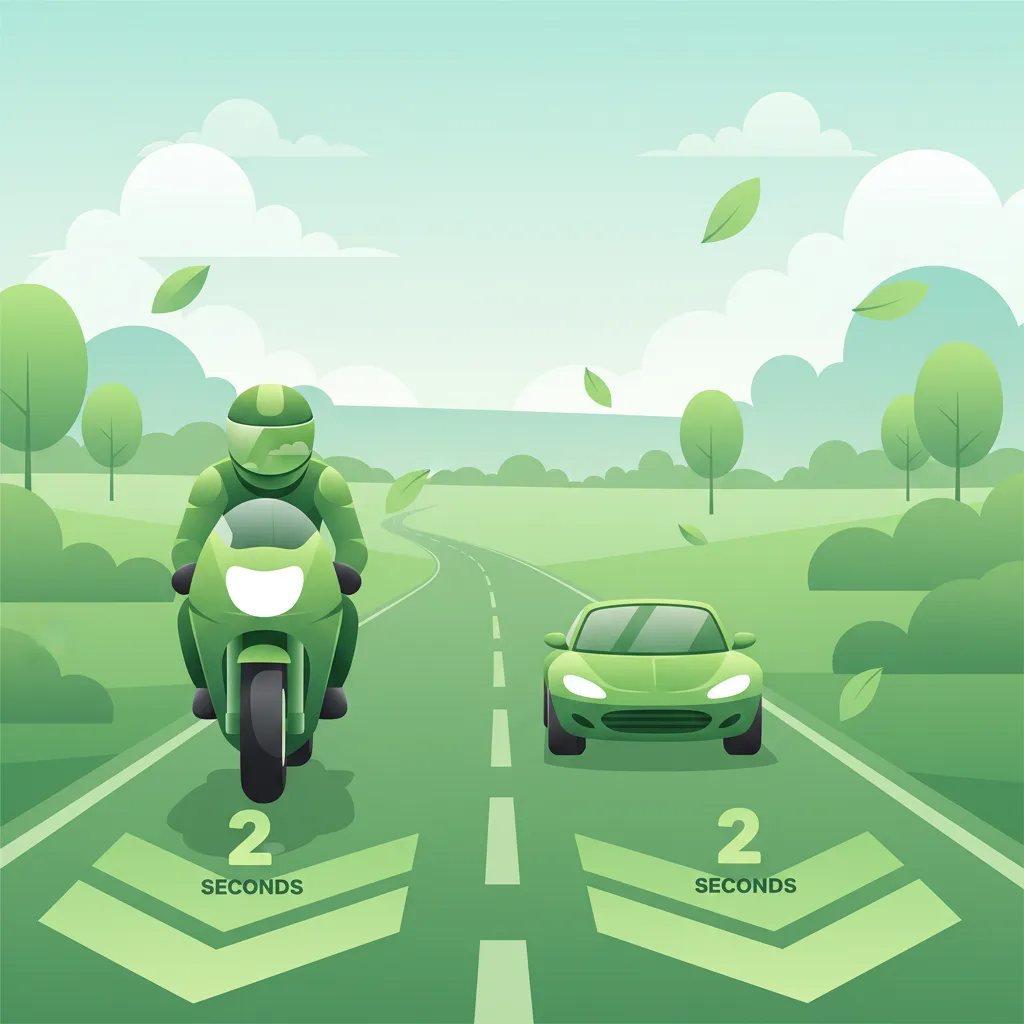
Maintaining a safe following distance is one of the most fundamental aspects of defensive riding for motorcyclists. It provides the crucial time and space needed to react to unexpected events, brake safely, and avoid collisions. This lesson delves into the Two-Second Rule, a simple yet highly effective technique used worldwide, and explains its specific application and necessary adjustments for riders seeking their Dutch Motorcycle License (Category A2). Understanding and consistently applying this rule is essential for your safety and for passing your CBR theory examination.
A safe following distance is not a fixed measurement in metres, but rather a dynamic gap that changes with your speed and prevailing conditions. For motorcyclists, this concept is particularly vital. Motorcycles, while often having superior braking capabilities compared to cars under ideal conditions, are also more vulnerable to road hazards and adverse weather. They require precision and foresight, which a proper following distance provides. This space allows you to perceive potential dangers, process them, make a decision, and then execute a safe manoeuvre, whether it's braking or steering, without endangering yourself or others.
The two-second rule translates the concept of "safe distance" into a practical, time-based metric. This temporal approach inherently accounts for changes in speed, as a two-second gap at 50 km/h will naturally be a shorter physical distance than a two-second gap at 100 km/h. This adaptability makes it a universal and indispensable tool for riders.
The Two-Second Rule is a safety guideline that instructs riders to maintain a minimum temporal distance of two seconds between their motorcycle and the vehicle directly ahead. This minimum temporal gap ensures that you have enough time to react and bring your motorcycle to a safe stop if the vehicle in front suddenly slows down or stops.
The rule operates on a simple principle:
The two-second rule isn't arbitrary; it's rooted in fundamental physics and human physiology:
Remember that "one-thousand-one, one-thousand-two" is an approximation. Practise counting these intervals in a calm setting to get a feel for a true two-second duration.
The Fixed-Object Method is the most reliable and recommended way to consistently measure your following distance using the two-second rule. It offers an objective, reproducible measurement that isn't dependent on your speedometer reading, which might be difficult to constantly monitor while riding.
Select a Reference Point: Scan the road ahead and identify a stationary object on the roadside that the vehicle in front of you is about to pass. Good choices include:
Observe the Lead Vehicle: Watch the rear of the vehicle ahead as it aligns with and passes your chosen fixed object.
Start Your Count: The precise moment the lead vehicle's rear bumper passes the fixed object, begin counting aloud or mentally: "one-thousand-one, one-thousand-two."
Reach the Reference Point: Note where your motorcycle's front wheel is when you complete your count.
Identify a stationary object on the side of the road or a distinctive road marking.
As the vehicle ahead of you passes that object, begin counting "one-thousand-one, one-thousand-two."
Your motorcycle's front wheel should not reach that same object until you have completed your count.
The two-second rule isn't just a number; it's a carefully considered duration that accounts for critical human and vehicle dynamics, especially for motorcycles.
As discussed, PRT is the time it takes for a rider to:
For an alert rider under optimal conditions, this can be around 1.0 to 1.5 seconds. However, factors like fatigue, distraction, alcohol, or even strong emotions can significantly increase PRT. The two-second rule provides a safety buffer, giving you precious fractions of a second more than your average PRT, which can be the difference between a near-miss and a collision.
Braking Distance is the distance your motorcycle travels from the moment you apply the brakes until it comes to a complete stop. This distance is heavily influenced by:
Total Stopping Distance (TSD) is the sum of:
The two-second gap is fundamentally designed to be greater than your typical TSD at a given speed under normal, dry conditions. This provides a safety margin allowing for varying road conditions and rider reaction times.
Motorcycles have unique dynamics that affect safe following distances:
While the two-second rule is the standard for ideal conditions, responsible motorcyclists know that conditions are rarely ideal. It is crucial to dynamically extend your following distance to three seconds, four seconds, or even more, whenever factors reduce traction, visibility, or increase stopping distance. This is often referred to as the Extended Gap principle.
The Three-Second Rule is the most common extension, serving as a minimum in moderately adverse conditions. More severe conditions may warrant even longer gaps.
Factors necessitating an extended gap include:
Wet or Slippery Roads: Rain, drizzle, melting snow, gravel, or oil spills significantly reduce the road's friction coefficient.
Snow or Ice: These conditions drastically reduce traction. Braking distances can increase by five to ten times.
Poor Visibility: Nighttime, fog, heavy rain, or glare from the sun all reduce your ability to see hazards and react promptly.
High Speed: Although the two-second rule accounts for speed proportionally, higher speeds increase the kinetic energy of the motorcycle exponentially, making reaction and braking errors more critical.
Heavy Traffic / Stop-and-Go Conditions: Frequent braking and acceleration increase the cognitive load on riders and reduce reaction time buffers.
Riding with a Passenger or Heavy Load: Added weight increases momentum and alters the motorcycle's weight distribution, increasing braking distance.
Curved Road Segments: As noted, cornering reduces available traction for braking.
Strong Winds: Headwinds can affect deceleration and stability, while crosswinds can push you off course.
An increased temporal following distance (typically three seconds or more) required when adverse conditions such as poor weather, low visibility, high speeds, or a heavy load compromise safe stopping capabilities.
In the Netherlands, specific legislation mandates maintaining a safe following distance, although it doesn't always specify a numerical temporal gap.
The core legal basis for following distance in the Netherlands is found in the Reglement verkeersregels en verkeerstekens 1990 (RVV 1990), specifically Article 5.2.
"A driver shall keep a safe distance to the vehicle ahead, taking into account speed, road, weather, and traffic conditions."
This article applies to all road users and all vehicle types, including motorcyclists. While it doesn't explicitly mention "two seconds," the two-second rule is universally accepted and taught as the practical method to operationalise this legal requirement. Failure to maintain a safe distance can result in fines and, in the event of a rear-end collision, legal liability.
For candidates undertaking the Complete CBR Theory Course for the Dutch Motorcycle License (Category A2), demonstrating a thorough understanding of safe following distances, including the two-second rule and its necessary adjustments, is mandatory. The CBR (Centraal Bureau Rijvaardigheidsbewijzen – Central Driving Skill Bureau) expects future riders to understand:
While the two-second rule is a widely recommended guideline, it's crucial to understand that it is an advisory measure for minimum safety. The legal requirement is always to maintain a "safe distance" suitable for the prevailing conditions.
Ignoring or misapplying the two-second rule can lead to dangerous situations and legal repercussions. Here are some common violations and their associated hazards:
Tailgating in Dry Traffic: Following the vehicle ahead with less than a two-second gap, even in seemingly ideal conditions.
Using a Moving Object as Reference: Attempting to use a bicycle, another motorcycle in an adjacent lane, or a vehicle travelling in the opposite direction as a fixed reference point.
Neglecting Weather Adjustments: Maintaining only a two-second gap in heavy rain, on a wet road, or when the road surface is visibly slippery.
Applying the Rule on Curves Without Correction: Using a straight-road two-second gap while navigating a sharp bend.
Failing to Account for Passenger or Load: Maintaining a standard two-second gap when carrying a passenger or heavy luggage.
Counting Errors at Night or in Low Visibility: Miscounting seconds due to difficulty seeing clear reference objects, or simply estimating distance visually.
Relying on Speedometer Only: Attempting to calculate or estimate distance solely based on speed readings without using the time-based counting method.
Effective motorcyclists continuously evaluate their riding environment and dynamically adjust their following distance. This requires a keen awareness of various factors and applying conditional logic.
Rain / Wet Roads: As friction drastically drops, the braking distance increases significantly.
Snow / Ice: Extremely low traction.
Nighttime / Low Visibility (Fog, Glare): Reduced ability to perceive hazards and read road signs.
Strong Headwinds / Crosswinds: Can affect motorcycle stability and perceived speed, impacting braking.
High Speed (>80 km/h on Motorways): Even in dry conditions, the sheer kinetic energy makes reactions more critical.
Urban Congestion (Stop-and-Go): Frequent, abrupt changes in speed by surrounding traffic.
Curved Road Segments: Tyre grip is divided between cornering and braking forces.
Heavy Load / Passenger: Extra mass and altered weight distribution lengthen braking distance.
Motorcycle with ABS vs. Non-ABS: While ABS prevents wheel lock-up, it does not significantly reduce the time required to react and begin braking.
Interaction with Vulnerable Road Users (Cyclists, Pedestrians): Their movements can be unpredictable.
The two-second rule and its extensions are not merely arbitrary guidelines but are grounded in extensive research and real-world accident data.
Understanding these underlying principles reinforces why the two-second rule is not just a tip, but a critical skill for safe motorcycle riding and a cornerstone of the Dutch Category A2 theory course.
Mastering the two-second rule and its necessary extensions is a fundamental skill for any motorcyclist, especially for those preparing for their Dutch Motorcycle License. It’s more than just a guideline; it's a dynamic safety system that adapts to your speed and the prevailing conditions. By consistently using the fixed-object method, understanding your perception-reaction time, and knowing when to extend your gap, you significantly enhance your ability to anticipate hazards, react safely, and prevent collisions.
For your Category A2 theory exam, remember that the "safe distance" requirement (RVV 1990 Article 5.2) is not just about avoiding a fine; it's about internalising a principle that will keep you safe on the road. Practise adjusting your following distance in various scenarios, and make it a subconscious habit. This proactive approach to safety will serve you well, making you a more confident, responsible, and skilled rider on Dutch roads.
Lesson content overview
Explore all units and lessons included in this driving theory course.
Explore search topics learners often look for when studying The Two-Second Rule and Its Application for Motorcycles. These topics reflect common questions about road rules, driving situations, safety guidance, and lesson level theory preparation for learners in the Netherlands.
Browse additional driving theory lessons that cover connected traffic rules, road signs, and common driving situations related to this topic. Improve your understanding of how different rules interact across everyday traffic scenarios.
Learn when and why to extend your motorcycle's following distance beyond two seconds. Covers adjustments for rain, fog, high speeds, and heavy loads, essential for Dutch driving theory.
This lesson focuses on the crucial safety strategy of adjusting your riding for adverse conditions. You will learn that on wet roads, your braking distance can double, necessitating a much larger following distance (e.g., a four-second gap or more). The content covers the risks of reduced visibility in fog and at night, and the destabilizing effects of strong crosswinds, explaining how a greater space cushion provides the time and space needed to react safely.

This lesson explains why the standard two-second rule is insufficient in adverse conditions and requires extension. It details how factors like rain, fog, and darkness reduce both visibility and tire grip, thereby significantly increasing total stopping distance. The content provides practical guidelines, such as extending the following gap to four seconds or more in the wet, to ensure the rider always has enough time and space to stop safely, regardless of the conditions.

This lesson focuses on the crucial safety practice of maintaining an adequate following distance to the vehicle ahead. It explains the 'two-second rule' as a minimum baseline and emphasizes the need to increase this gap to three or four seconds in adverse conditions like rain or poor visibility. For a motorcyclist, this 'space cushion' is a critical buffer that provides the necessary time and space to react to sudden hazards or stop safely.

This lesson reinforces the critical relationship between adverse conditions, reduced traction, and massively increased stopping distances. It provides a clear framework for how much riders need to increase their following distance and reduce their overall speed to maintain a safe margin for error. The curriculum teaches riders to constantly reassess their speed based on visual feedback from the road surface and the level of visibility, ensuring they can always stop within the distance they can clearly see.

This lesson revisits the concept of following distance, emphasizing its heightened importance in the high-speed motorway environment. It explains how increased speeds dramatically lengthen both reaction and braking distances, making a minimum two-to-three-second gap absolutely critical for safety. The content also stresses the importance of maintaining a space cushion to the sides, creating potential escape routes in case of sudden incidents in adjacent lanes.

This lesson provides a detailed explanation of the two-second rule as a simple yet effective method for maintaining a safe following distance in good conditions. It breaks down the concept of total stopping distance into its two components: reaction distance (the distance traveled before applying the brakes) and braking distance (the distance traveled while braking). Understanding this calculation is fundamental for appreciating the need for a sufficient space cushion to react to sudden events ahead.
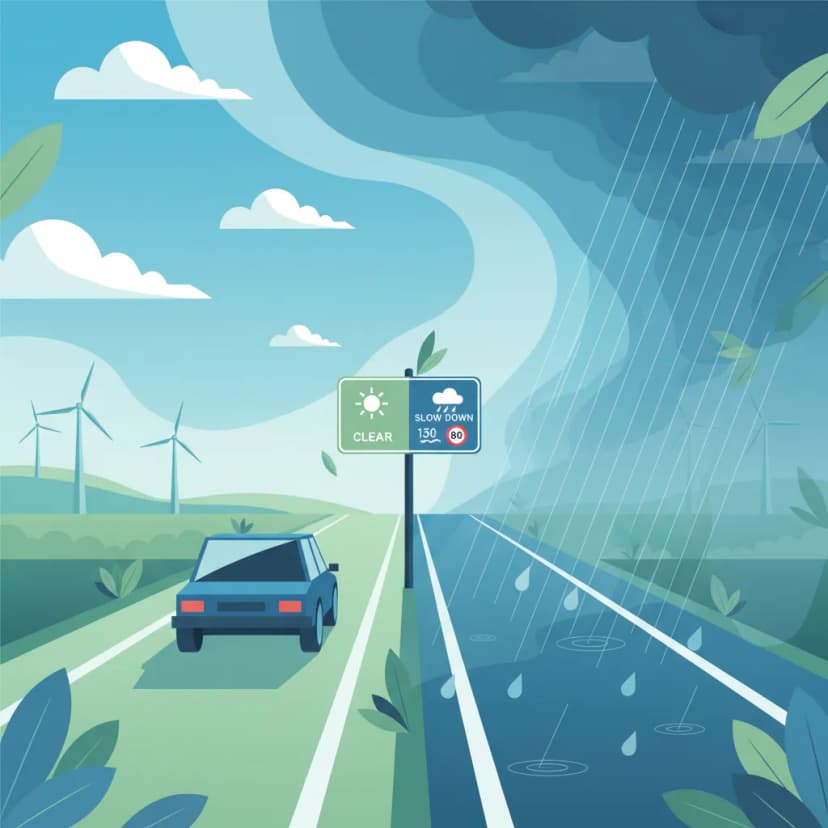
The posted speed limit is a maximum, not a target. This lesson teaches the crucial skill of adapting your speed to prevailing conditions. You will learn how to assess factors like traffic density, poor weather (rain, fog), limited visibility (at night), and slippery road surfaces. Adjusting your speed downwards in these situations provides you with more time to react to hazards and significantly reduces the risk of losing control or being involved in a collision.

This lesson provides a detailed guide to riding in wet and low-visibility conditions. You will learn to make all your control inputs—braking, accelerating, and steering—exceptionally smooth to avoid breaking traction on slippery surfaces. The content covers the dangers of painted lines and manhole covers when wet, and the importance of increasing your following distance dramatically to account for longer braking distances.

This lesson introduces the Dutch concept of 'voorspellend rijgedrag,' or anticipatory riding, a proactive approach to safety. It teaches motorcyclists how to look beyond the immediate vehicle in front and scan for clues that predict the actions of other road users, such as turn signals, wheel direction, and driver head movement. By anticipating potential conflicts before they happen, riders can position themselves to avoid danger and ensure a smoother, safer journey through complex traffic.

Riding on two wheels requires special care on surfaces with reduced grip. This lesson teaches you how to handle challenging conditions like rain, ice, wet leaves, or tram tracks. Key principles include reducing speed significantly, making all control inputs (braking, accelerating, steering) much more smoothly and gradually, and increasing your following distance to allow for much longer stopping distances. Recognizing potentially slippery areas is a critical part of proactive hazard perception.
Understand the physics behind total stopping distance for motorcycles. Explore how speed, road conditions, and vehicle load impact your ability to stop safely, crucial for Dutch theory knowledge.
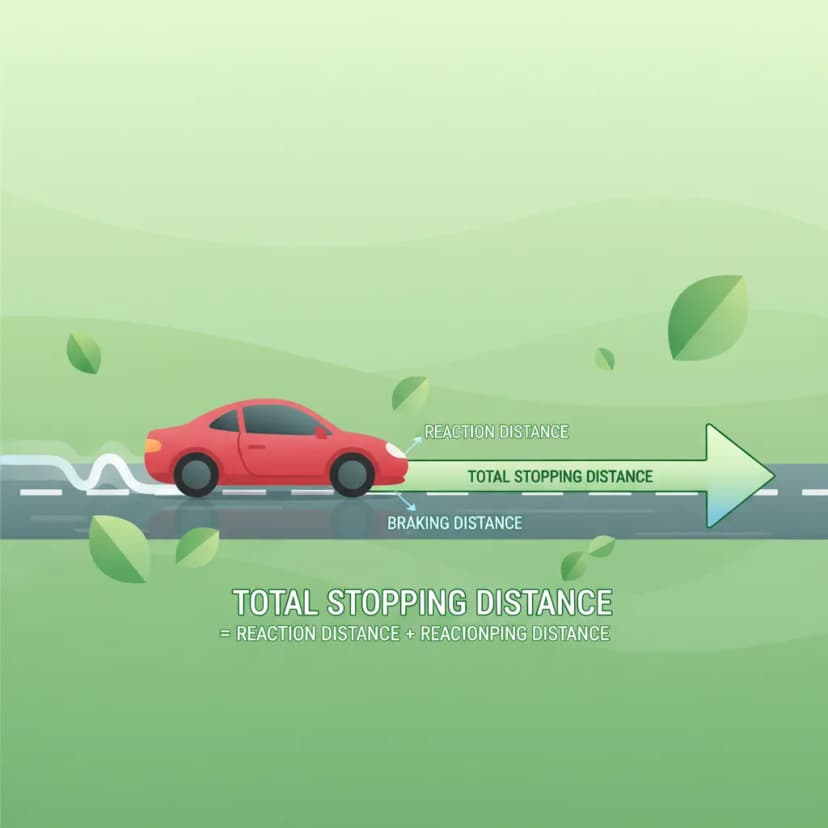
This lesson provides a theoretical understanding of the components that make up the total stopping distance. It explains how to calculate reaction distance (the distance traveled before applying the brakes) and braking distance (the distance traveled while braking). The content highlights how speed exponentially increases stopping distance and how other variables like rider alertness, road grip, and brake condition play a significant role in the final calculation.
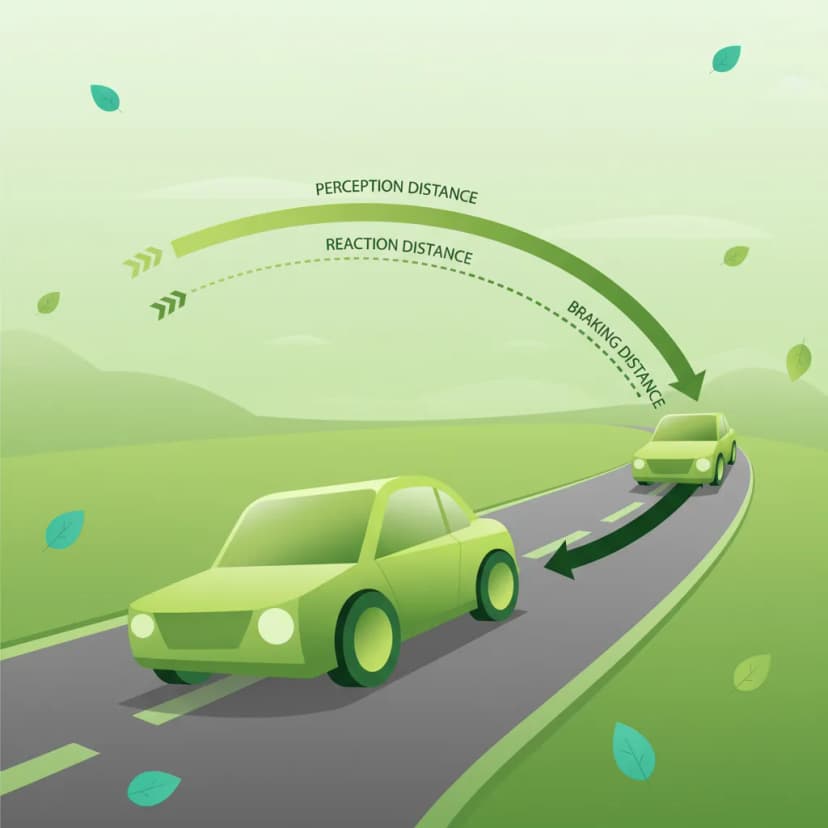
This lesson breaks down the concept of total stopping distance into its two key parts: the distance traveled during your reaction time and the distance the motorcycle travels after the brakes are applied. You will learn the formulas and rules of thumb for estimating these distances at various speeds. The content highlights how factors like rider fatigue, road surface conditions, and tyre quality can significantly increase your overall stopping distance.
This lesson provides a detailed explanation of the two-second rule as a simple yet effective method for maintaining a safe following distance in good conditions. It breaks down the concept of total stopping distance into its two components: reaction distance (the distance traveled before applying the brakes) and braking distance (the distance traveled while braking). Understanding this calculation is fundamental for appreciating the need for a sufficient space cushion to react to sudden events ahead.
This lesson reinforces the critical relationship between adverse conditions, reduced traction, and massively increased stopping distances. It provides a clear framework for how much riders need to increase their following distance and reduce their overall speed to maintain a safe margin for error. The curriculum teaches riders to constantly reassess their speed based on visual feedback from the road surface and the level of visibility, ensuring they can always stop within the distance they can clearly see.
This lesson explains why the standard two-second rule is insufficient in adverse conditions and requires extension. It details how factors like rain, fog, and darkness reduce both visibility and tire grip, thereby significantly increasing total stopping distance. The content provides practical guidelines, such as extending the following gap to four seconds or more in the wet, to ensure the rider always has enough time and space to stop safely, regardless of the conditions.
This lesson focuses on the crucial safety practice of maintaining an adequate following distance to the vehicle ahead. It explains the 'two-second rule' as a minimum baseline and emphasizes the need to increase this gap to three or four seconds in adverse conditions like rain or poor visibility. For a motorcyclist, this 'space cushion' is a critical buffer that provides the necessary time and space to react to sudden hazards or stop safely.
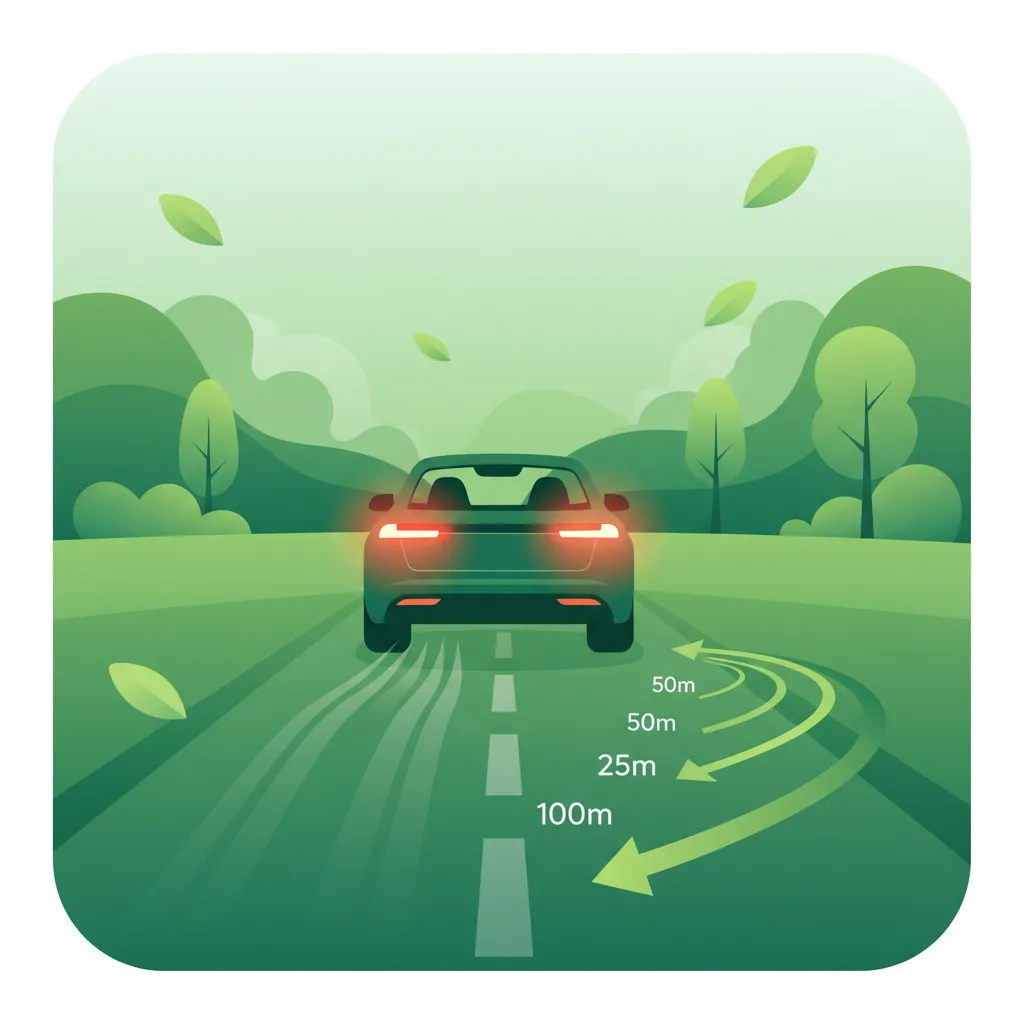
This lesson explains the components of the total stopping distance: the reaction distance (distance traveled before you start braking) and the braking distance (distance traveled while braking). You will learn the general formulas and rules of thumb for estimating these distances at different speeds. Understanding that braking distance increases exponentially with speed is a critical piece of knowledge that reinforces the importance of maintaining safe speeds and following distances.
This lesson revisits the concept of following distance, emphasizing its heightened importance in the high-speed motorway environment. It explains how increased speeds dramatically lengthen both reaction and braking distances, making a minimum two-to-three-second gap absolutely critical for safety. The content also stresses the importance of maintaining a space cushion to the sides, creating potential escape routes in case of sudden incidents in adjacent lanes.

This lesson provides a comprehensive guide to safe and effective deceleration on a motorcycle. You will learn the principles of controlled braking, including the progressive application of both the front and rear brakes to maximize stopping power while maintaining stability. The content also explains the role of engine braking in managing speed and how the Anti-lock Braking System (ABS) helps prevent wheel lock-up during hard braking.

This lesson clarifies the specific Dutch regulations concerning stopping and parking for motorcycles, including designated parking bays and rules for parking on pavements. It also covers the mandatory procedures for safely navigating tunnels, such as required lighting, lane discipline, and actions to take during a breakdown or emergency. By understanding these rules, riders can avoid fines and navigate these specific traffic situations with confidence.
Find clear answers to common questions learners have about The Two-Second Rule and Its Application for Motorcycles. Learn how the lesson is structured, which driving theory objectives it supports, and how it fits into the overall learning path of units and curriculum progression in the Netherlands. These explanations help you understand key concepts, lesson flow, and exam focused study goals.
While the Two-Second Rule is a good baseline, motorcyclists often need more space due to less stability, smaller contact patches, and being less visible. In adverse conditions like rain, fog, or on slippery roads, or when riding at higher speeds, extending this to three or more seconds provides a crucial extra margin for safety and effective braking.
To measure, pick a fixed object on the roadside (like a sign or tree) when the vehicle in front passes it. Then, count 'one-thousand-one, one-thousand-two'. If your motorcycle reaches the object before you finish counting, you are following too closely. Adjust your speed to increase the gap.
Yes, the Two-Second Rule applies, but on the autosnelweg where speeds are much higher, it's generally recommended for A2 motorcyclists to maintain a three-second or even greater following distance. Higher speeds significantly increase stopping distance, making extra space vital for safe reaction.
The Two-Second Rule primarily accounts for your reaction time. It ensures you have enough time to perceive a hazard and initiate braking. However, the total stopping distance also includes the actual distance travelled while braking. A larger following distance, therefore, provides both more reaction time and more braking distance, contributing to overall safety.